Will AI-enabled automation constitute more than half of the Gross World Product by 2100?
Introduction
In this essay, I hope to build a reasonable forecast of the proportion of the world's gross product from AI-enabled automation by 2100. Overall, I think it is highly likely that by this time, AI-enabled automation will constitute more than half of the Gross World Product (GWP). I will present an argument in favour of this hypothesis.
I define product AI-enabled automation as goods that we can produce entirely robotically, or services that an intelligent system can fully give to a human. To structure our thinking, we will first partition the economy into two parts - the part of an economy that is not substantially vulnerable to AI-enabled automation and the part that is. This partition of goods into two types is similar to the 'Corn and Prayers' model [2]. We will find that the ratio of products produced by automated entities to non-automated entities is around 70% in 2100.
We will dedicate the first section to estimating the economy's total output produced by non-automated entities, like humans or humans with tools, in 2100. The method for doing this will be to assume a constant growth rate in the current service economy and then compound this into the future. First, we will estimate the growth rate on historical World Bank data since 1961. Then we will include an adjustment for economic slowdown based on major bio-risk and an adjustment to factor out what proportion of our GWP is already automated. The second section will be dedicated to the output of the entire economy. A part of this prediction of which will rely on Metaculus forecasts.
The last section will discuss some further models of the impact of AGI on GWP, assuming the current Metaculus timeline predictions. Finally, I will construct a straightforward economic growth model using some of the projections on the development of AGI.
Construction of a Base Case
To rigorously answer this question, we will first construct a "base case" where we think the GWP produced by non-automated entities will be by 2100. Another motivation for this section is because I believe it helps get a feel for the magnitudes of sizes we are talking about when it comes to the size of the world economy by 2100.
To construct this base case, I think it is reasonable to assume that economic growth in products and services from non-automated entities will continue to grow similarly to the past. In other words, I expect the 'prayer' type products, as explained in the previous section, to grow without any large shocks or collapse in the future. The rationale for this is that it is unlikely that a large economic explosion would increase the production of non-automated goods. In services that are non-susceptible to AI automation, the main driver of growth is population growth. I do not want to complicate this analysis by including population growth forecasts. Hence, I will defer to a steady-growth assumption.
Therefore, I think the size of non-automated product in 2100 will be equivalent to our current GWP from non-automated entities, growing at the median world growth rate estimated on historical data.
The Growth of Sectors Not Susceptible to Automation
What is the current non-automated fraction of the world's GWP? To do this, we need a reliable measurement of the present fraction of the world's economy that is not susceptible to automation and how we expect this sector to grow in the future. This is tricky to measure, so we can only use the following best proxies. Given that most of the service sector is currently non-automated from AI, we can safely say that the percentage of service-orientated GWP is produced from non-automated entities. The World Bank puts this figure at 65% [3] of the GWP.
This base case will assume a constant growth rate based on historical economic data, namely the average growth rate of the world from 1961 to 2020. This base case is meant to capture what I think the size of the non-automated economy will be by 2100.
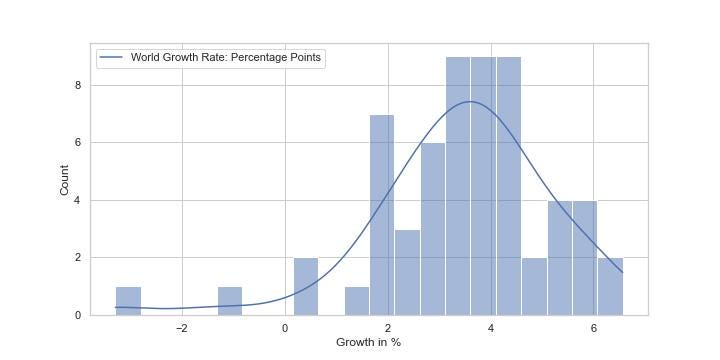
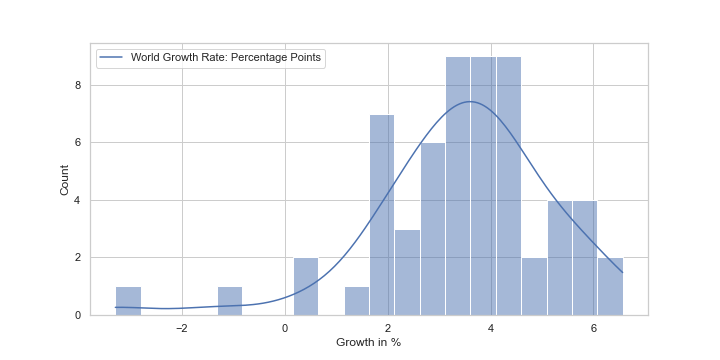
The histogram above shows the distribution of GWP growth rates for the world, sampled annually from the World Bank database from 1961 to 2020. The median rate of growth of world GDP is 3.4% per year, with the 25% and 75% percentiles at 2.7% and 4.5% respectively. The left-most outlier is the GWP change in the year 2020, from COVID. If we were to compound this rate for the remaining 80 years of this century since 2020, what would the entire economy's value be? Our current gross world product as of 2020 currently stands at $85 trillion. Using simple compounding, a very naive estimate of the GWP at time T after 2020 is below.
$$ GWPT=85×(1+r)T $$
Compounding this using the formula, would put us at around $1.2k trillion by 2100. The plot below shows the projection over time for the GWP until 2100. for this base case for the median, 25% and 75% quartiles of growth rates. Even assuming constant growth at the
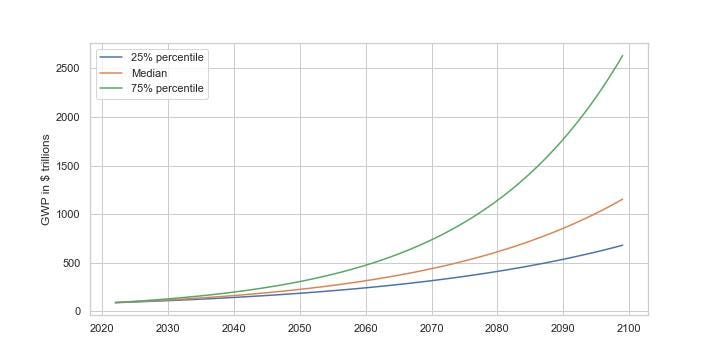
Now, we use the World Bank's service sector estimate of 65% to get a proper value of the GWP produced by non-automated entities. This service sector estimate means that $780 trillion of the $1.2k trillion will come from non-AI enabled sources. We will use this estimate for the next section.
An adjustment for BioRisks and small Sample Bias
There are two major mitigating factors to this estimate above. The first is biorisk, and the second is sample bias. Because of these reasons, I would put down a base-case growth rate of 2.5% as an adjusted value over the next 10 years.
In reality, increased risk from another pandemic is likely to cause the same economic slowdown that we've experienced in the past two years. Within the past 300 years, we've had 20 of pandemics that had effects worldwide. However, not all of these have had casualties of over 1 million, nor had the same economic effects at Covid-19. Nevertheless, two significant events stand out - the Spanish flu and Covid-19. Although its full economic impacts are still blurry, the Spanish flu killed more than 30 million people between 1918 and 1920.
There is also other flaws with this steady-growth assumption. First, it is unlikely that we remain in a regime of linear growth, considering the small sample size of growth rates that I have used. This approach is fairly similar to an excellent blog post in This Can't Go On by Holden Karnofsky [5]. His Business As Usual projection puts GWP at ~$1,000 trillion (1990 $) in 2100. However, the main point in this blog post is that it is very unlikely that we will be in a period of steady, small variable growth in the long run. Rather, we might re-enter another explosive period of economic growth, or enter a period of economic collapse.
Because of these two reasons, I think it is more conservative to put the forecasted economic growth rate to 2.5% for our base case because of these two reasons.
What is the Implied Value coming from AI-enabled Automation by the end of 2100?
Now that we have our base case scenario, what is the added portion we expect from AI-enabled automation? In this section, we'll build a rough estimate with Metaculus community predictions. One of the ways we might be able to get a good estimate is by looking at the current Metaculus estimates for the gross world product in 2100. The forecasts for this question are shown below.
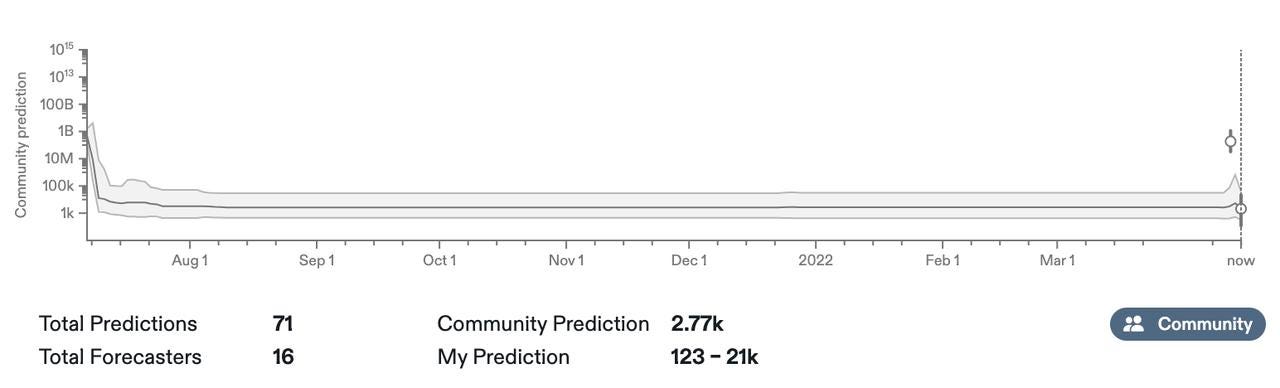
I expect these community estimates already price due to increased GWP from AI-enabled automation, so we can develop an implied value of the marginal product contribution. The current Metaculus median estimate for GWP in 2100 is $2.7k trillion, with the 25th percentile being $325 trillion, and the 75th percentile being $38k trillion. These bounds are quite wide, so we should definitely treat these estimates with caution.
$$ GWP_{\text{AI-enabled}}=GWP_{\text{total}}−GWP_{\text{base case}}$$
The total GWP is just the sum of non-AI enabled products and services, and AI-enabled products and services. As shown in the expression above, we can back out the community's implied forecast of the Gross World Produced attributed to just AI-enabled automation. Our current median estimate for GWP by 2100 in total is $2.7k trillion. For the base case scenario from the last section, it's $780 trillion. Subtracting the two values, it seems we've priced in a value of $2k trillion for future AI-enabled automation in the world economy in 2100.
This ratio of $2k trillion of AI-enabled automated production, over a total GWP of $2.7k trillion puts us at a ratio of 74% of product created from AI-enabled automation. This estimate is significantly higher than the 50% benchmark in the question. This is one of the reasons I believe that AI-enabled automation will constitute more than half of the GWP by the end of the century.
The Effect of Artificial General Intelligence on Economic Growth
In this section, we'll try to bootstrap a reasonable value for GWP in 2100 due to AI-enabled automation. We will Metaculus forecasts that relate to the introduction of artificial general intelligence (AGI). We will also assume that AGI will constitute the main catalyst of AI-enabled automation once it's devised.
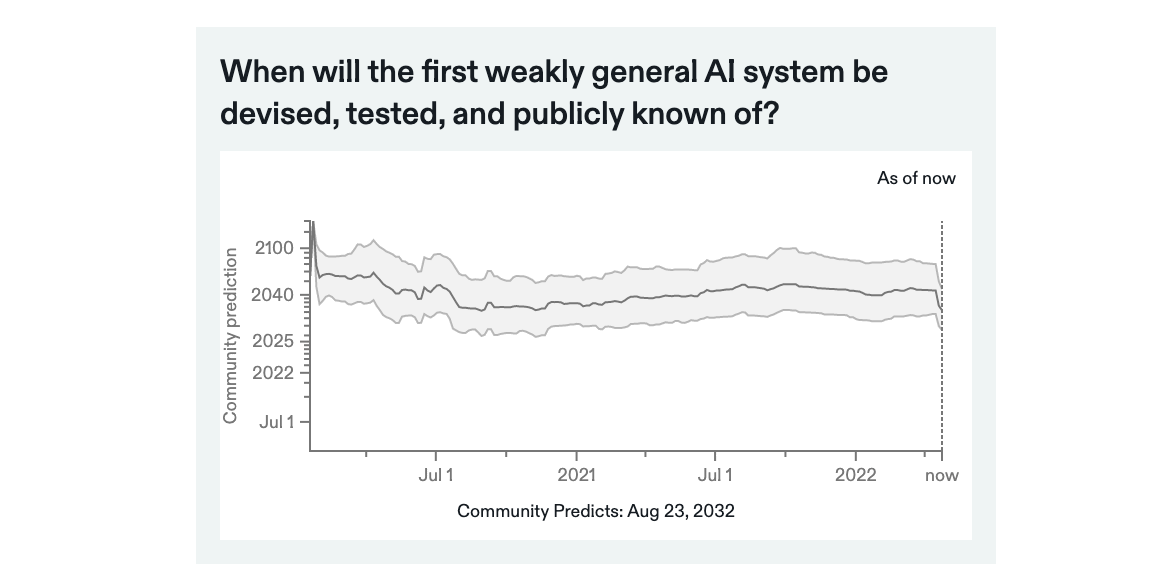
The Metaculus community currently predicts that the first AGI system could be devised, tested, and publicly known in 2037. AGI is defined as the ability of a programmed entity to understand or learn any intellectual task that a human being can. For the purposes of this section, let's assume that this means that the world economy is fully ready to deploy AGI for AI-enabled automation in 2037 and assume that all future automation stems from AGI.
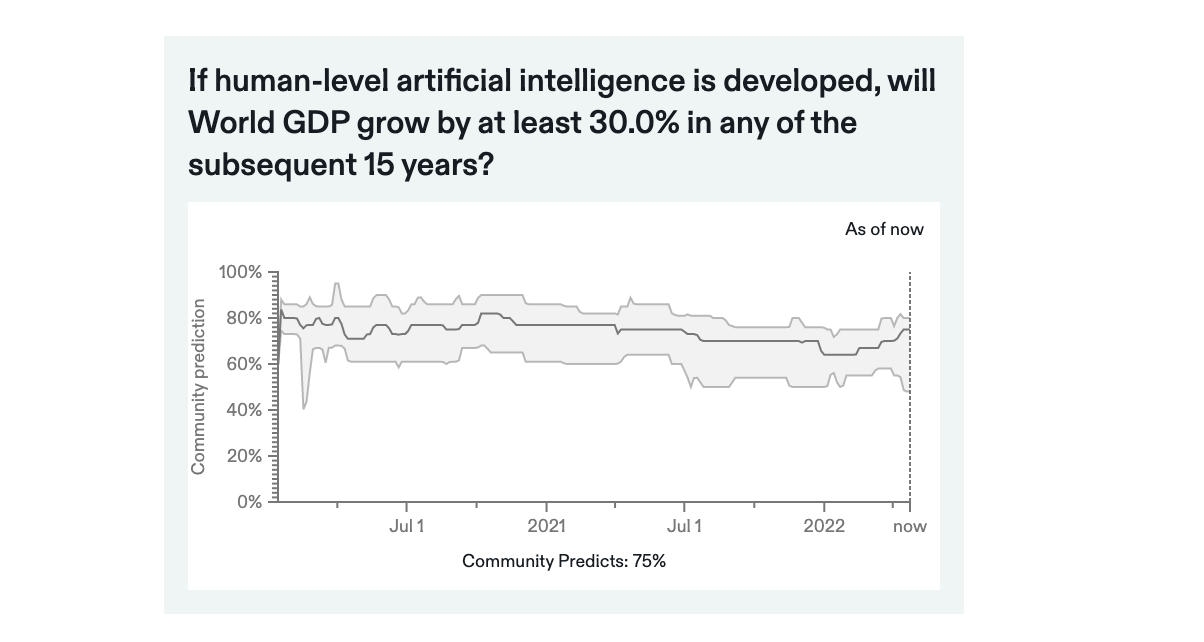
In the plot below, we have Metaculus estimate for the GWP's probability of growing by at least 30% after human-level artificial intelligence is developed. Once AGI is developed, the community expects to have a 75% chance of the world's GDP growing by 30% in the next 15 years. In other words, after the first AGI systems are developed, we have an expected value of 23% in the next 15 years, which is the growth rate of 30% multiplied by the probability of this event occurring. I think this is a reasonable prediction - it is not too high because we generally expect population growth to decline, and so we also expect the majority of GDP growth to stem from artificial intelligence. However, note that this is around a 2% rate of growth in GDP annualised, so it's slightly less than what we get from our estimates from the previous section for total growth.
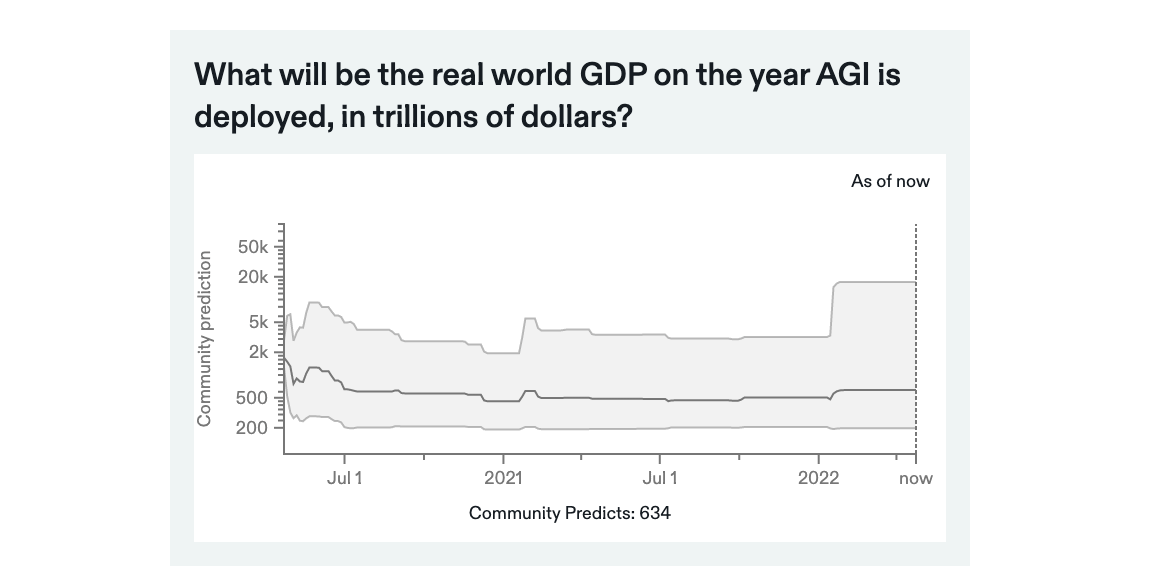
Using community Metaculus forecasts, we see that the real world GDP on the year that AGI is deployed has a median estimate of 630 trillion dollars. This puts a bound on ratio of what we can expect from AI-enabled automation by the end of the century. More precisely, since the community expects a growth rate of 2% each year for the 15 years after AGI is deployed, we can come up with a rough lower bound for what growth might be attributable to just AGI in 2100.
Assuming these starting values in 2037, the graphs below map out what growth could be like until 2100. The lines below all represent different initial values for the the strictest model, where we have a rate of 2% growth of 15 years after 2037, but completely stagnant growth after that. GWP_1 represents the median estimate of GWP in 2037 of $650 trillion, and GWP_2 and GWP_3 represent the 25% and 75% percentiles of GWP in 2037. Even the most conservative estimates place that the GWP that would come from AGI from this median value is $850 trillion by 2100. Compared to the base case value of $780k trillion, this already puts the estimate of the contribution of AI-enabled automation to exceed non-AI enabled automation by 2100, in a conservative scenario.
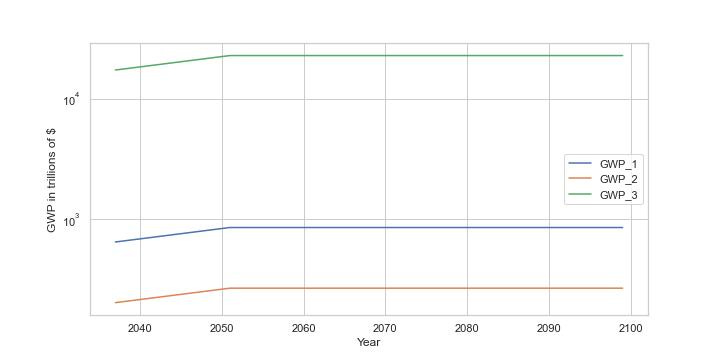
Hence, the community is pricing in another reason for AI-enabled automation to exceed 50% of total GWP by the end of the century.
Conclusion
In this essay, I've argued that AI-enabled automation could constitute more than half of the world's GWP by the end of the century. To do this, I've partitioned the economy into the sectors that are susceptible to future AI-enabled automation, and the sectors that aren't. Using Metaculus forecasts, World Bank data and simple heuristics, I model that the proportion of GWP that will come from AI-enabled automation is around 70%. In addition, using community forecasts that pertain to the development of AGI, I see a consistent result of AI-enabled automation value exceeding that of non-AI enabled value even in conservative scenarios.
References
[1] https://www.openphilanthropy.org/sites/default/files/Modelin
[2] https://www.nber.org/system/files/working_papers/w20941/w20941.pdf
[3] https://data.worldbank.org/indicator/NV.SRV.TOTL.ZS
[4] https://data.worldbank.org/
[5] https://www.cold-takes.com/author/holden/