The Man I Want To Meet The Most
Thank you to Eric Gilliam, who told me about Mr. Loomis. All mistakes are mine.
Can great science still be done at home?
Before the 1900s, most of science was done informally by curious amateurs, like Edison, Faraday and Franklin. Even with the coming of institutions, major discoveries from amateurs continued into the 1900s, as explained in the Genius of The Amateur by Lungu and Djajadikerta.
But on this blog, I haven’t written any historical biographies. Whilst now is a great time to be an independent scientist, I had yet to feel emphatic to a story that I found worth sharing. After all, the 1800s were a different time, and I had trouble building a parallels.
But at last, I’ve found someone that flipped this switch. This person existed recently enough to feel like I could speak to them. He had a similar career to my own, despite me being much less successful. And I think studying him can help my own strategy for science.
The independent scientist that I want to meet the most is Alfred Lee Loomis.
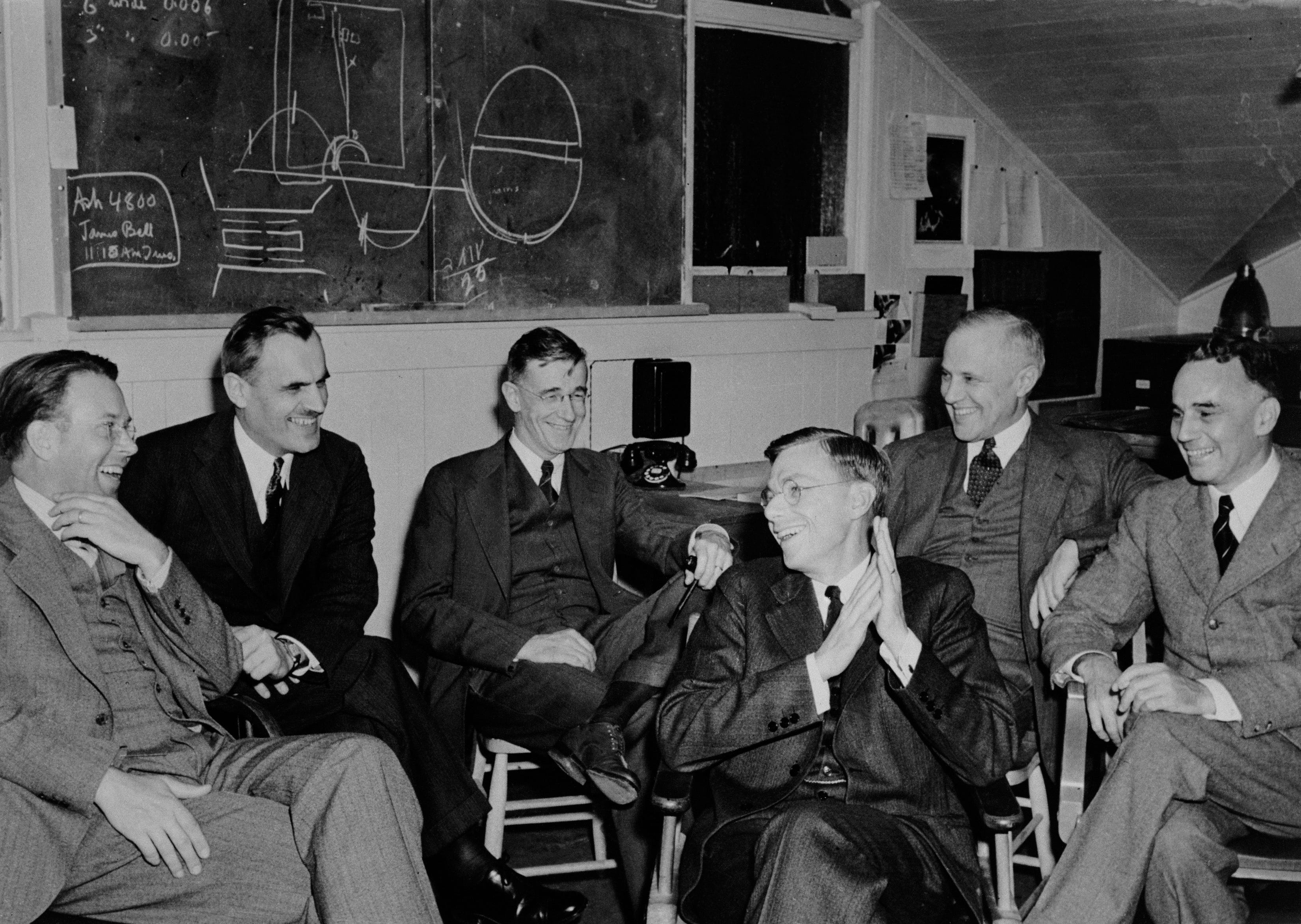
Known as the last great amateur physicist, Alfred Lee Loomis was a successful bond broker during the day. But in his evenings and weekends, he used his wealth to build a private lab - the Loomis Lab in Tuxedo Park, New York. Here worked with some of the leading physicists of all time - Ernest Lawrence, Arthur Compton, and Enrico Fermi.
But Loomis didn’t just provide the money. He did the work. He invented long range radar, developed ultrasonic chemistry, made more accurate clocks, contributed to brain research, and sponsored countless other projects.
From studying his life, I’m more confident that doing science means getting resources, doing experiments, making models, and then sharing results. It doesn’t matter if you’re part time, like Loomis was. If you’re doing science, you’re in the game.
This rest of this post will be my commentary on moments from Jennet Conant’s spectacular biography on Loomis, ‘Tuxedo Park’. Please buy and read it.
Alfred Lee Loomis was born in 1887 to a family of physicians. After a stately upbringing, he excelled in mathematics undergraduate at Yale. But outside of classes, Conant writes that he modelled boomerang trajectories by playing with them with his professors outside. He also studied the aerodynamics of kites, inspired by the Wright brothers.
It seems that the curiosity to model anything, from boomerangs to marbles in a bowl (Mr Feynman), is a trait that binds great physicists. It doesn’t take a lab at the start - that can come later.
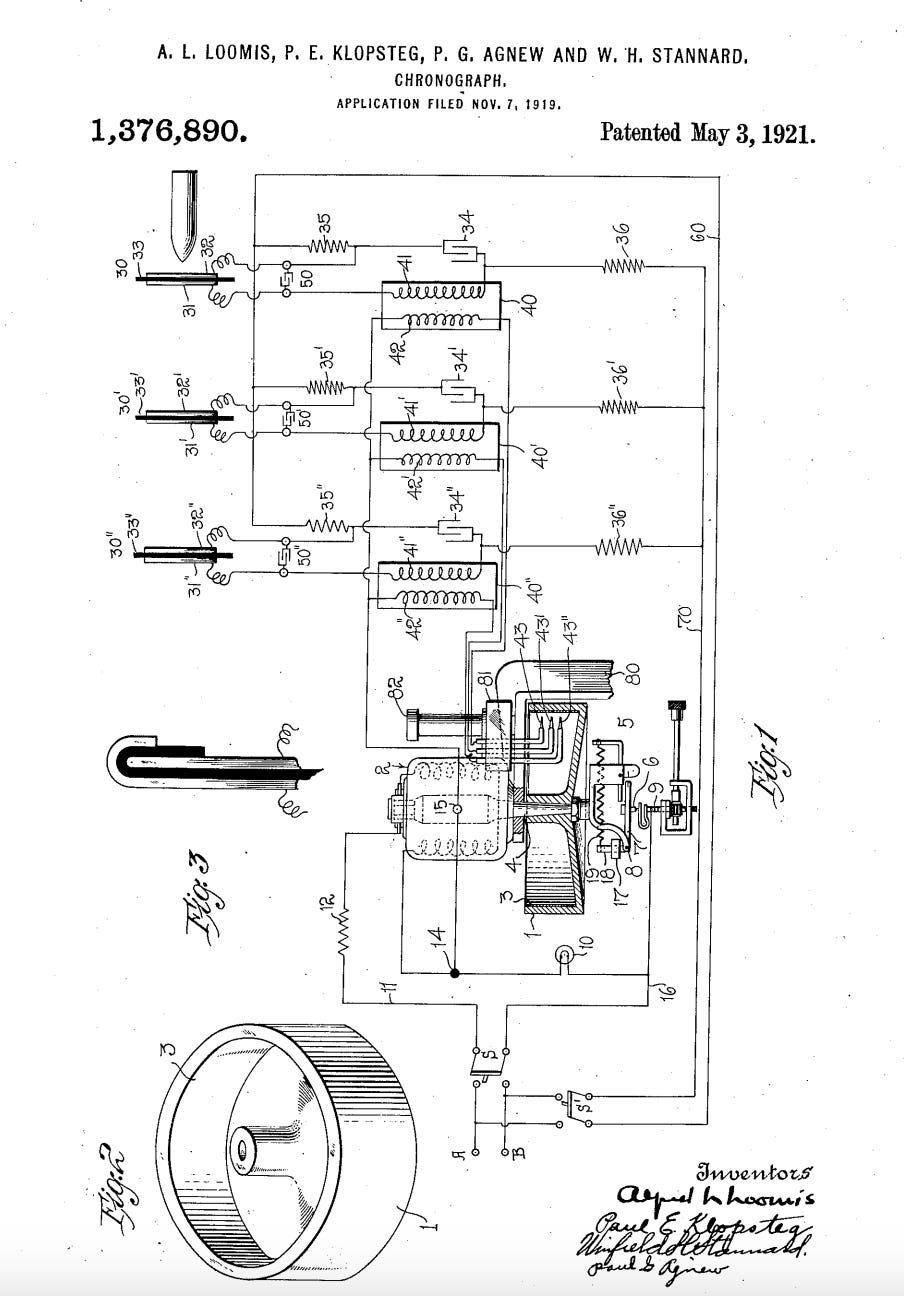
After graduating from Harvard law, he served in the military during the First World War. Obsessed with the physics of artillery and tanks, he convinced the army to deploy him to the engineering division. There, he completed his first major work. It was a novel way to measure the speed of artillery shells, which culminated in a tool known as the Loomis Chronograph.
After the war, Loomis made a fortune in financing rural utility companies between 1924 and 1929, underwriting up to 15 percent of all the securities in the United States. He dealt with towers of industry like the American Superpower Corp, and Consildated Gas of New York in brokering deals with electricity providers across America.
I felt an affection to reading about his bond business, since I am a bond trader myself. It gives me courage that someone can do two things well, both finance and science.
Loomis ended up living a luxurious life in the Tuxedo Park, New York, but was not yet satisfied. He was unable to recreate the feeling of accomplishment from making his chronograph during the War. But by chance, he met the physics professor R.W Wood who was working out of his barn near his aunt’s. Wood at the time was working on a garage experiment in optics. Always looking for opportunities and friends, Wood laid out a research program for Loomis on high energy waves in liquids and other biological media, based on Langevin’s work in supersonics.
Loomis pounced on this opportunity. In 1926, he then went on a grand tour to visit labs in England and France. Clearly inspired, he made plans to set up his own laboratory at his Tudor styled mansion in Tuxedo park. After installing top notch equipment, he scaled his research with Wood and created apparatus to generate supersonic waves at high voltage.
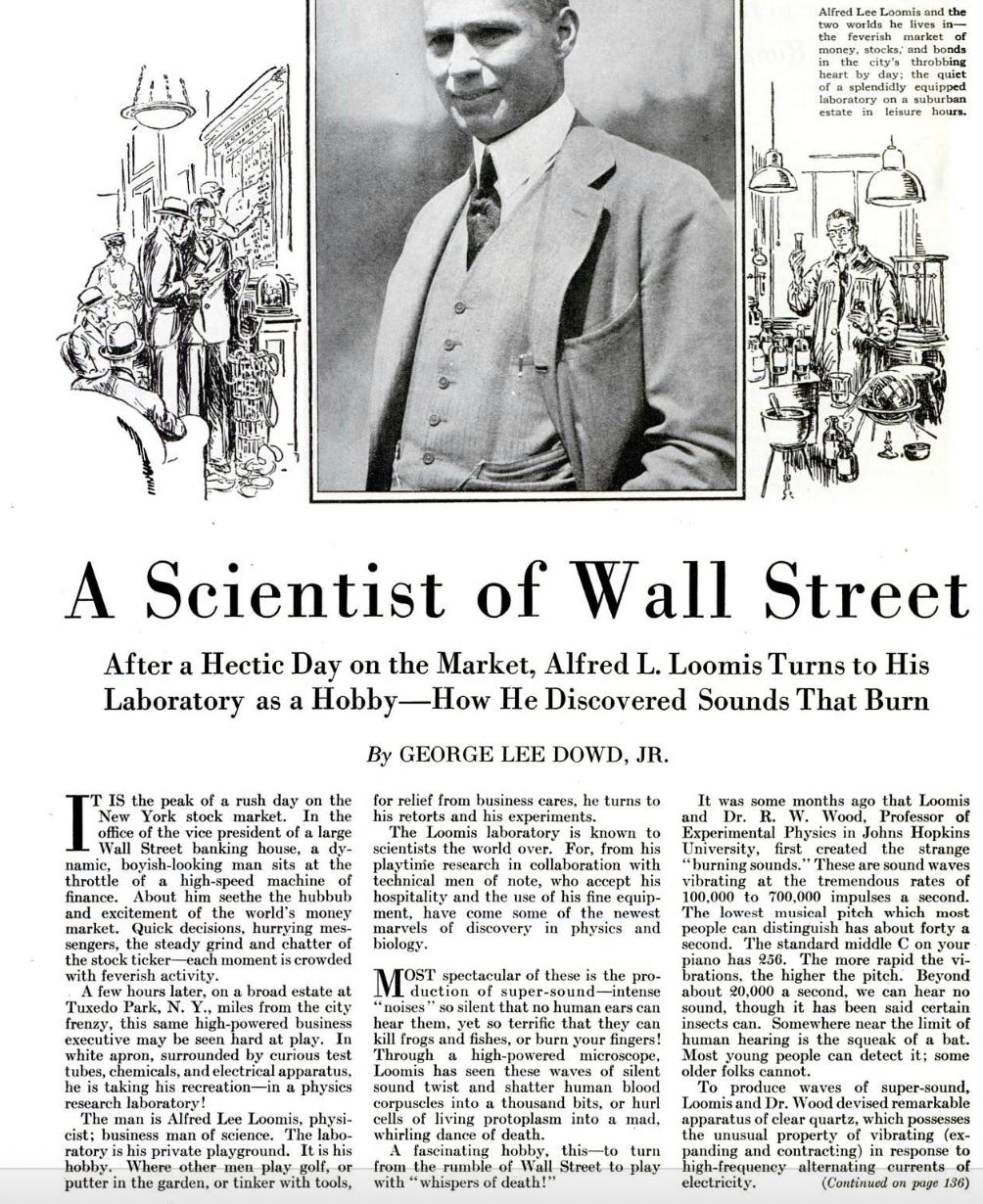
There is a famous article on him published in Popular Science Monthly, August 1928, on this the results of this garage experiment:
From Conant’s account, he spent the day time working in bond broking at his firm, but the evenings and the weekends in the Loomis Laboratory. It appears that he was able to manage such a big business without working into the evenings. That being said, he was a hard working person with relentless energy, and had a tendency to ignore his family. He sent all of his kids to boarding school as soon as he could.
This was a lesson in being optimistic about my own efficiency. I want to do more with my time, and Loomis’ biography suggests this is possible. Loomis was incredibly strategic about his business matters, and was able to solve problems quickly. It also suggests that the work by day, science by night model can work if I structure my time correctly.
Loomis as wide-ranging in interests, often bouncing between different projects. In a report by Caryl Haskins, it Conant quotes that ‘He never had one idea. He always had dozens of ideas. There were a lot of people working on things Alfred was directing and suggesting’. His working style was more like a ‘seeder’, putting forward the foundational work early on and then letting others run with it. This should read as encouraging for people with wide ranging interests.
Like many independent scientists today, it appears that Loomis struggled to get legitimacy amongst the scientific community, despite his accolades. By the mid 1900s there was already quite a bit of prejudice towards ‘gentlemen scientists’ not working in full time academia. To remedy this, he tried to sponsoring conferences, inviting scientists to the Loomis lab, and hosting. He just kept working, and tried to let the work speak for itself. It appears that the best thing we can do as independent scientists is to just work, gather feedback, and keep speaking to academics.
It’s clear that Loomis was a once in a century character. But what I’ve found most inspiring about the book was Loomis had the ‘Baconian’ ideal that science could be done by anyone.
Of course, Loomis was both a genius and well resourced. But he started doing things with boomerangs and kites - something we can all do.
Conant, J. (2002). Tuxedo Park: A Wall Street tycoon and the secret palace of science that changed the course of World War II. Simon & Schuster.