Sneeze for the Camera Baby!
We have strong evidence that particles emitted by sick humans, like mucus and saliva, contains stuff that can infect other humans. These particles travel in the air. And we know that air purifiers filter out particles. So, we expect that air purifiers should reduce infection rates.
But how does this actually work at a mechanistic level, and how good are our existing models on the physics of airborne transmission? If we understood these things a little better, we might have more leads in figuring out how to improve the DIY air purifier ideas. But digging into the literature made me realise that there were lots questions I didn’t have the answer to. In this post I wanted to go through some of the big questions that I’ve learnt about.
In this essay I hope to communicate some real uncertainties out there. Because of this, I’m starting to think that we need to do much more experiments on aerosols in a wider range of environments. Owing to the somewhat distributed nature of this task, I think this is one that might be good for independents if there was some standard experimental format / procedure in imaging them from many people. I am also optimistic that there might be experiments that I can do at home for cheap on the electrostatics of aerosols, high speed cameras, and more. But I need to think about this more, so stay tuned!
For a great history of this type of thing, I recommend Zimmer, C. (2025). Air-Borne: The Hidden History of the Life We Breathe.
Droplet Size Variability
We should care about the particle sizes that pathogens reside in. Right now, fully rated HEPA / Furnace filters are quite expensive, something I learned first hand trying to make my Corsi-Rosenthal box. But what could be big if true is if we could say something like ‘humans mostly emit particles at X, Y, Z sizes, and of those, only the Y sizes are able to carry pathogens, and are airborne, and are amenable to filtration’. If that was the case, and Y was larger than we thought (such we didn’t need to use HEPA filters for it), then it could open up a bunch of possibilities for different materials.
Sure, HEPA filters are guaranteed to filter out most things, and we should use them. But in an emergency scenario, supply chains lock up, people are afraid to go outside, and things just generally get harder to get (remember the toilet paper fiasco in the UK?). So what do we do when logistical issues mean that HEPA filters or other filters are in tight supply? Wouldn’t you want to know if you could rework your spare underwear to stop you from dying?! Maybe it wouldn’t stop your pollen allergy, but something is better than nothing!
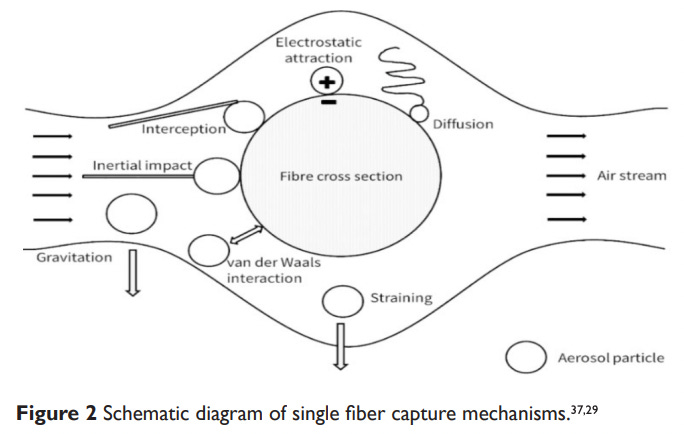
Unfortunately, we are unsure of the size distributions of the particles that humans emit when breathing, coughing, speaking, talking, sneezing, or similar. There have been a few landmark studies in the past to try and measure particle size distributions, (Wells 1934, 1955, Duguid 1945, Loudon & Roberts 1967, Papineni & Rosenthal 1997, Yang et al. 2007, Morawska et al. 2009b and most recently Johnson et al. 2011) but discrepancies remain (Bourouiba 2013, Aerosol Science CDT. (n.d.). Aerosol/Droplet Expiration.).
After I looked into this a bit more, I realised how many degrees of freedom there are in trying to measure these distributions, as well as the different physical and biological factors that affect them. These discrepancies likely come from many sources (Aerosol Science CDT. (n.d.). Aerosol/Droplet Expiration), all of which warrant further investigation. Here are some of the main ones:
from the different instrumentation; how are the instruments calibrated? What is the flow setup? My first foray into doing biological experiments in my house made me realise how significant the variability from instrumentation can be.
physical factors like humidity, temperature and more can affect particle sizes since it affects the rate of evaporation of particles.
human and physiological factors to do with the individuals can change the size distributions as well. How does the particle distribution change depending on whether they are healthy or sick? Do humans with different physiology emit different sizes of aerosols?
Moreover, we still don’t seem to know how many viruses are actually loaded into these droplets. How much RNA are in these droplets? What’s the composition?
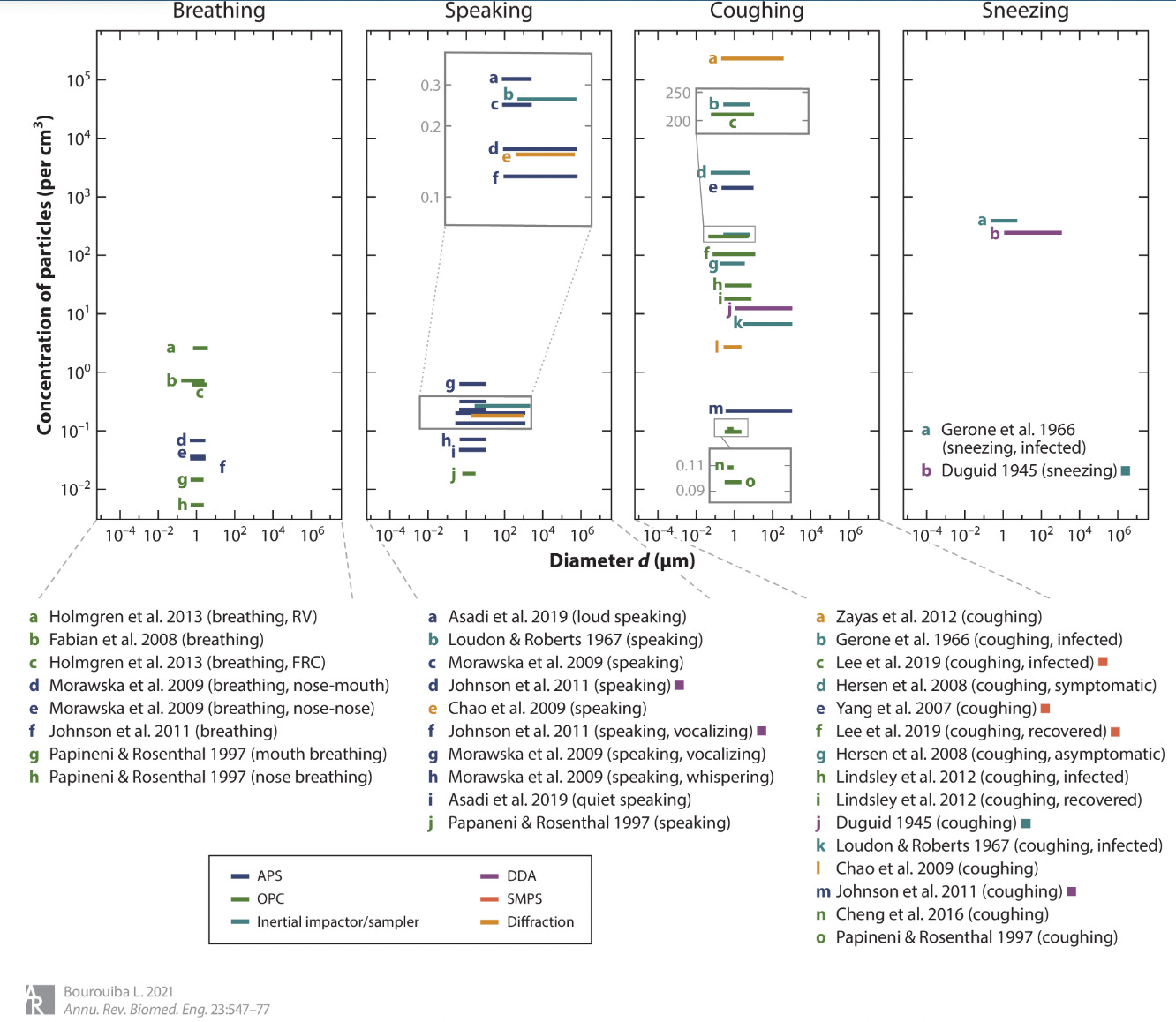
I found this uncertainty worrying given how simple and seemingly important this question is. When you breathe, talk, cough, sneeze or sing, you emit fluids. This is mucus, saliva, stuff from your lungs, vocal chords, and more. We have high confidence that things capable of infecting others (and yes, I’m being deliberately vague here), lie within these particles. These particles have different sizes, and there is a distribution of those sizes. But measuring this distribution has been hard.
The following chart is an amazing illustration of the variance in droplet sizes measured with different methods and in different studies taken from (Bourouiba 2021). What I am particularly concerned with is the variance in speaking and coughing. We cough more when we are sick, so it’s no good that there is quite a bit of variance here.
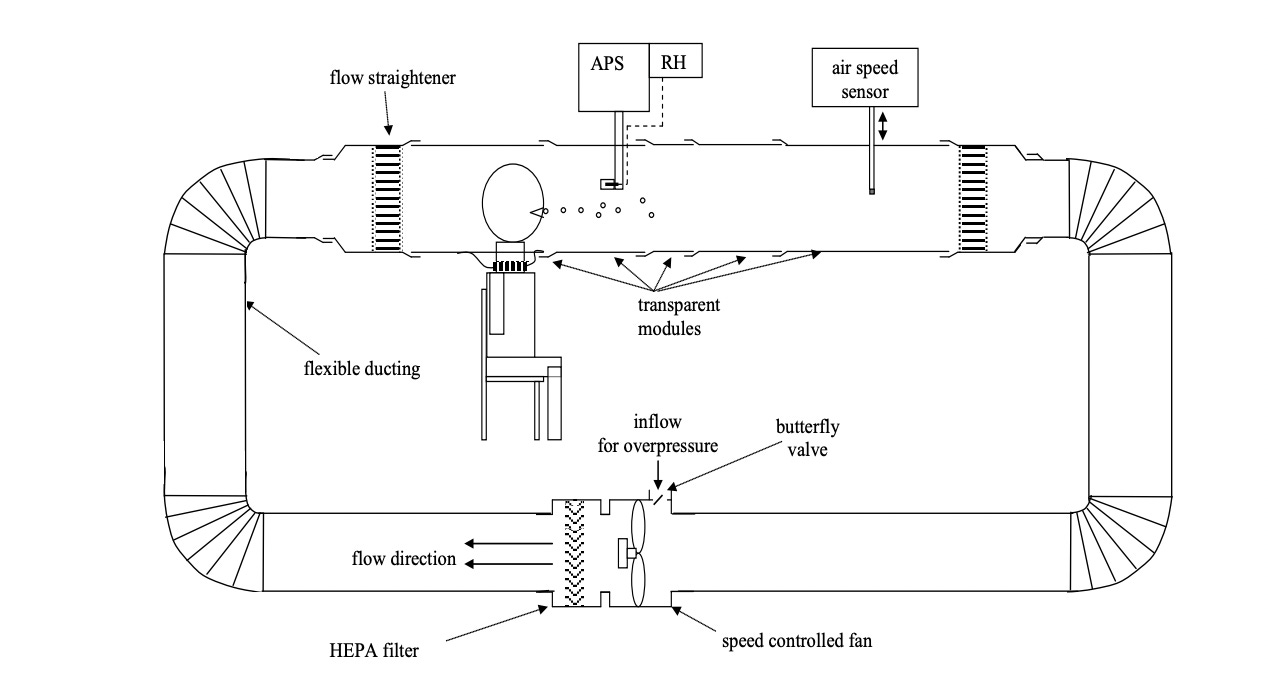
Here’s an example of what the experimental setup might look like. Below is an image detailing Johnson et al. 2011’s experimental setup to measure particle distributions. It looks a bit like a medieval torture device doesn’t it. It’s also worth bearing in mind that they only used healthy volunteers under age 35 for this. They also had to apply a correction to the raw data to estimate the actual distribution nearer the mouth - which of course
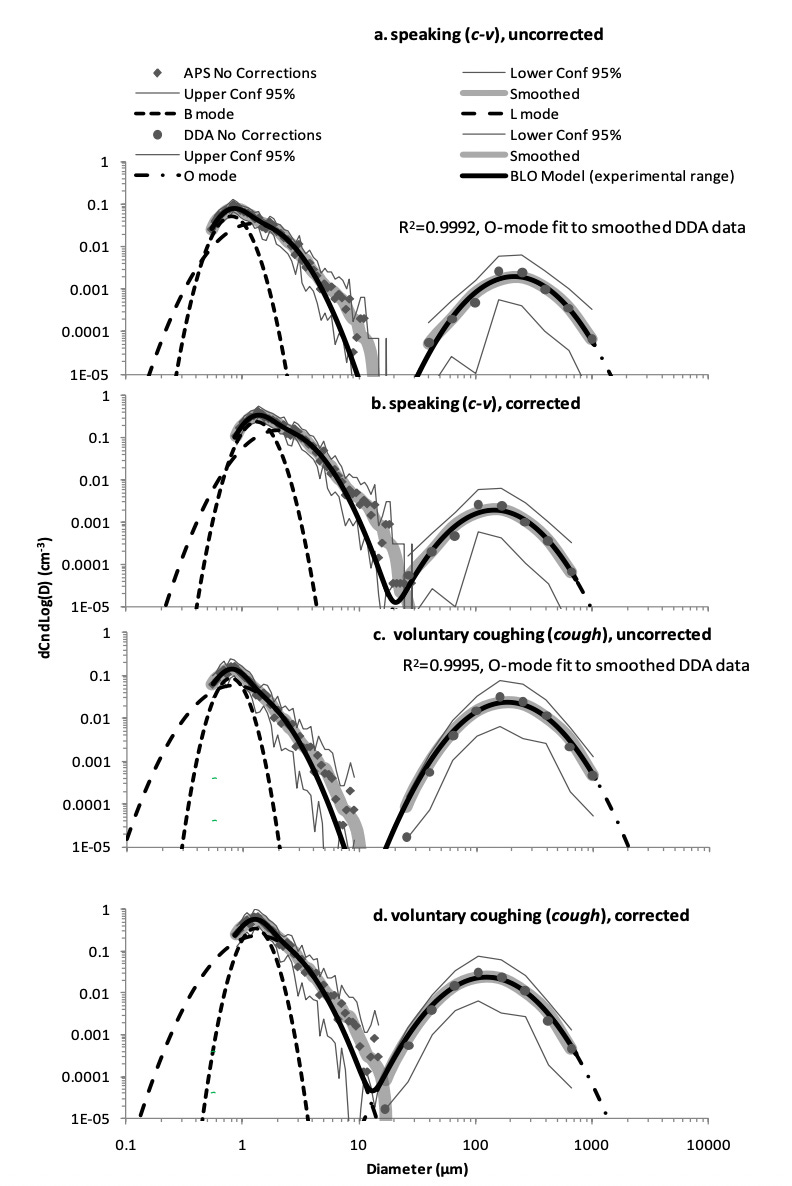
And here’s the distribution of particles that they measured. You can see two humps that support the idea that aerosol sizes are ‘bimodal’.
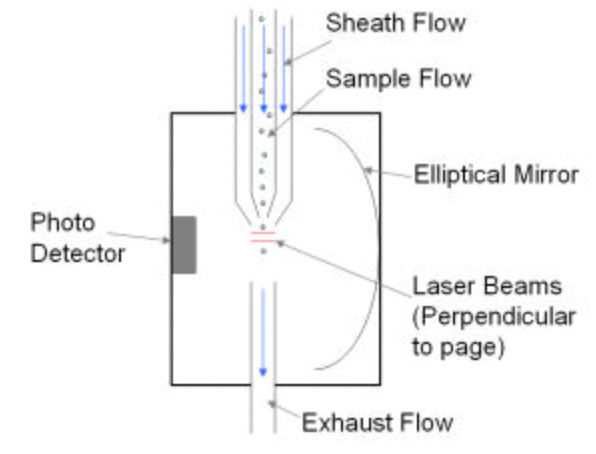
To get a feel for how these particles are measured, some of the studies use an aerodynamic particle sizer, which works by pushing through particles through two lasers that are close together, and then measuring the time difference takes for the particle to cross them. With this image, I hope to illustrate how janky the process of measuring stuff like this is.
Aerosol Dynamics
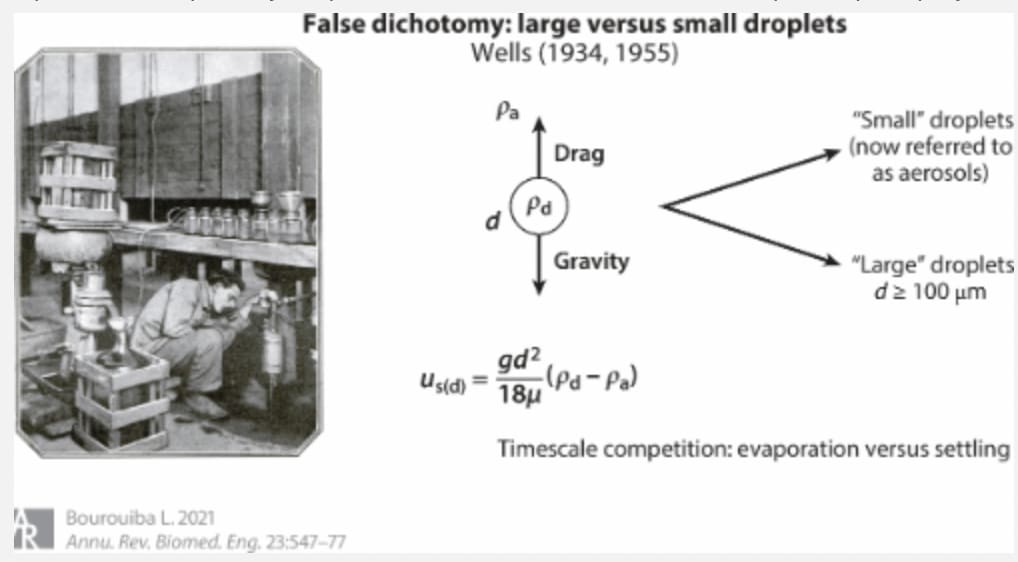
Wells’ paradigm in the 1930s aimed to describe the mechanics of how aerosols worked. In this paradigm, a droplet particle experiences two competing forces - gravity, and buoyancy. If the particle was sufficiency small (less than 100um), then it would evaporate before falling, and then be suspended in the air.
Because of this, particles were split into two types - aerosols which remained in the air under by forming what was known as droplet nuclei, and large droplets which fell to the ground due to the action of gravity (Diagrams credited to Bourouiba, 2021).
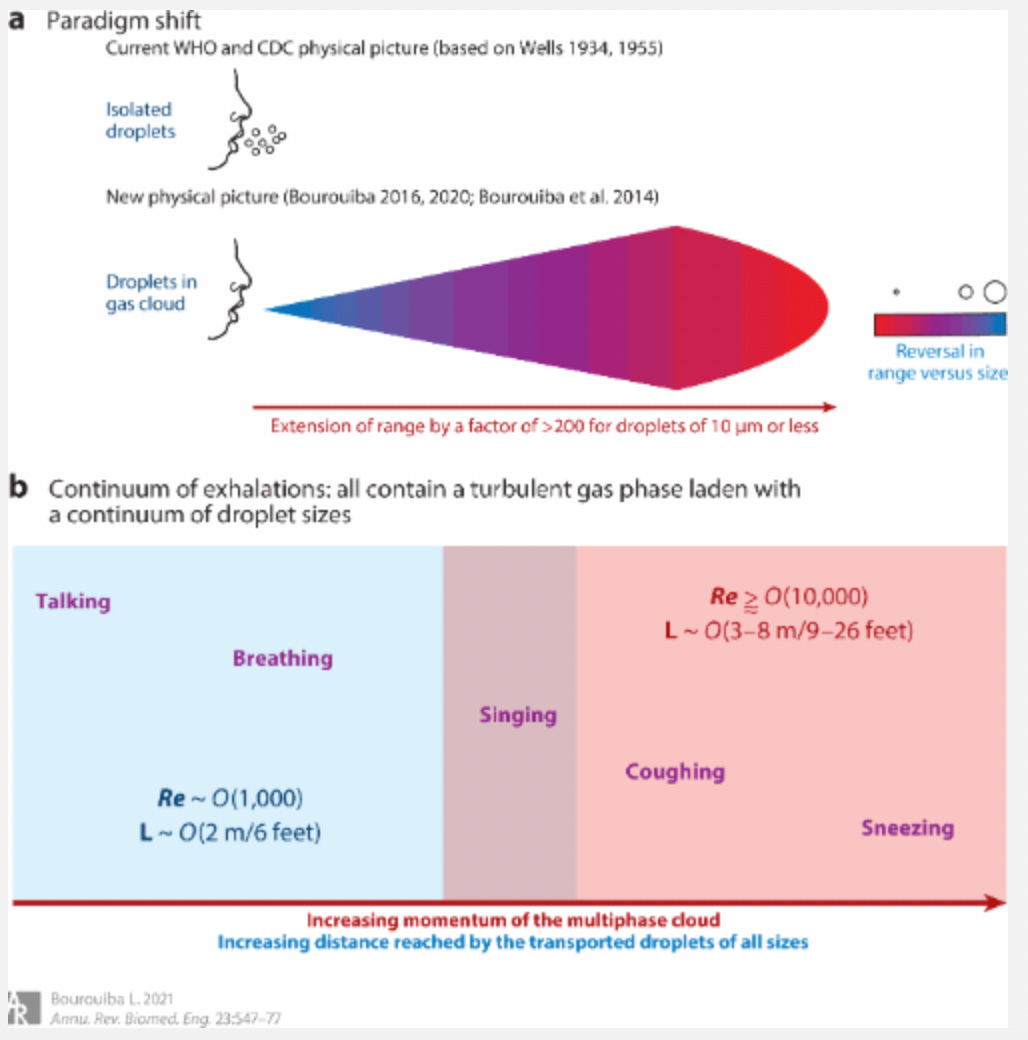
But the picture seems much more complicated than that now. More recent research is shifting the paradigm into a much more elaborate, where human exhalation should be thought of as a much more diverse distribution droplets encased in a moist gas cloud (Bourouiba, 2021).
The gas cloud part is important. Bourouba argues that it is not just size of the particles that affect range, but rather the properties of this cloud as well. To make things more complicated, there’s turbulence. This gas cloud has interaction effects with the environment too, is probably affected by humidity and temperature. This already tells us that we should be considering different environments when prescribing public health guidance.
The upshot of this is that its likely that particles go a lot further than what the Wells model suggests, which you can read in the papers referenced below.
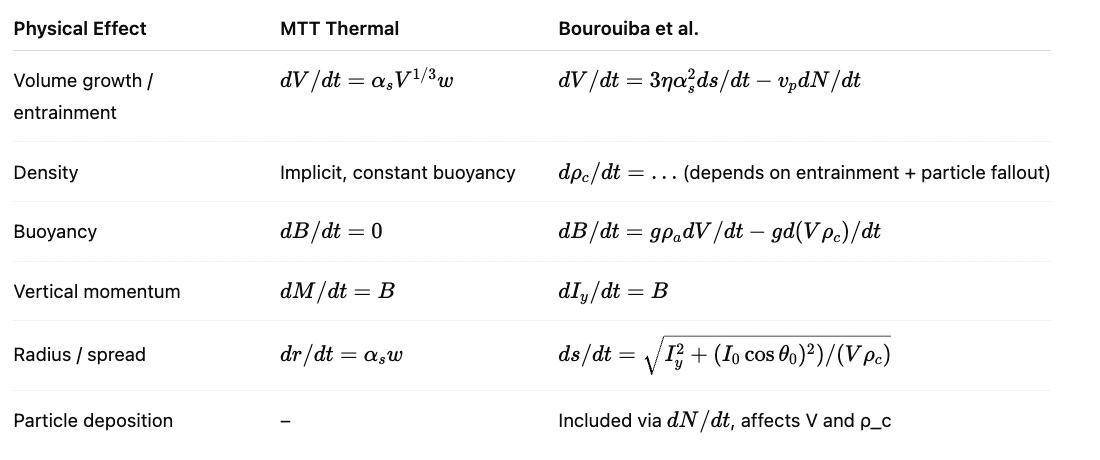
The dynamics of such clouds are adapted from ‘plume theory’, which concerns the motion of a fluid (the warm, moist gas cloud from our exhalation) in another fluid (the air). In plume theory, there are several effects which govern the dynamics of the cloud. You have the usual suspects like buoyancy, momentum and density. But, there is also another quantity called entrainment which is the when the gas cloud increases in size due to introductions of the outside fluid. Bourouiba 2013 adapts classic plume theory (called the Morto-Taylor-Turner model) to take into account particles suspended in the plume of our exhalation.
On a side note, I think that this a cool example of a paradigm shift in thinking! There was no heavy math or theory involved, rather a change in ideas and interpretation. Thomas Kuhn founded the idea of paradigm shifts in his book The Structure of Scientific Revolutions, and I highly recommend it.
Also, don’t take my word for all of this! I don’t think I’ve read enough studies yet to be convinced one way how to model these things, so I’m keen for feedback :)
Experimental methods
Ok, so I’ve gone on a rant about variability in droplet sizes. So what are the things we can do? What’s my plan given that I’ve spent some time looking at this stuff?
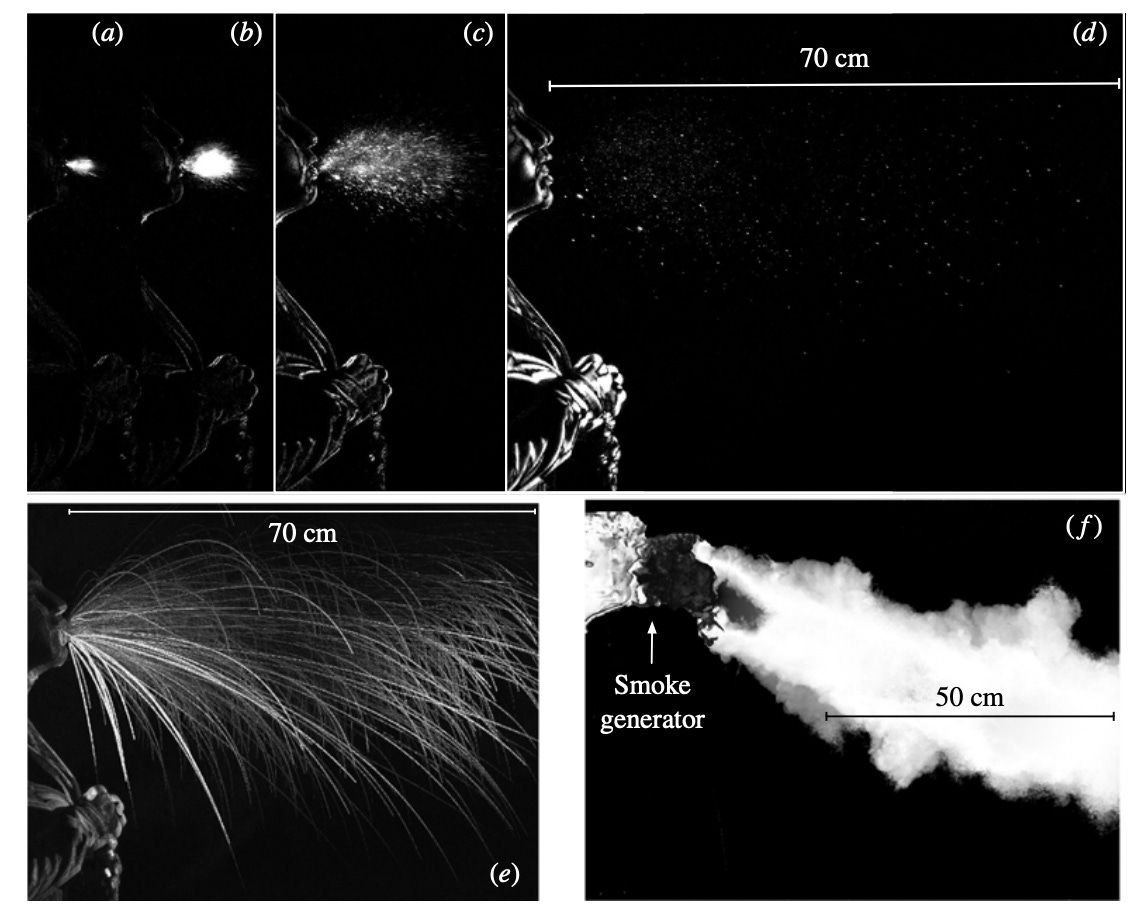
Because of this, I think that we need more aerosol data in a more diverse range of environments. I really would love to measure this stuff in the wild, in different environments. I can’t afford the expensive laser air particle counters at the moment (since they range in the several thousands of dollars range), and so I bought a cheap high speed camera to try and replicate the experiments shown in (Bourouiba, Lydia, Eline Dehandschoewercker, and John W. M. Bush 2014).
In their experiments, they use a high speed camera to look at the dynamics of someone sneezing and coughing in front of a black, velvet screen lit up by lights around. I was surprised about how well it worked!
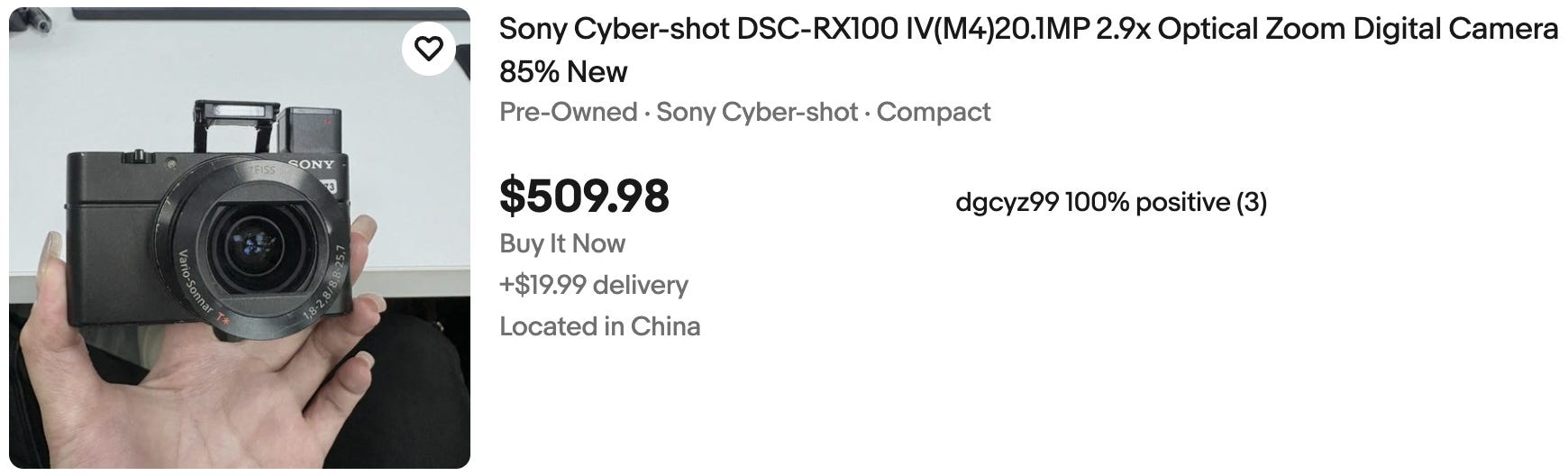
I think taking images is great because its simple and reproducible. Unfortunately, high speed cameras are pretty expensive. However, after a bit of digging, I found that Sony actually included a 1000fps feature in one of their consumer cameras, which I bought on eBay today for around $500! So for my next experiment, I think I’m going to try and turn my house into studio to take some images of me sneezing. Once I do this, I’ll share my tips so that you guys can do it too.
References
Bourouiba, L. (2021). Fluid dynamics of respiratory infectious diseases. Annual Review of Biomedical Engineering, 23, 547-577. https://doi.org/10.1146/annurev-bioeng-111820-025044
Bourouiba, Lydia, Eline Dehandschoewercker, and John W. M. Bush. “Violent Expiratory Events: On Coughing and Sneezing.” Journal of Fluid Mechanics 745 (March 24, 2014): 537–563. © 2014 Cambridge University Press
Wells, W. F. (1934). On air-borne infection: Study II. Droplets and droplet nuclei. American Journal of Hygiene, 20, 611–618.
Wells, W. F. (1955). Airborne contagion and air hygiene: An ecological study of droplet infections. Cambridge, MA: Harvard University Press.
Duguid, J. P. (1945). The numbers and the sites of origin of the droplets expelled during expiratory activities. Edinburgh Medical Journal, 52, 385–401.
Loudon, R. G., & Roberts, R. M. (1967). Droplet expulsion from the respiratory tract. American Review of Respiratory Disease, 95, 435–442.
Papineni, R. S., & Rosenthal, F. S. (1997). The size distribution of droplets in the exhaled breath of healthy human subjects. Journal of Aerosol Medicine, 10(2), 105–116.
Yang, S., Lee, G. W. M., Chen, C. M., Wu, C. C., & Yu, K. P. (2007). The size and concentration of droplets generated by coughing in human subjects. Journal of Aerosol Medicine, 20(4), 484–494.
Morawska, L., Johnson, G. R., Ristovski, Z. D., Hargreaves, M., Mengersen, K., Corbett, S., … Katoshevski, D. (2009). Size distribution and sites of origin of droplets expelled from the human respiratory tract during expiratory activities. Journal of Aerosol Science, 40(3), 256–269.
Johnson, G. R., Morawska, L., Ristovski, Z. D., Hargreaves, M., Mengersen, K., Chao, C. Y. H., … Corbett, S. (2011). Modality of human expired aerosol size distributions. Journal of Aerosol Science, 42(12), 839–851.
Aerosol Science CDT. (n.d.). Aerosol/Droplet Expiration. Retrieved from https://www.aerosol-cdt.ac.uk/aerosol-droplet-expiration/ Aerosol Science CDT
Mohammed AMF, Saleh IA, Ibrahim YH, et al. Theory and technology of air filtration: review. Material Sci & Eng. 2022;6(1):6‒12. DOI: 10.15406/mseij.2022.06.00173