The Viability of Space Solar Energy

Earth-based Solar Panels aren’t “Ambitious” enough to be effective
Renewable energy is important. It is well known that continued reliance on fossil fuels would further impact the climate through CO2 emissions. In addition, diminishing supply is putting a strain on the sustainability of coal and oil. It also lends itself to unstable economies for those reliant on importing fossil fuels, which is shown in the Ukrainian conflict.
Now, one obvious renewable energy source is our sun. Solar panels convert light into a dc current, which can power homes. However, the biggest criticism of solar energy is that does not produce enough power to sustain our needs in the long run. There are two main reasons why solar energy falls short, and these are primarily to do with a matter of “quantity”. These issues are specific to the fact that they work off the sun. Firstly, light only appears for a limited amount throughout the day (in the peak daytime), and most places on Earth only really get 5 hours of optimal sunlight. Countries that naturally receive less light would probably have little incentive to invest in solar panel technologies (see footnote [2]). Secondly, there isn’t enough space to fit solar panels, to the point where their output is of any large, tangible benefit. Sure, we can try to make solar panels more efficient, but this only offers limited advantage.
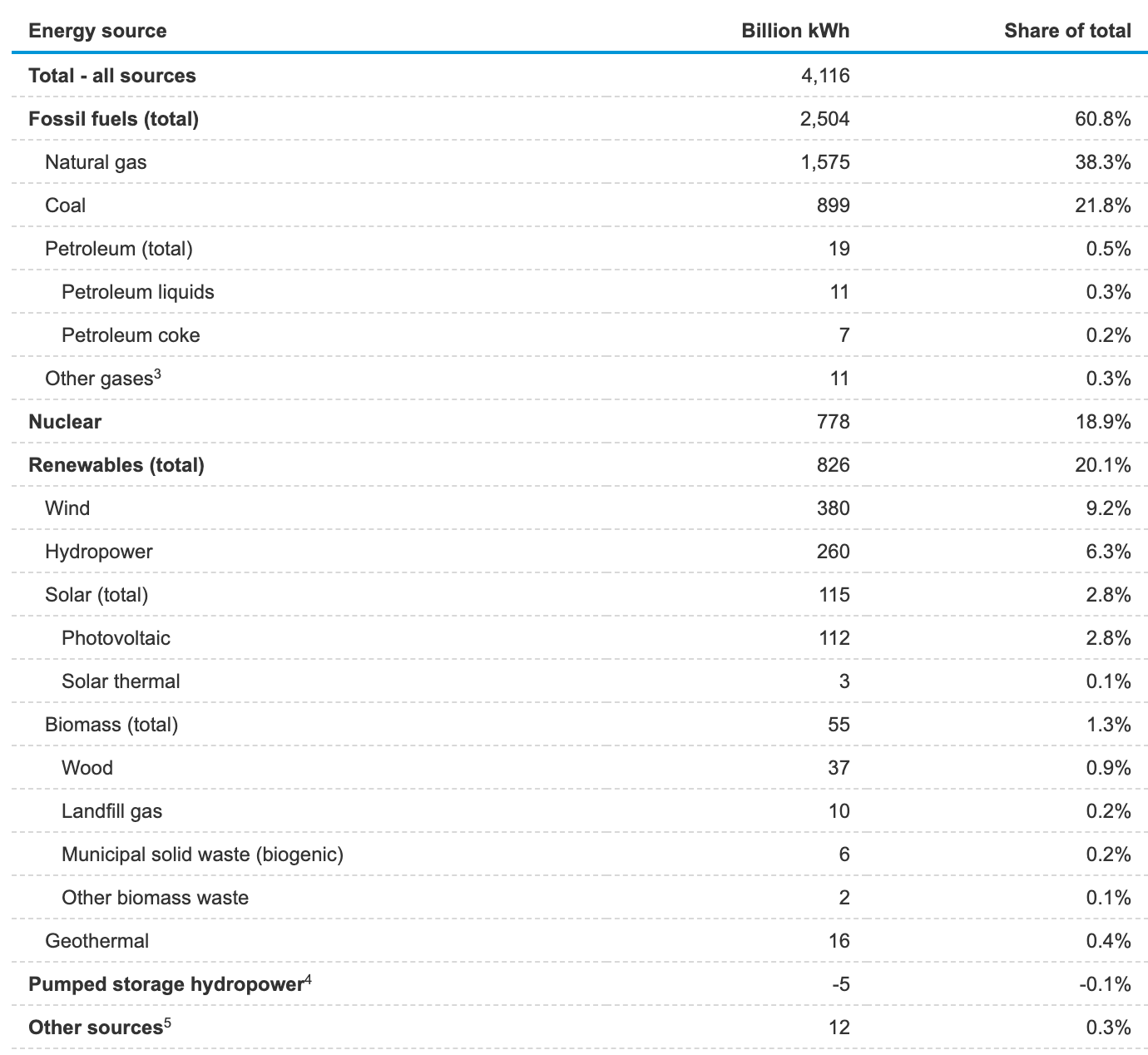
Currently, the contribution of photovoltaic solar energy in the United States stands at 2.8% as of 2022 [1]. This is a pretty pathetic amount, and a lot smaller than I thought. I’ve attached the numbers here for reference. The total energy from solar panels this year was 112 billion kWh. Overall, I am quite surprised by how low this number is. We still don’t make full use of solar energy. In this post, I wanted to make a first principles calculation over the economic viability of a solar panel in space, and who I think will get there first. The below is data from the EIA, as of 2022, that outlines the current composition of US energy sources.
Fixing the Sunlight Problem
In my mind, there are two ways to have greater light exposure for solar panels. One solution therefore to fix the issue of little sunlight is by launching satellites into space, in an orbit that is synchronised with the motion of the sun so that it maximises light. Alternatively, we could also start by placing lots of solar panels in a place with lots of sunlight. One of the viable places would be Yuma desert in the US. In this section, I will concentrate on a model that fleshes out the possibility of the first solution.
What does energy look like in the future? We can get power from satellites. One of the main things I think that will take-off in the future is space solar powered satellites. Why space? Let’s look at the reasons. Firstly, let’s see how much sunlight a solar panel gets in Malaysia, for example. We find that throughout the day, we receive 5 hours of good sunlight. However, we can construct a way to make the satellite orbit the Earth so that it remains at the same spot above. To do this, we need to have the satellite orbiting the Earth at exactly the same angular momentum as the Earth’s orbit around the sun. It is easy to convince yourself geometrically that the angular momentum of the satellite relative to the Earth is precisely this angular momentum as well.
To start with, what would be the altitude of orbit required for a satellite to receive constant sunlight? In this section, we’ll examine two possibilities. For a satellite to be ‘pinned’ in the same place along the equator, and always facing the sun, it needs to have the same angular momentum orbiting as the Earth does orbiting the sun. The Earth’s angular velocity is, of course, 2 pi / 365 radians/days. This means that we need a satellite to orbit at this angular momentum, which means that, using the following formula, we require the following. In the equation below, M is the mass of the Earth, and G is the gravitational constant.
$$ T = \frac{ 1 } { 2 \pi } \sqrt{ \frac{ a ^ 3 } { GM } } , \quad M = 5.972 × 10^{ 24 } kg, \quad G = 6.6743 × 10^{-11} m^3 kg^{-1} s-2 $$
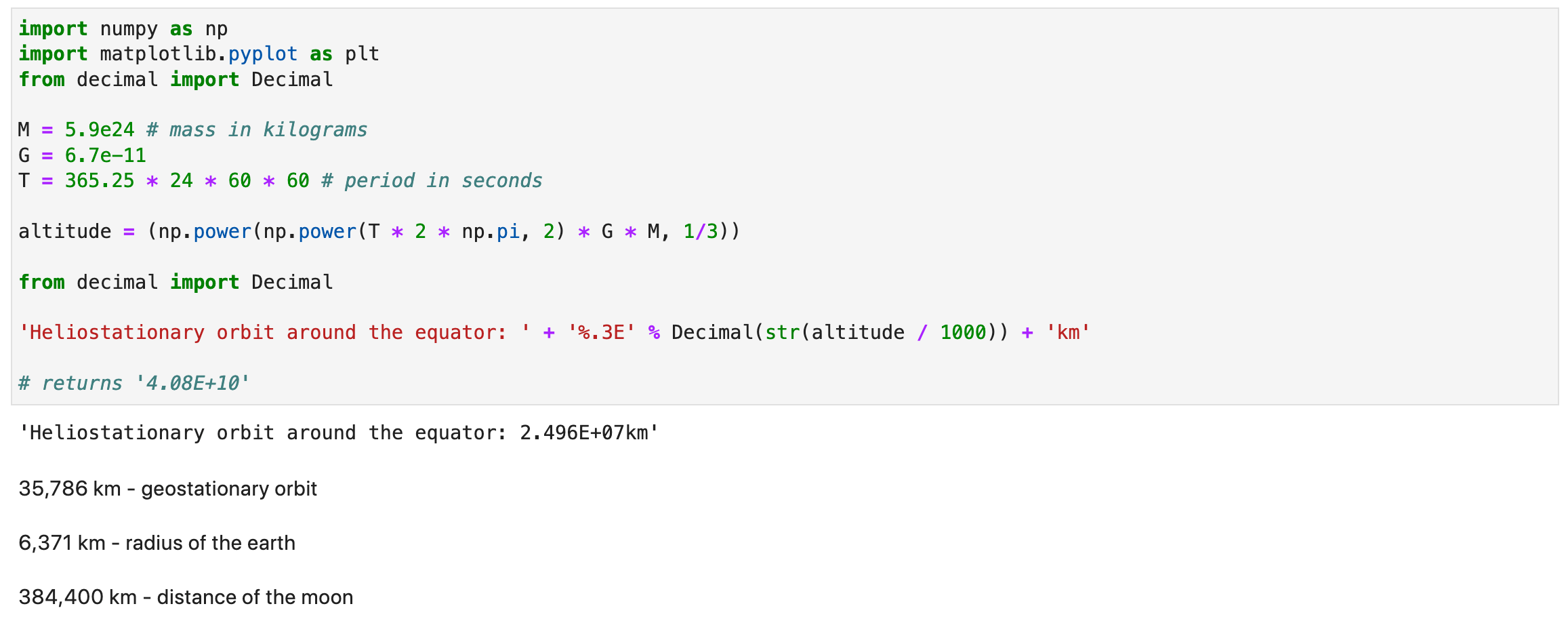
The period T in this case, would just be just a year. We can then back out what the orbital distance from this equation. In this case, the distance would be incredibly far away. As shown below, I inverted the relationship and it shows that the required orbit would be at a distance of 24 million km away, which is much farther than a geostationary orbit. Hence, this looks unfeasible.
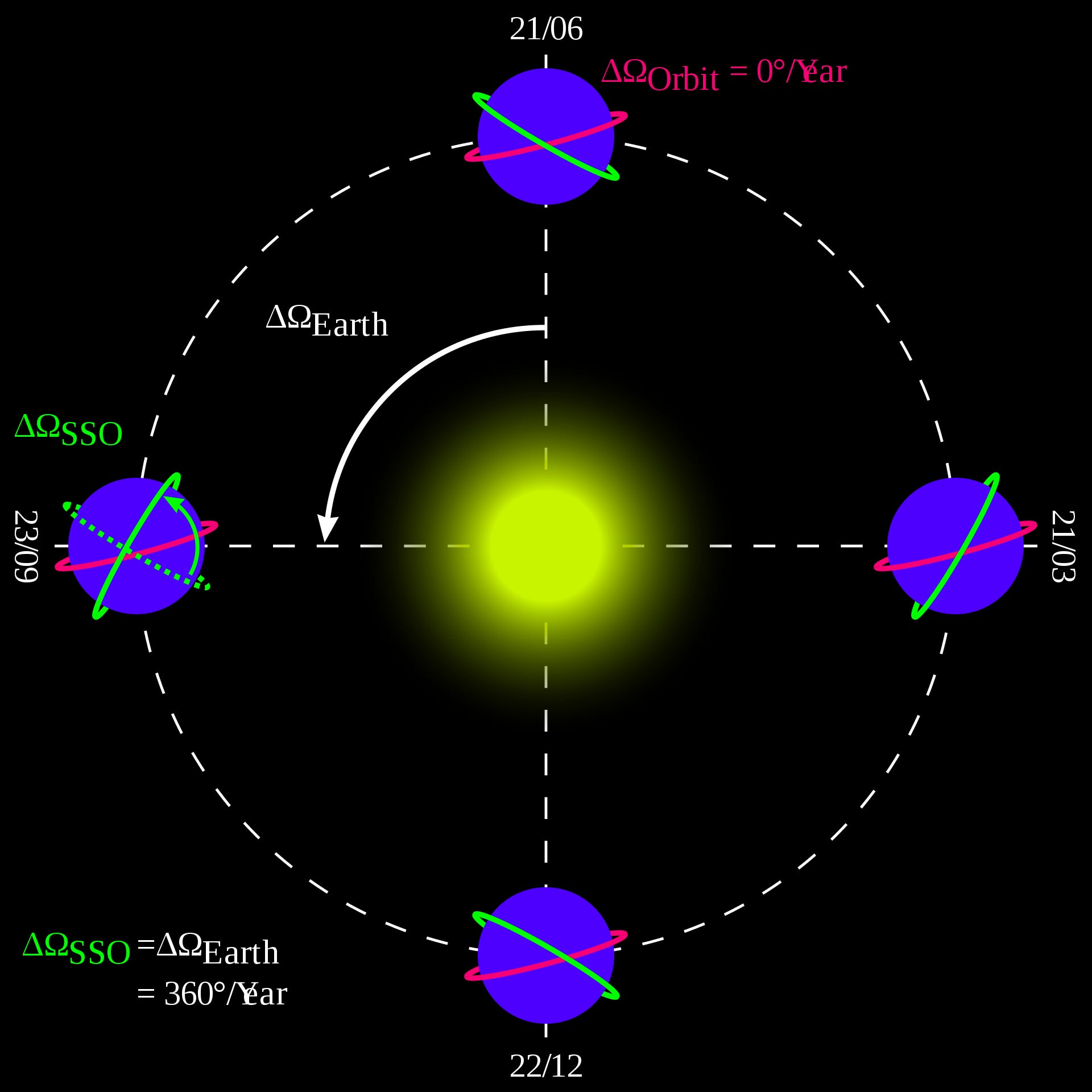
Alternatively, we could also construct what is called a ‘heliocentric orbit’. This is an alternative approach where we make the satellite orbit the poles instead. This allows us to orientate our solar panels so that they always fit the sun. We then introduce a gradual change in the angle of the rotation axis so that it is constantly orientated along the ring. Many solar panels could then be arranged along this ring. A satellite in a Sun-synchronous orbit would usually be at an altitude of between 600 to 800 km. At 800 km, it will be travelling at a speed of approximately 7.5 km per second.
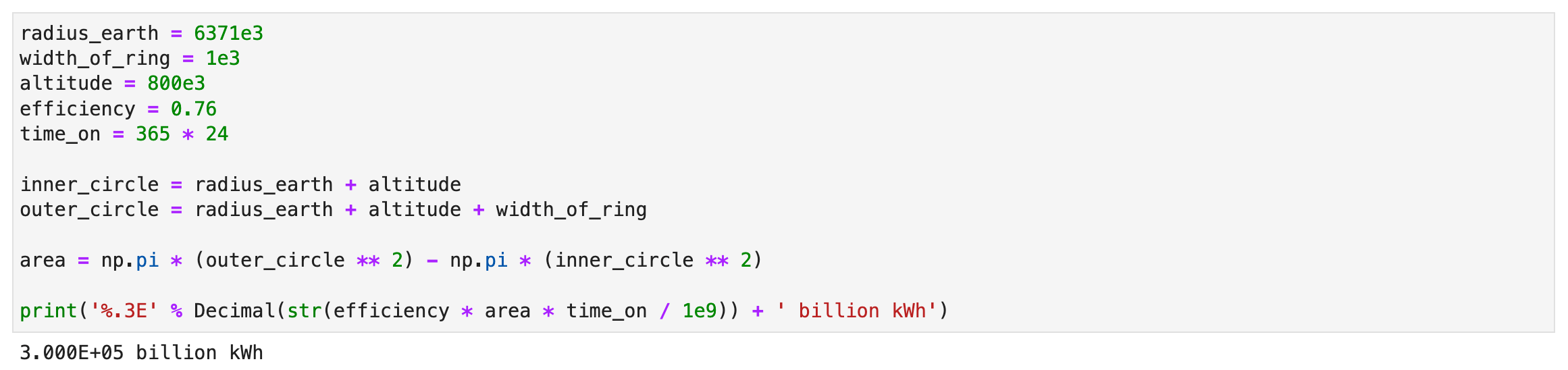
Something we could try is create a big ring around the Earth, and then ask ourselves what the total area would be hit by the sun. Assuming that this is 800km above the surface of the Earth, the graph below plots the energy as a function of the width of the ring. Assuming the ring is 1km wide, what would be the area covered?
The Construction of a Space Solar Device and its Efficiency
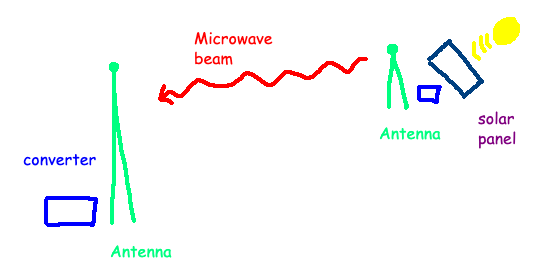
To build a satellite in space, we need 4 components. First, we need the solar cell in space that converts light to electricity, in the form of a d.c. current. The next step is to then convert this into a microwave that can be transmitted some distance. The next step after this would be to convert it back into d.c. energy. I expect that the main bottlenecks for efficiency would be these converters, as well as the beam itself. In this diagram, I show the components that we need.
I expect that one of the bottlenecks in the efficiency will be the microwave transmission. In terms of the transmission efficiency, the amount of the microwave energy that can be transmitted is encoded in a relationship between a parameter tau and the efficiency [1]. In this case, the efficiency is a function of this parameter tau, and the experimental relationship is shown in the graph below.
$$ \tau = \sqrt{ A _ t A_r } / \lambda D $$
This parameter tau has In the A_t and A_r are the areas of the transmitting and receiving apertures. Lambda is the wavelength of the beam. D is the distance between the antennae. As shown in the graph below, for the higher values of lambda we already seem to approach a high level of efficiency. In particular, when the value of tau is 2.4, then the experimentally measured of the value is close to 1.
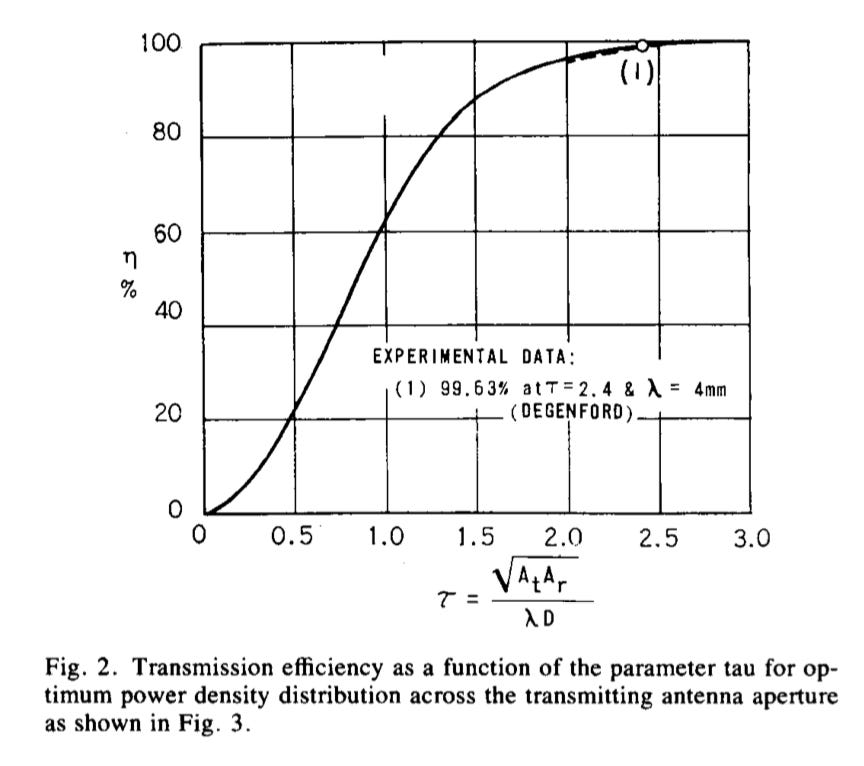
Overall, the first estimate of efficiency in a full system is expected to be 76% [1]. This means, to the first order, that we can expect a multiplier, from just being in space, of around 3.6 times. Overall, this means that we can expect this much more power from a solar satellite in the sun. I think that whilst this multiplier is small, it is not negligible.
$$ \text{Output Multiplier} = 0.76 \times \frac{ 24} { \text{Earth Sunlight time}} \simeq 3.6 $$
Assuming an efficiency of 76%, I calculate the total kWh that a 1km ring of solar cells would generate 800km above the surface of the Earth, assuming they have full sunlight all year round. In this case, it would be 300,000 billion kWh, which is around two orders of magnitude larger than the total energy output of the US across all energy generation types.
Other thoughts
Would a Dyson sphere be a viable option?
What are the Economics and Risks of an operation like this?
Who is going to rent out solar panels? I suspect that we are at a risk of a monopoly situation in this case.
Who will get there first? To make the trade economic, the cost of maintainence and the cost of flying materials up to space needs to be smaller than the value of energy, assuming they can export. How much energy can a solar cell produce? Well, the typical domestic solar panel can produce Solar PV systems are made up of several panels, with each panel generating around 355W of energy in strong sunlight. Already, this means that we can generate around 5 times more solar energy.
I posted this question on Metaculus for review.
I think China will get there first.They have programs that already are testing this technology.
I also think Malaysia could serve to be a viable export partner.
Footnotes
[2] This probably raises the question of monopoly in the global solar energy market.