Noether’s Theorem and the Principle of Least Action
My thoughts on actions, Lagrangians and symmetry
Lagrangians are mathematical expressions that store pretty much all the information we need about a physical system, and I will explain what they are in the next section. They often contain symmetries, which means that they don't change when we twist and turn them in some particular way. Symmetries and Lagrangians are special because it allows us to construct conserved quantities. Conserved quantities are physical, observable things that stay the same throughout the evolution of a physical system.
Physicists love to discover conserved quantities not only because of their profound philosophical consequences but also because of their use in solving equations. It is easier to solve mathematical equations with quantities that you know sit still and remain constant.
Continuous symmetries are 'smooth' symmetries, like a rotation. Noether's theorem states that for every continuous symmetry, we can construct a conserved quantity. So, for example, if we have rotational symmetry in a physical system, we automatically get conserved angular momentum for free. Here is another example. Surprisingly, Noether's theorem can show that energy conservation is a consequence of the time translational symmetry — or when the Lagrangian itself doesn't depend on time. In other words, if the background 'scene' of which a physical system is placed remains the same throughout time, then the combined energy of that system will also remain the same.
This concept of symmetry is pervasive in simple mechanics and every field of classical and modern physics. For example, in quantum physics, the symmetry of quantum mechanical systems corresponds to the conservation of quantum angular momentum. In the theory of electricity, the conservation of charge and spin of electrons results from symmetries that electrons obey.
What are the mathematical details about how this works? First, I need to explain the principle of least action and how we use it to figure out what fields will do if we know the Lagrangian.
The Action and the Lagrangian
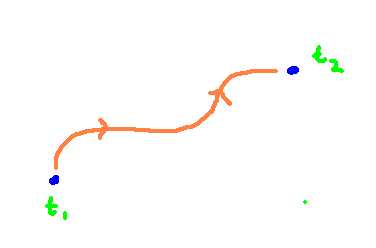
Suppose we have a particle, or field, evolving between two predetermined times. Let's call these times t1 and t2. If it was a particle, we could picture the evolution of the particle by drawing a path through space, beginning at time t1 and ending at time t2. If it was a field, imagine a heatmap slowly evolving through time.
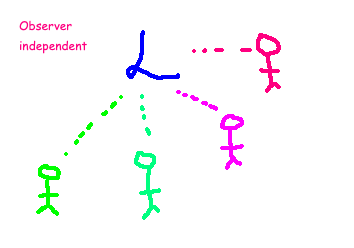
What can we say about the behaviour of these physical objects, and how do we know what path the particle will take? In physics, we start with a model of our physical system, which is typically a Lagrangian. A Lagrangian is a mathematical quantity, usually the difference of a system's kinetic and potential energy, and spits out an actual number at any given point in time. We like to use Lagrangians because they are observer-independent. They are independent of the reference frame and coordinate system we use to describe the physics of the system.
It doesn't matter whether an observer is upside down, travelling near the speed of light. Often, the numerical value of physical quantities will be different depending on what coordinates one uses. However, the Lagrangian will be the same, regardless of the observer that is calculating it. This independence of the reference frame is helpful since it allows a clean calculation with little ambiguity.
To understand what happens, we need to construct a quantity called an action. For example, if we have a Lagrangian, we build a cost associated with it by integrating the Lagrangian between these two times. Integrating something means adding up all the small slices of the Lagrangian at many points in time. This total cost of movement from t1 to t2 is called the action. It is typically denoted by a capital S. The vertical curly line in front of the Lagrangian represents the integral.


The expression above is the mathematical definition of an action. The Lagrangian is usually a function of both the position and first derivative of the position of a particle. The greek letter phi represents the position of a particle in space. The second term, with the curly delta in front of it, is the first derivative of the position of a particle. This first derivative is meant to capture the rate of change of a particle with respect to time.
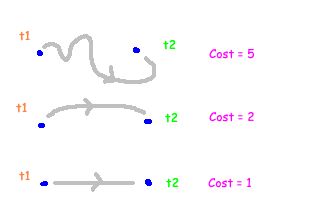
What does an action look like geometrically? We can illustrate this with some diagrams, and the paths I drew below are just illustrations so you can get the general concept of what is going on. If your Lagrangian consists of just kinetic energy in free space, you tend to get higher costs for the more complicated paths, so the value of your action tends to be bigger. The diagram shows some values of the 'action' for different paths a particle can take between the times t1 and t2. The value of the action is the 'cost' that I've written here. As you can see, the most complicated path at the top costs the most. The least costly path is just the straight path.
What are the physical objects here?
In our eyes, whilst Lagrangians are mathematical objects, we consider just the action itself to be physical. There is a philosophical reason why. It turns out that different Lagrangians give rise to the same action. So, there are cases where can we have two different Lagrangians but the same action. This means that we can have two different Lagrangians but the same physical laws that come out.
Why is this true? The reason why is that some particular mathematical expressions, called 'total derivatives', vanish when we integrate over them. Total derivatives are mathematical expressions that can be written as the change of some other underlying expressions. It is not true that mathematical expressions, in general, can be written in terms of the derivative of other mathematical expressions. If they can, provided they get really small, far away from the origin, we can see that they vanish under an integral, given the right set of conditions.

In the equation below, we have an action that is written as the integral of a particular Lagrangian and a total derivative term. However, we can split out the integral and write it as two different parts. Once we split it out, we eliminate the total derivative term since it vanishes when we apply integration.

This is an exciting thing to note! It means that when we have two Lagrangians, we have a slightly less strict condition to consider them as 'equal'. They don't need to be the same to give rise to the same physics. They are the same if they differ only by a 'total derivative' term. For example, in the diagram below, the functions f, g, and h are all associated with total derivative terms, giving rise to the same action. I've written these three functions in different colours to get the point across.
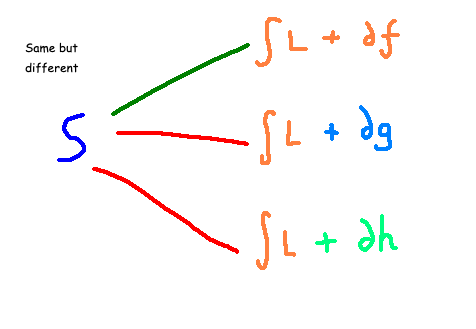
Mathematically, we could write the following expression to represent this idea of Lagrangians being the 'same', even when they differ by a total derivative. In the expression below, the function f needs to come from the space of differentiable functions.

A function is differentiable if the notion of a 'rate of change' can be appropriately applied. If functions are jumpy, rough or ill-defined in places, then it might not be possible to take a sensible 'rate of change' since a pretty strict set of mathematical conditions need to be fulfilled to do this correctly. The collection of all differentiable functions is called C¹. The study of whether operations like differentiation and integration are well defined is called mathematical analysis, and it is a fascinating field of study.
The Euler-Lagrange Equations
The 'principle of least action' tells us that the behaviour of the field or particle is precisely the behaviour that minimises the action. So, if we know the action, we need to do some math to find out the behaviour of the field that minimises the action. There is a field of math called the calculus of variations, and it deals with looking at the 'rate of change of functions'.
The particle version of the Euler-Lagrange equations is shown in the equation below. On the left side, we first take the derivative of the Lagrangian with respect to the velocity. Then, we differentiate that quantity once again with respect to time. On the right-hand side, we differentiate the Lagrangian with respect to position. These two expressions need to be the same, and generate a path which minimises the action.

The field version is very similar, and I aim to explain this more in a future post. It is written below.

References
[1] The Classical Theory of Fields: Volume 2 (Course of Theoretical Physics Series) 4 by Landau, L. D. (ISBN: 9780750627689)