Calculations for Practical Heuristics in Far UVC Use
TL;DR: I try to calculate from first principles how to use Far UVC in my living room, and outline where I think modelling is required
Status and Disclaimer:
This is a calculation exercise, designed as a minimal trust investigation for me to learn more about how a heuristic Far UVC implementation might actually work for me, and where the gaps are.
I wanted to get a better feel of the modelling assumptions that people are using in this space. I think you can learn this best by actually doing it. I spent around 5 hours working on this and the writeup.
I am still learning, but I felt that spelling out my math (under some very very dubious assumptions) to the wider world would be useful to myself.
It is not medical, practical, nor safety advice.
Background reading
Does Far UVC work?
Far UVC Tools that already exist
Meta reading
Tools that I built for this post
What I am aiming for
The purpose of this document is to make clear some of my basic reasoning on:
What is the coarsest, most first pass safe model of UVC in my room?
Can I use this as a way to get intuition on what is trustworthy and not trustworthy?
Can I use this as a way to get an intuition on what actually needs to be modelled and estimated, versus stuff that doesn't actually really matter?
What are problems in the modelling that I've read so far?
What is wrong about just getting into the modelling?
Rabbit holes?
Model coarseness?
What would a simple heuristics document look like?
Modelling Far UVC in my House
Question: If I had a SINGLE Far UVC lamp in my room that I bought from a store and put it on my ceiling, would it be dangerous? How much dimming do I need? And if so, would it work, given the data that I have?
Exposure is:
How much energy is absorbed from the lamp over time per unit area.
It's the quantity we want to calculate / predict to decide if the lamp configuration is safe (based on current studies of recommended max doses, which is another question) and if it also deactivates pathogens to the level that we need.
it's measured in this context as mJ / cm^2.
We want to make sure that the exposure level over the course of a day (call it 8 hours)
isn't too high such that it's unsafe,
but high enough so that it deactivates pathogens.
and...
Since exposure varies depending on where you are in the room, exposure is the integral of your irradiance over time.
For this essay, I'll focus more on the method to ensure 1), if I had a single lamp. We start by computing the irradiance of the lamp on my environment.
Onto… Computing irradiance
To get exposure, we need to get the irradiance from the lamp at a given point in a room. Irradiance is
the amount of energy delivered, per unit time, per unit area
it's measured in most of the papers above in microWatts / cm^2 .
So the question is, if I had a lamp centrally placed on my ceiling, what's the irradiance at a given point?
The first step is to get an IES file of the Far UVC lamp that you want. This IES file gives the power value (Watts / sterradians), or Intensity, for a given angle of theta and phi assuming one unit distance away from the centre.
You can get IES files from OSLUV, Assays
The IES files give a quantity called intensity:

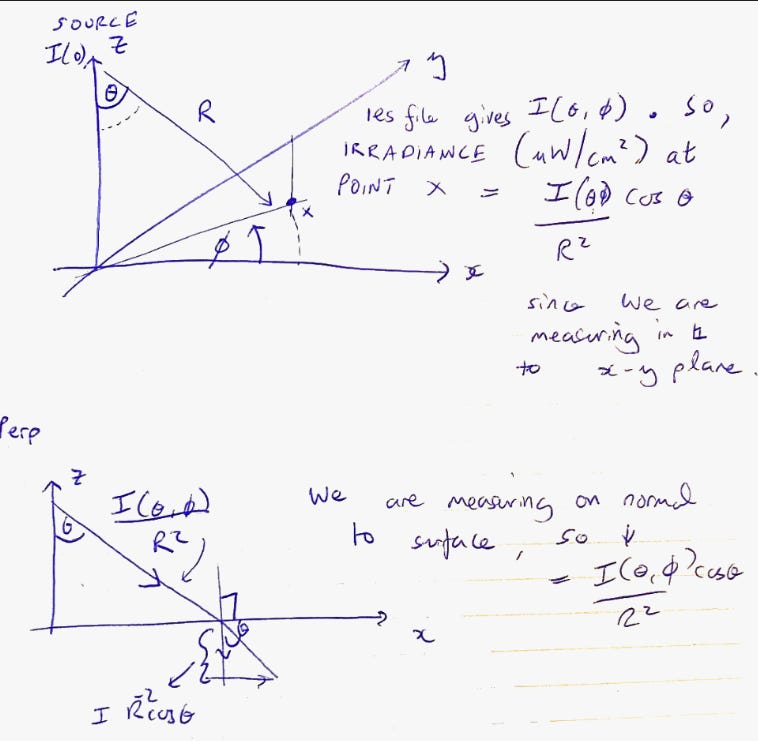
A diagram of these angles is shown below!

To get the irradiance at a point
Get your theta and phi values of that point, as well as the distance of the point to the light source. The magnitude of irradiance there is, where d is the distance,

$$ Irradiance(d, \phi, \theta) = I(\phi, \theta) / d^2 $$
If you're measuring the component of irradiance perpendicular to the floor (although that's actually questionable for now), you need to add an extra term

$$ Irradiance_{perp}(d, \phi, \theta) = \cos(\theta)I(\phi, \theta)/d^2 $$
The diagram which shows this is below!


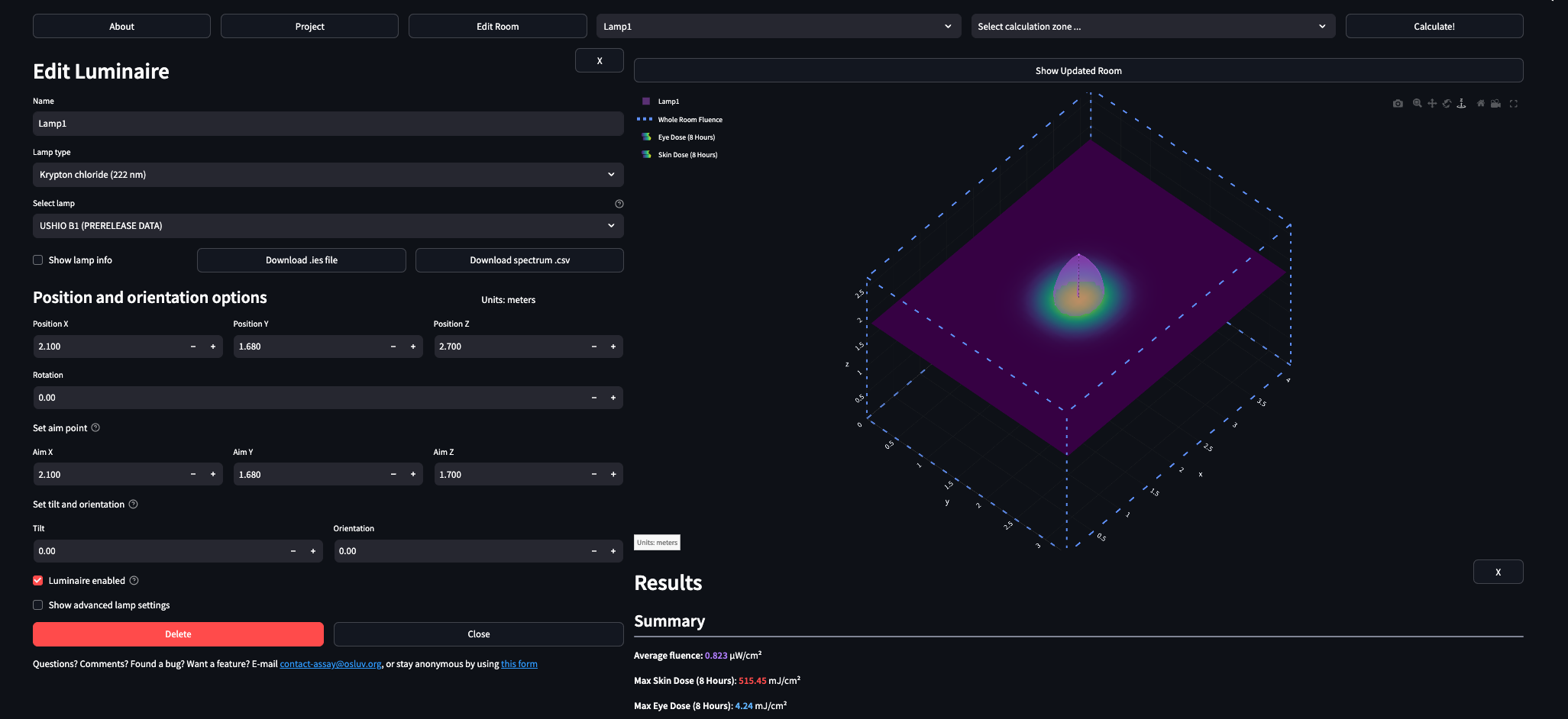
I did this by myself with a lamp IES file (which I wish not to name since this post is about calculation, and not an endorsement of any product) that I placed theoretically on the centre point of my ceiling.
You can do this yourself with the following tools!
The one that I built at Casual Physics Enjoyer, uvc_modelling
Predicting the exposure
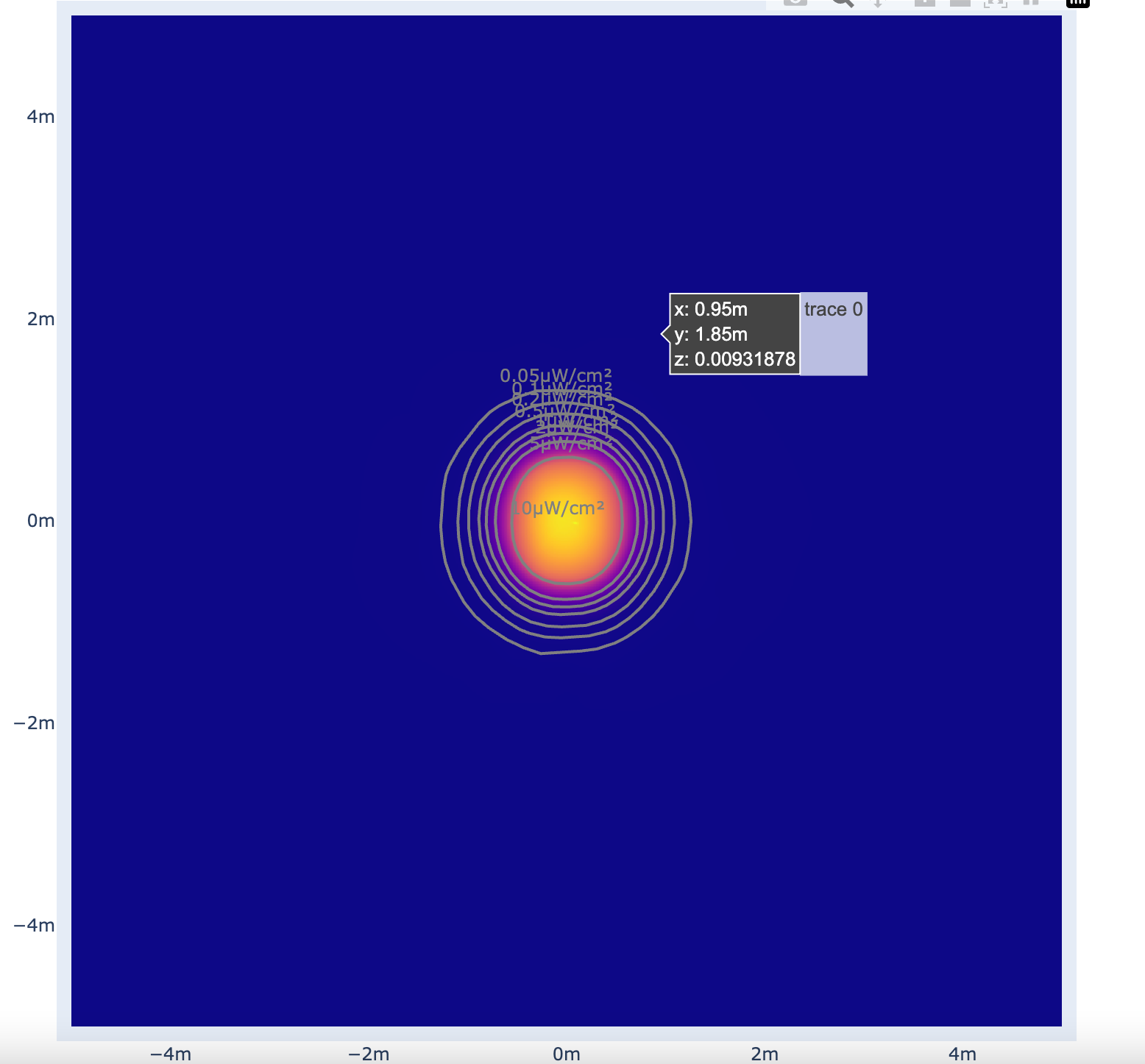
Ok, so now we have the irradiance at any given point in a room. A cross section at the height measured looks like:
Assuming that
I can only afford only ONE lamp
ignoring ventilation effects for now
I can be modelled as a 'point'
that, as a 'point' I can be modelled at a single height
and that, quite dubiously, that I am 'uniformly distributed' in the room (ie uniformly present everywhere on that heatmap on average) at the given height over a time period, then...
I can measure the
'average' irradiance by just averaging the values of irradiance in a grid.
'max' irradiance, which would be directly under the lamp.
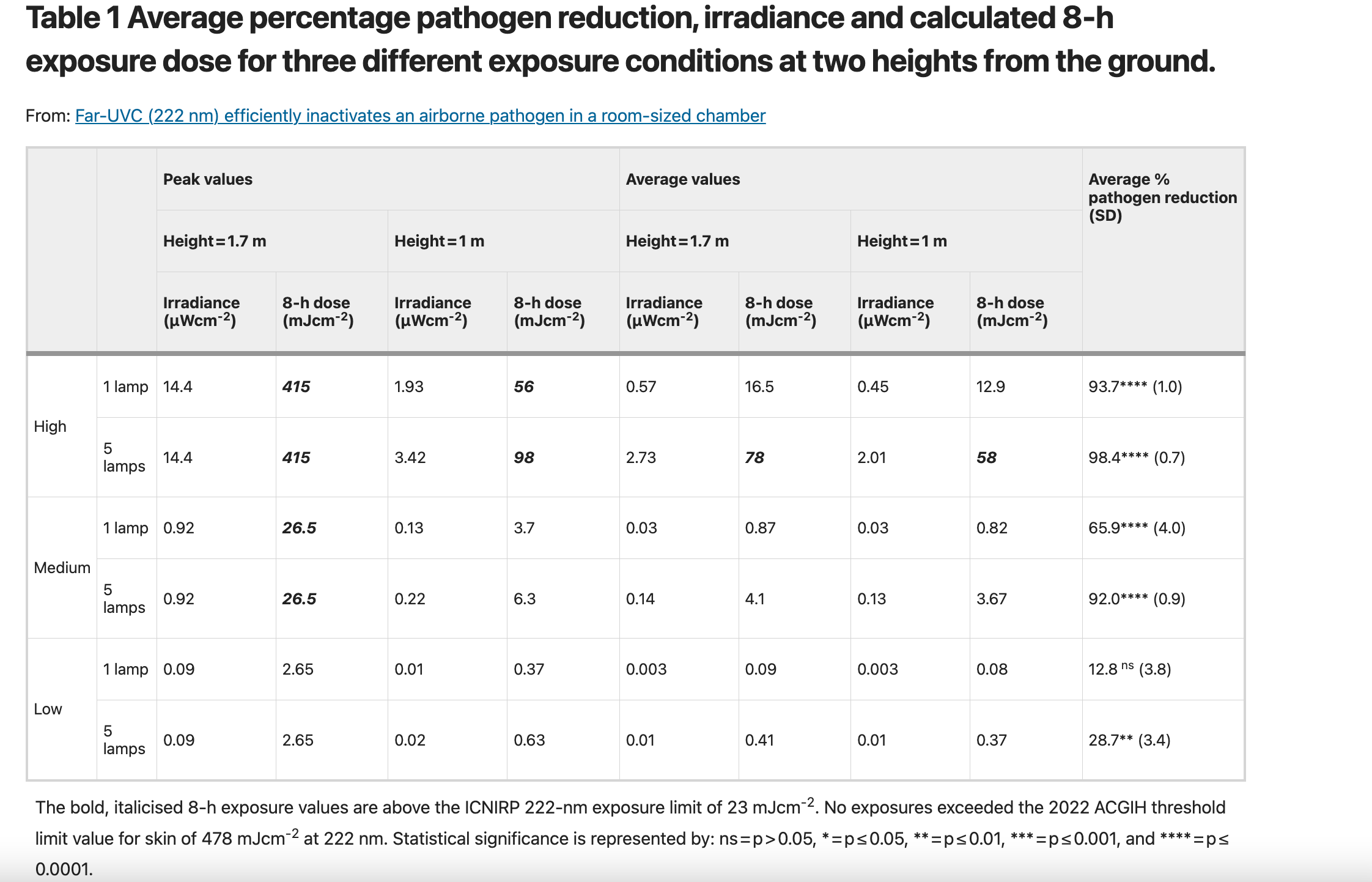
So in my case, with my given lamp, and to illustrate my point, using the following dimensions taken from Eadie, E., Hiwar, W., Fletcher, L. et al. Far-UVC (222 nm) efficiently inactivates an airborne pathogen in a room-sized chamber. Sci Rep 12, 4373 (2022).,
room_width = 3.36 # meters

room_length = 4.2 # meters

mounting_height = 2.26 # meters

target_height = 1.8 # meters, my height
Using Casual Physics Enjoyer, uvc_modelling, I get that the average irradiance and maximum irradiance from the lamp I chose is
Average irradiance at 1.7m height: 0.809 microW/cm²

Maximum irradiance at 1.7m height: 57.407 microW/cm²
So now we have an average value of irradiance of 0.809 microW/cm². Notice how different it is from the maximum irradiance of 57 microW / cm^2!
To get the max exposure in a day, multiply 8 hours = 8 60 60 seconds = 1600 mJ / cm^2
To get the average exposure in a day, multiply 8 hours = 8 60 60 seconds= 23 mJ / cm^2
Ok so, if I was standing directly under the lamp for 8 hours, I'd get 1600 mj / cm^2 of exposure in the extreme case.
Safety
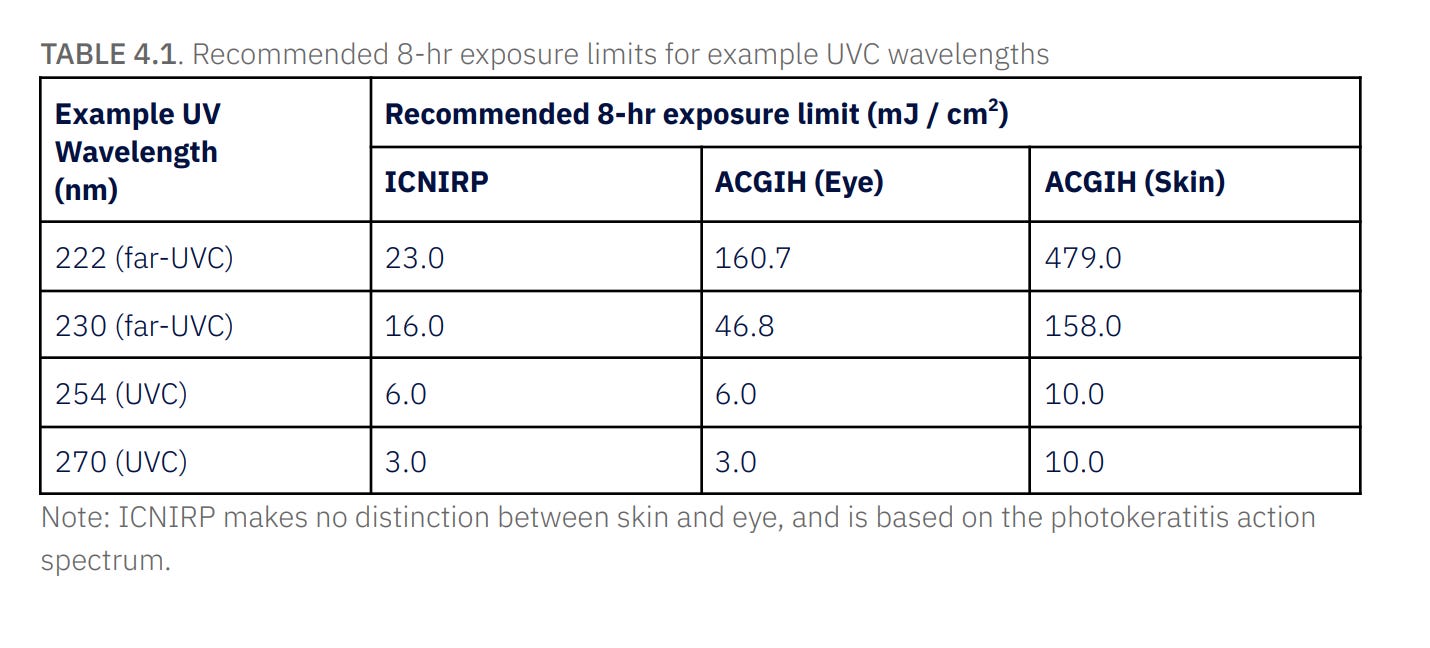
Suppose I wanted to play it super safe, I want to make sure that my max exposure level is underneath the max exposure eye guidelines from the ACGIH. From the aggregate safety data in Blueprint Biosecurity, Blueprint for Far UVC, here are the limit levels:
Ok, so let's review
With a single lamp as is
Average irradiance at 1.7m height: 0.809 microW/cm²
Maximum irradiance at 1.7m height: 57.407 microW/cm²
So need to tune down the lamp by a factor of 10% (with a dimmer / filter) to get within the eye exposure level, from the ACGIH.
*So this means that the max exposure then is reduced 150 mJ.**
So this means that the average exposure in the room then is reduced 2.3 mJ.
Now, assuming that the pathogens are mixed in this room, with the same ventilation rate (3 air changes per house) as in Eadie, E., Hiwar, W., Fletcher, L. et al. Far-UVC (222 nm) efficiently inactivates an airborne pathogen in a room-sized chamber. Sci Rep 12, 4373 (2022)., we're guessing at least an 65% average pathogen reduction based on a SUPER ROUGH GUESS BY STUPIDLY LIFTING THE RESULTS OF THE PAPER ONTO MY CONTRIVED CASE.
The main takeaway
Ok, so here are the main points I took away from doing all this, in terms of modelling and trust:
On model 'coarseness' and justification of work
I think we do actually need much better models than what I posted here, since there are sufficiently enough unknowns, that are important enough to estimate, such that it would help in a necessary way
So:
Better modelling does feel 'necessary' given the parameter ranges of the problem
Better tools do feel 'necessary'
So I guess I do agree with those suggestions of enhanced modelling by Blueprint Biosecurity, Blueprint for Far UVC
On modelling the exposure
There is a possibility that I could do harm to myself if I put the selected lamp on at full strength and stood under it for the whole day.
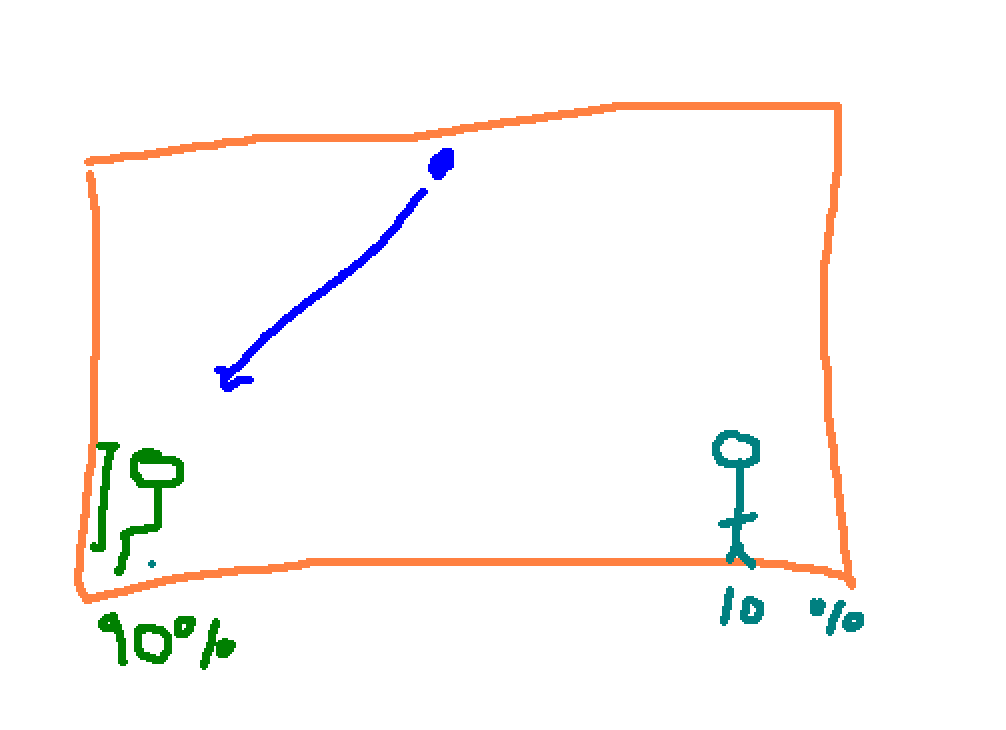
The average exposure level quoted in papers can be misleading, since we are not always, uniformly moving around the room - in my case, I am usually staying at the same point in the room doing work, so I would need a more granular irradiance number.
In the case of one lamp, average versus max exposure levels are really different, so IT WOULD BE WORTH
Modelling different ways to smooth this out by adding multiple lamps then dimming those even further. We would need to figure out an easy way to put these lamps in a simple formation to reduce the difference between peak and average.
Modelling reflectance is also worth it.
The multiplier isn't accurate because the light doesn't hit us at an angle perpendicular to the floor.
It is worth modelling reflectance too.
On ventilation + other uncertainties
I need to find a way to guess my actual air changes per hour in my house, which is where CFD would come in!
All the usual stuff around uncertainty of susceptibility, ventilation, confounding variables listed below
What would a Heuristics Document Look Like?
This exercise has helped me to also figure out - 'what would a heuristics document look like' if we somehow delivered far UVC lamps to people around the world and tried to give them instructions on how to set it up.
This was something tangible mentioned in Blueprint Biosecurity, Blueprint for Far UVC
This is a more 'product driven' engineering approach that I can structure my thinking around.
I came to this conclusion after trying to build my uncertainty tree outlined in my previous post
Help me understand more what actually needs to be modelled
Forces me to think about a base case which would be relevant
My main takeaway was
it will be challenging creating such a heuristics document for a large number of diverse environments
Here are some uncertainties that I think I would need to resolve to make sure a document was effective.
Is there any modelling work / research gap to be done on making CFD and simulations more accessible?
TO RESOLVE:
Write a first principles, easily accessible simulation from the 2003 paper on UV sterilisation []
Find models which already exist []
Try get a CFD simulation up and running [x]
What would be an ideal state to achieve?
TO RESOLVE:
Write down a document on an ideal room on conditions []
This seems fairly high priority
Replicate the paper by Eadie et all
We want a document with heuristics that are not too complicated?
What do we need to model?
TO RESOLVE:
Figure out how sensitive far UVC is to different ventilation regimes []
Figure out the range of Z values across different pathogens []
Figure out what is the strongest level of UVC that is harmful []
Figure out the level of ozone that is harmful []
Figure out if Far UVC is sensitive overall to ventilation effects []
Figure out what is the most common UVC lamp []
What would a document with heuristics look like?
TO RESOLVE:
Figure out the right template []
Figure out average hospital waiting room size in the US []
What level of simplicity should the document aim to get?
TO RESOLVE:
Ideally we test this in the field with random people, and see if they can get it set up right []
Correctness of implementation is important []
Estimates should be reasonably conservative enough to account for error []
What should a heuristics document try to acheive?
TO RESOLVE:
Figure out 'true' efficacy required []
It should outline the target reduction in pathogens that we are aiming for []
Why is it difficult to jump straight into modelling?
How can we model or estimate Z values more effectively without additional experiments?
How do we measure / estimate susceptibility of pathogens to far UVC?
TO RESOLVE:
Compile more information about Z values []
Is the tooling required for Far UVC easy enough to use, or do people demand more?
TO RESOLVE:
Create maybe a simple far UVC simulator and put it online []
Have someone actually use the Far UVC simulator in a non trivial way
Other notes: A Review of my last post + worries getting too much into modelling
I started trying to replicate the papers referenced in A Modelling System for Far UVC, but then I paused because I questioned the usefulness of that exercise
CFD is complicated
It's hard, so I need to start from the ground up
Needed to start from an even lower level of base truth
Can go into a rabbit hole of trying to model things that are either unrealistic or irrelevant
The risk about building all the tooling is that all of the work gets 'coarse grained' by the end user if they can't use the tools in the first place
You might end up just trying to model things at a level of precision that is useless
Imagine if I spent a year building some fancy tool only for no one to use! Or end up in a situation where such a tool is misused because
I've already spent 2 years doing fluid dynamics at Cambridge
The joy of doing fluid dynamics means that I might get distracted doing physics problems out of textbooks for several days instead of asking myself the real questions