On a Tube Of Hot Gas
I'm trying to find simple systems that have blurry physics. These often take me down rabbit holes which makes me question things I take for granted.
This week I came across the Crookes radiometer, which is a mill that moves when you shine light on it.¹
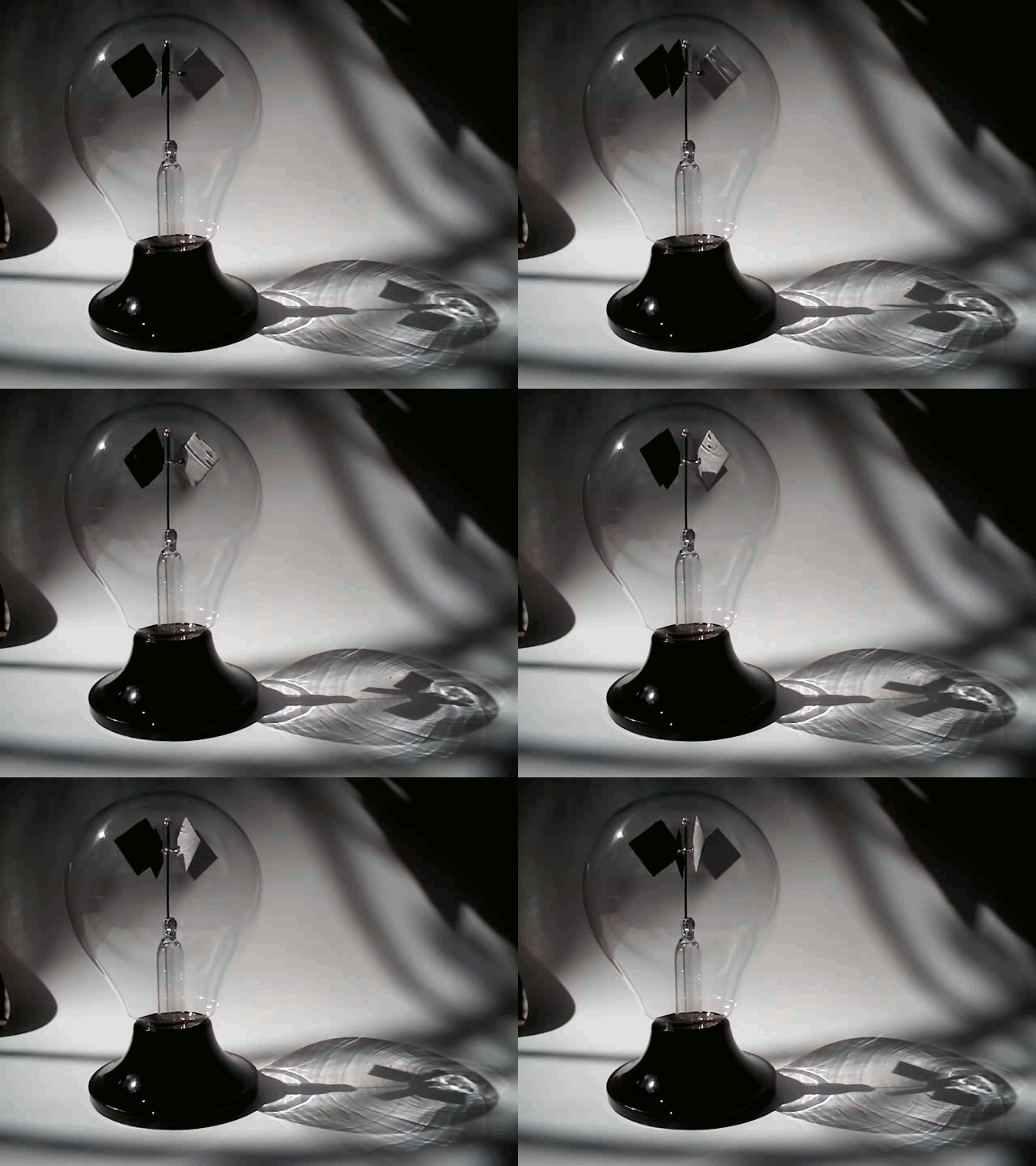
Because it moves when the light turns on and off, it was originally thought that light was the cause of the motion. The fact that light exerted pressure was suspected before the theory of photons, in classical electromagnetism.³ In Maxwell's treatise on light and electromagnetism, Maxwell quotes light as having energy:
Thus, if in strong sunlight the energy of the light which falls on one square foot is 83.4 foot pounds per second, the mean energy in one cubic foot of sunlight is about 0.0000000882 of a foot pound, and the mean pressure on a square foot is 0.0000000882 of a pound weight.
— Maxwell, A Treatise on Electricity and Magnetism (1873), §793
His argument was that light were rays that pointed in a given direction, with electric waves and magnetic waves perpendicular to that direction. These waves had energy. Maxwell's calculation for the energy of this wave was as follows:
First, it required some amount energy to move electric charges close to one another. This is because like charges repel and therefore an amount of work is required to make them close. Therefore, a charge distribution contained energy. But Gauss's law related an electric field to a charge distribution, which meant that an electric field also contained energy. A technical derivation of this in the footnote.⁴ There's also an explicit derivation by David Tong in his lectures on electromagnetism.
Note to all readers - buy this treatise!
There is one mystery about the radiometer though. In a complete vacuum, the mill doesn't move. So it can't be from the pressure of the photons, because the vanes of the mill are too heavy. It only moves in a near vacuum, but it does require some air to work. This means that it must be a thermal effect of the air that somehow involves heat. I tried to model this but I was really blurry about reasoning about hot gases and what temperature even means and ended up going down a rabbit hole .
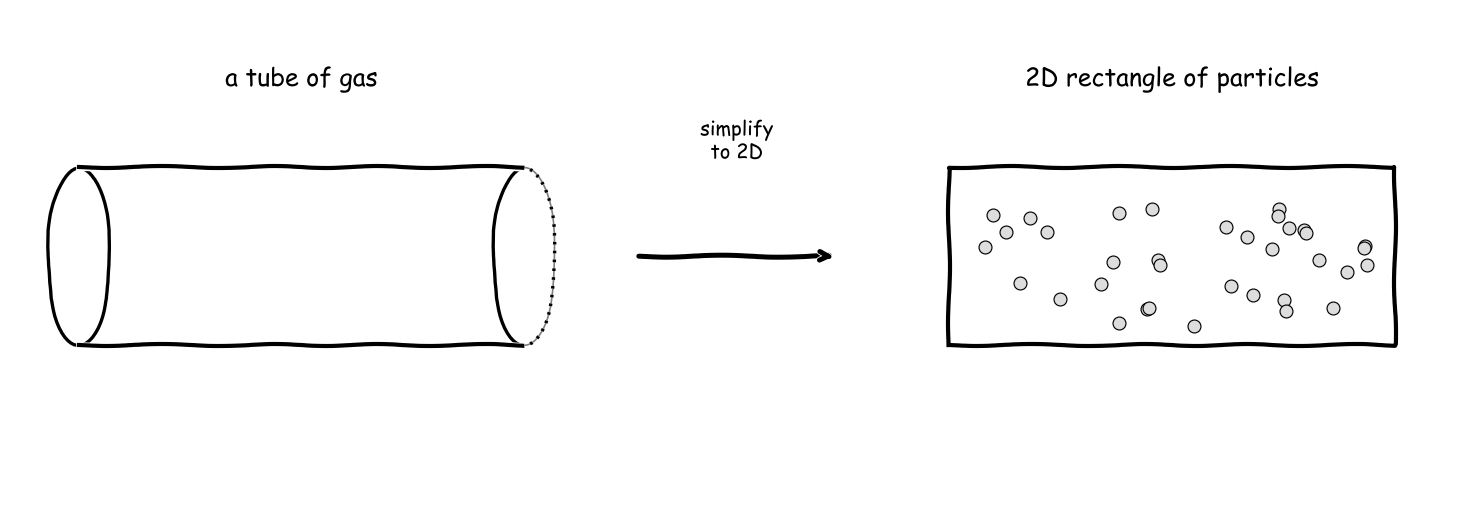
So to break this down I tried to simplify the problem and figure out how a tube of gas behaves when you make one side hot and the other side cold. One easy simplification I did was to just imagine the tube as a two dimensional box:
Ok, so what's the first thing we could measure? One thing would be temperature. You might take the idea of temperature for granted but it's actually not that obvious. We are usually taught that temperature is a function of the speed of molecules, but that doesn't sit right as a reasonable definition. Also, even if temperature was a meaningful construct, how would we know that certain physical process always occurs at a universal temperature?
Hasok Chang's Inventing Temperature is a great book that goes into the history of this. From my reading notes:
Before the 1700s, whilst people had thermometers, it wasn't clear if there was any way to calibrate them to a universal temperature. The first chapter is how people figured out if water boils at a consistent temperature. It wasn't clear that water boiled at a consistent temperature! The book goes over Henry Cavendish's supervision of the 1776 Royal Society discussions on the fixed points of temperature (Cavendish, 1776). And it wasn't clear, pre-1800s, what boiling actually was.
— my notes on Chang (2004), Inventing Temperature: Measurement and Scientific Progress, Oxford University Press. Primary source: Cavendish, H. (1776), Phil. Trans. Roy. Soc. 67, 375–420.
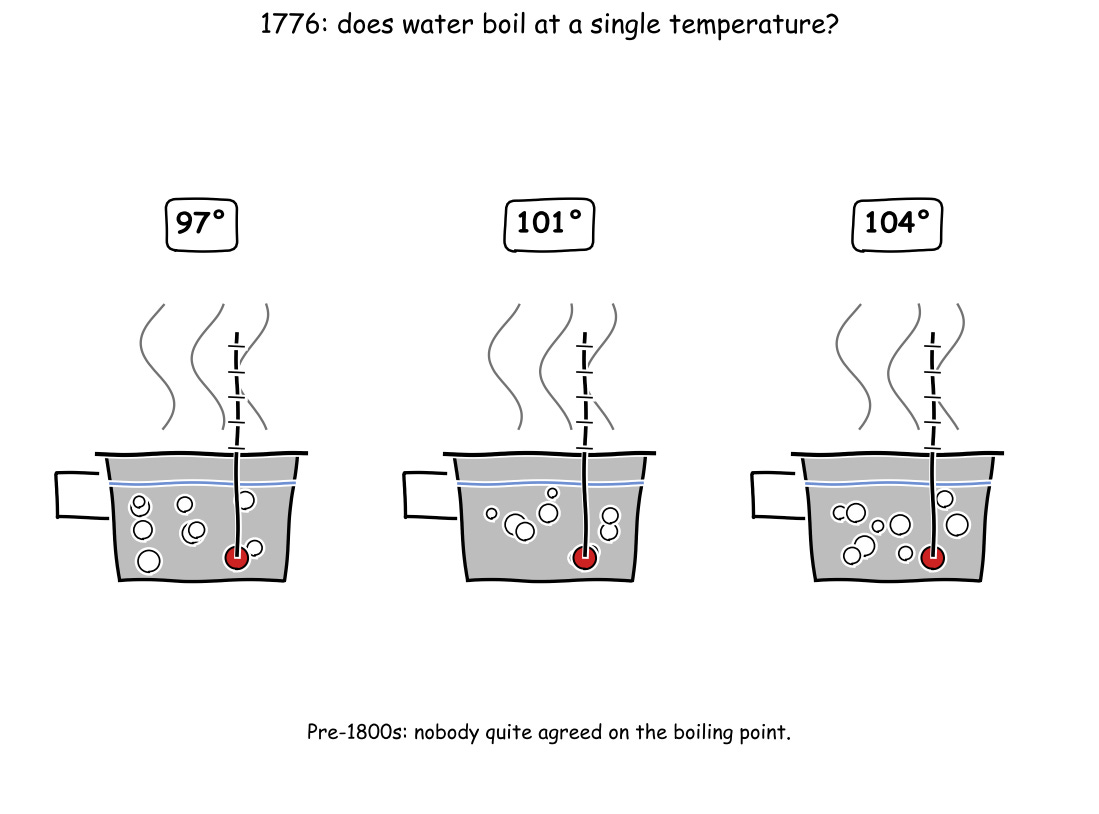
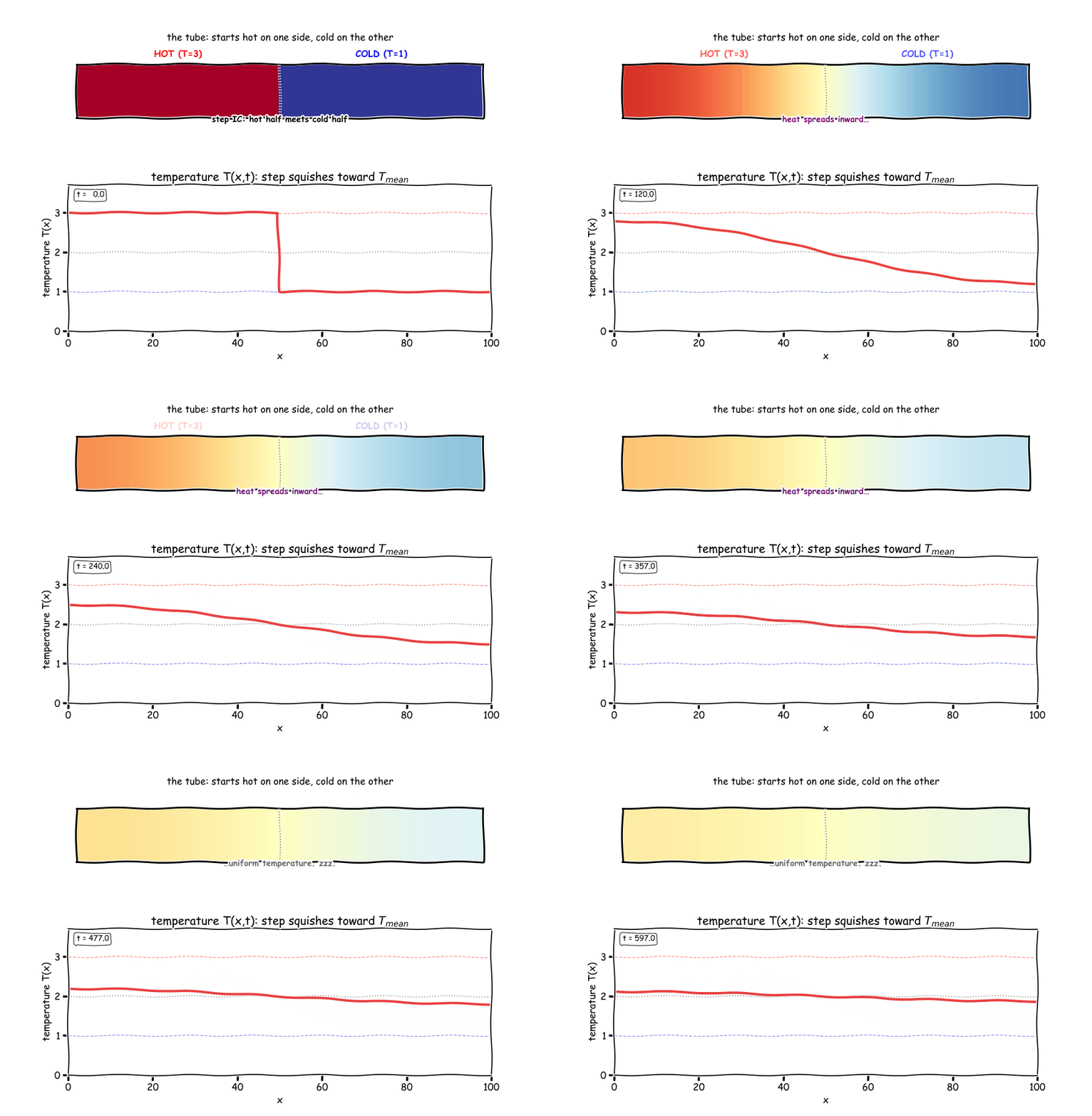
For now, let's just pretend that this thing called temperature IS well defined. And let's say someone from the Royal society gave us a thermometer that actually worked and was consistent. The first interesting thing we can do is start the system with one end cold and the other end hot, and then see how it evolves.
If we DIDN'T know anything about atoms, and just measured the temperature, this is what we would observe:
And before we go into the math, let's think about what ye people of old would have to say about this. Carnot would have said that the difference in temperature causes a 'motive' power, which means 'heat' flows from one side to another. This was originally in the context of a steam engine, where he wrote:
Wherever there exists a difference of temperature, motive power can be produced.⁵
He also would've said that this process would be irreversible. I wrote previously about irreversibility:
In classical mechanics, if you knew the state of the world with no friction, you could in theory reverse time and find out its initial state. This is because Newton’s second law is a differential equation that fully specifies a path of a system if you know the necessary initial conditions.But if you heated one side of a metal rod, stopped heating it, and then waited, the heat would spread out uniformly across it. And so, there would be no way to figure out which side you initially heated. Therefore, processes in heat couldn’t be _reversed_.
There's also more terms involved. Initially the state is not in equilibrium because the state variables are changing, but then it tends to a state of equilibrium.
Ok on to the math. Fourier originally did this experiment using a rod and some temperatures and after some math gave us the hear equation, the results of which are simulated above. T(x,t) evolves is the heat equation⁶:
$$ \frac{\partial T}{\partial t} \;=\; \alpha\,\frac{\partial^2 T}{\partial x^2} $$
But then, observations like Brownian motion were evidence that molecules existed.
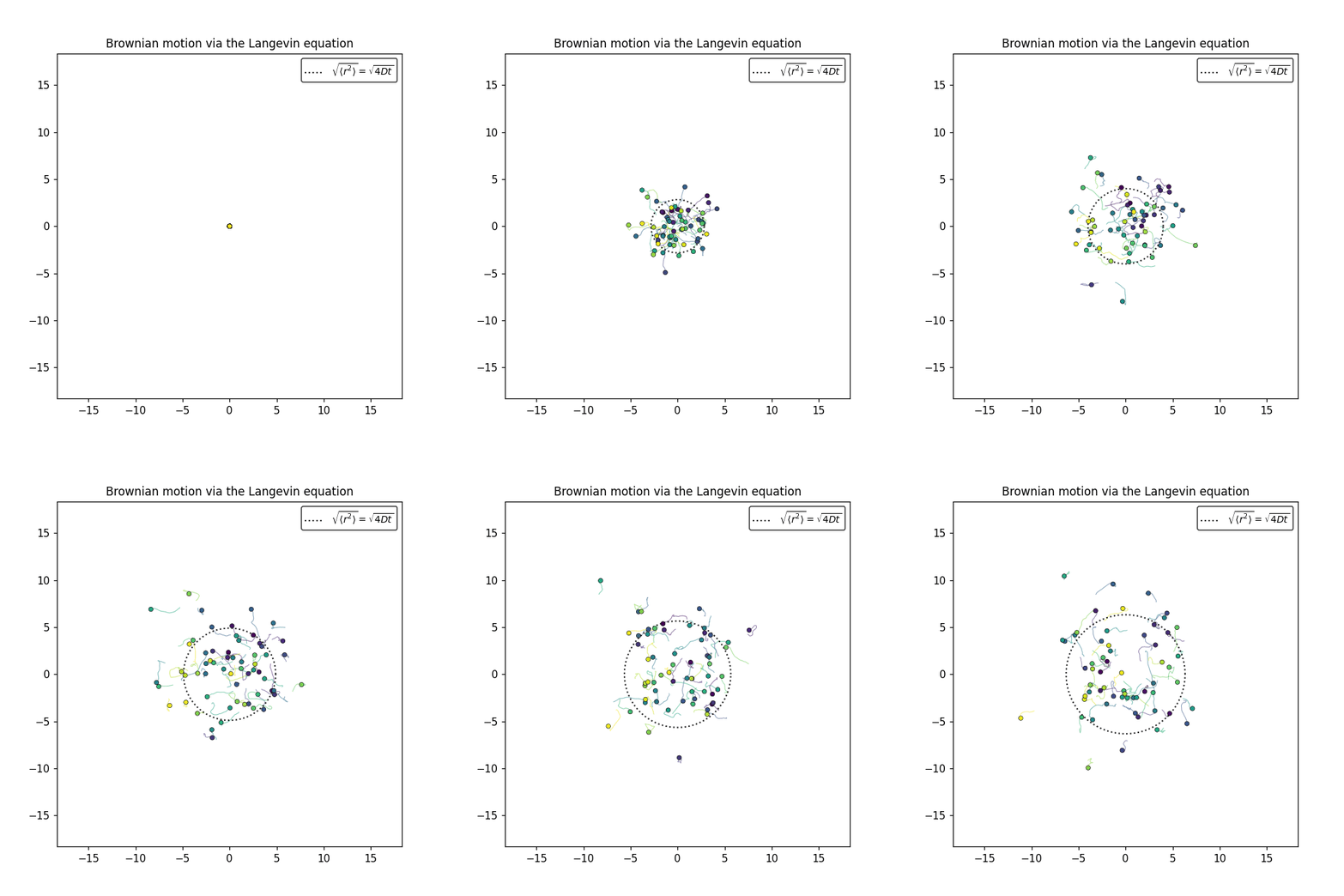
It was then Boltzmann that realised that you could relate the temperature of a gas to the average speed you'd find the molecules, according to a distribution, which I wrote about here.
For a given temperature, Boltzmann used symmetry arguments to show that given a temperature of a gas, the velocity of the particles were distributed as
$$ f(\mathbf{v}) \;=\; \left(\frac{m}{2\pi k_B T}\right)^{3/2} \exp\!\left(-\frac{m\,|\mathbf{v}|^2}{2\,k_B T}\right) $$
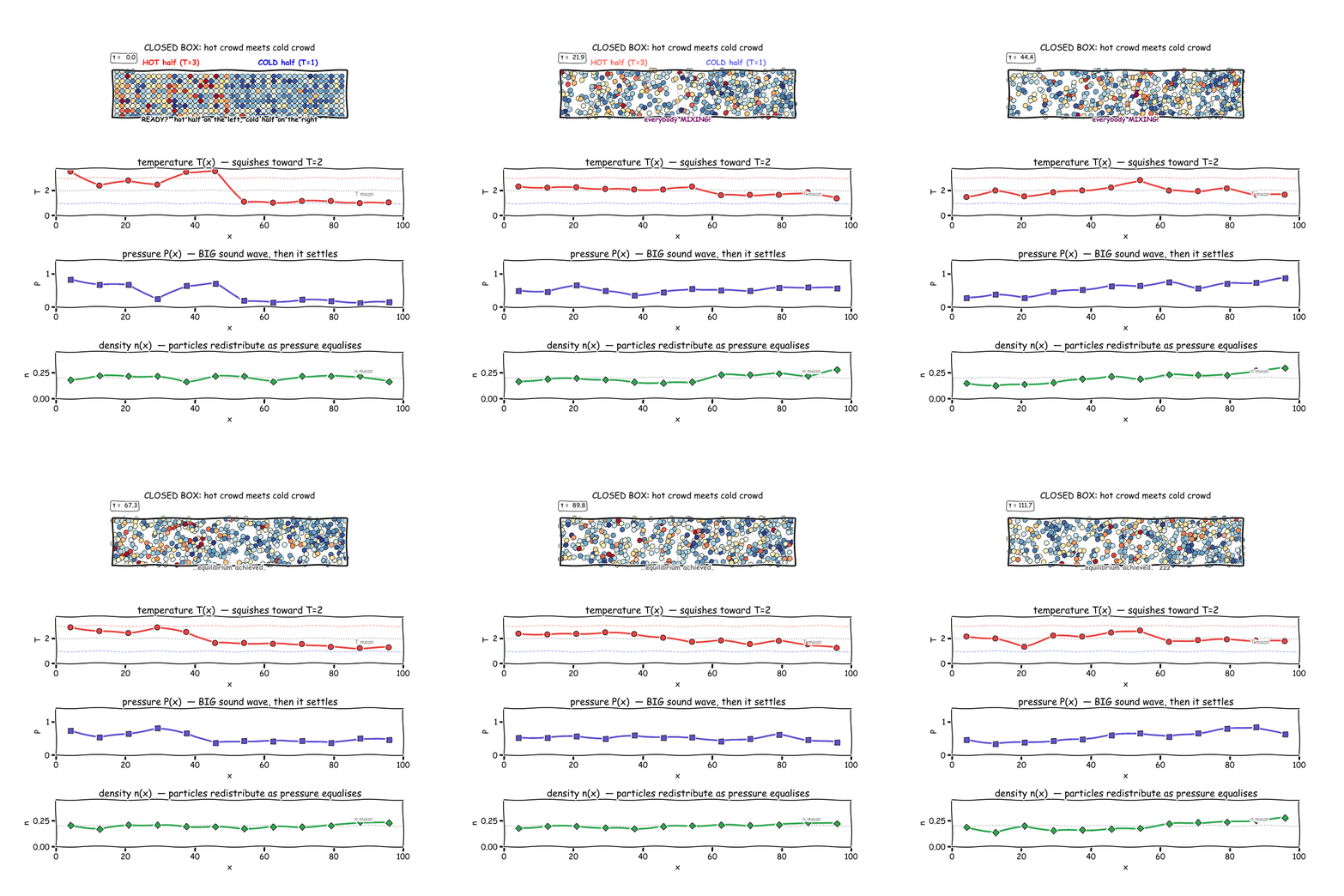
And so with some boundary conditions, I decided to try simulate the gas going to equilibrium but modelling them as particles, sampling the pressure and density as well at each point.
Ok, now that have that over with, now its time to try and simulate the thermal effects in the Crookes radiometer, lol…
¹ I worked through the radiation-pressure story in detail offline — the push is real but about a million times too weak, and it points the wrong way.
³ Photons have no mass, but they do have momentum. Light carries momentum: a photon of energy E carries momentum p = E/c. A surface absorbing power P soaks up momentum at F = P/c.
⁷ It was Rudolph Clausius who formalised the first 'non reversible quantity', called entropy, that could never decrease. He was building on the work of Carnot's Reflections on the Motive Power of Fire.
⁸ "Prigogine was one of the first to develop a framework for entropy as a local quantity, instead of global as first computed by Clausius. They are very keen on asserting the world as a non-equilibrium process."
⁹ The micro-to-macro link: Given the temperature of an ideal gas, the Maxwell–Boltzmann distribution]gives the probability distribution of the speeds of the particles." Transport coefficients follow from the number density, mean speed, and mean free path λ.
¹⁰ I tested the heated tube in other simulations as well. This was in numpy but I also used SPARTA. Without the temperature gradient, the gas distribution obeys the Maxwell Boltzmann distribution" (N₂ std(vₓ) measured 304.9 m/s vs theory 304.9 m/s).
¹¹ On externally-driven steady states: "the system receives work done on the system… so it is in a non equilibrium steady state."
² Animation by Nevit Dilmen, licensed under CC BY-SA 3.0, via Wikimedia Commons.

¹² From my [[13th April notes]]:
Really well written so far. I am enjoying it. The first chapter is how people figured out if water boils at a consistent temperature. It wasn't clear that water boiled at a consistent temperature! The book goes over Henry Cavendish's supervision of the 1776 Royal Society discussions on the fixed points of temperature (Cavendish, 1776). And it wasn't clear, pre-1800s, what boiling actually was. Now that I think of it - I don't know what boiling actually is in detail. Henry Cavendish was the first one to find stability in measure.
Full references: Chang, H. (2004). Inventing Temperature: Measurement and Scientific Progress. Oxford University Press. Cavendish, H. (1776). Report to the Royal Society committee on the fixed points of thermometers. Philosophical Transactions of the Royal Society of London, 67, 375–420.
⁵ Sadi Carnot, Réflexions sur la puissance motrice du feu et sur les machines propres à développer cette puissance (Paris: Bachelier, 1824). English translation: Reflections on the Motive Power of Heat, trans. R.H. Thurston (New York: J. Wiley, 1890). The quoted line ("Wherever there exists a difference of temperature, motive power can be produced") appears in Thurston's translation around p. 49.
⁶ AI-assisted derivation but checked by me! Where the heat equation came from. Joseph Fourier derived it in Théorie analytique de la chaleur (1822).
Step 1: Generalise Newton's law of cooling. Newton (1701) had observed that a hot body cools at a rate proportional to its temperature difference with its surroundings. Fourier applied that locally*: between any two thin neighbouring slices of material, the heat that crosses the interface per unit time is proportional to the temperature difference between them, the area of contact, and inversely to the separation. Taking the continuum limit gives Fourier's law:
$$ q \;=\; -k\,\frac{\partial T}{\partial x} $$
with k the thermal conductivity (a material constant).
Step 2: Combine with conservation of heat.* The heat content of a thin slice [x, x+dx] changes at the rate flux-in minus flux-out:
$$ \rho\,c_p\,\frac{\partial T}{\partial t} \;=\; -\frac{\partial q}{\partial x} $$
Substituting Fourier's law gives ∂T/∂t = α ∂² T/∂x² with α= k/(ρc_p).
⁴ AI-assisted derivation but checked by me! Energy stored in an electric field. Start from the electrostatic energy of a continuous charge distribution ρ(𝐫) in its own potential φ(𝐫):
$$ U = \tfrac{1}{2}\int \rho(\mathbf{r})\,\varphi(\mathbf{r})\,d^3r $$
The factor of 12 corrects for double-counting each pair. Use Gauss's law to replace ρ with ε₀ ∇·𝐄:
$$ U = \tfrac{\varepsilon_0}{2}\int (\nabla\!\cdot\!\mathbf{E})\,\varphi\,d^3r $$
Integrate by parts via ∇·(φ𝐄) = φ ∇·𝐄 + 𝐄·∇φ. The total-divergence term becomes a surface integral at infinity and vanishes for any localised distribution. With 𝐄=-∇φ, the remaining piece is -𝐄·∇φ=|𝐄|²:
$$ U = \int u_E\,d^3r, \qquad u_E = \tfrac{\varepsilon_0}{2}\,|\mathbf{E}|^2. $$
The energy that was "stored in the arrangement of charges" can be re-expressed as an integral of an energy density u_E that lives wherever the field is non-zero — there is no charge in the integrand any more. The magnetic analogue, u_B = |𝐁|²/(2μ₀), comes from the same argument applied to the work done against back-EMF when ramping up a current. For an EM wave, |𝐄|/c=|𝐁|, so u_E=u_B and the total density is ε₀|𝐄|². See David Tong's Lectures on Electromagnetism, §4.