Preliminary Thoughts on Solar Cell Efficiency
I’m on holiday with my girlfriend in Bantham, Devon, in South England. As I write this near a window, I admit that I am stunned by the beauty of the coasts of the British Isles. It is no wonder that old civilisations have competed aggressively for these shores. Devon has an expanse of farmland scenery, a beautiful estuary you can swim in, and lots of sunlight. This abundance of sunlight and space seems to have an odd connection with some of the problems I’ve been thinking about in the solar energy space.
Ideally, we’d want to use as little of this landscape as possible since solar cells tend to be jarringly unaesthetic - massive black panels sticking out unforgivingly. One solution, and perhaps the only solution, is to ramp up the efficiency of solar cells. It is no secret that photovoltaic technology is painfully inefficient, with commercial efficiency still below 30%. In this article, I’ll review some of the candidates for higher-efficiency solar cells.
Before that, though, I think it’s important to caveat that from a business perspective, racing for superior cell efficiency might not be a great predictor of success of an entrant into the solar cell technology market. I’ll draft some rough thoughts on this below.
Why should we care about solar cell efficiency?
From lurking online, I’ve noticed that a few startups have been focused on their solar cell efficiency numbers as a key metric. One firm is Oxford PV, where on their main page, we see a big masthead like so:
“Our commercial-sized perovskite-on-silicon tandem solar cell holds the world-record efficiency of 26.8%, as certified by Fraunhofer ISE”.
In the startup world, it doesn’t feel like higher efficiency necessarily equates to a magically profitable, competitive solar startup. The reasons for this relate to my thoughts about firm success in general feels of which is a broad market reasons that markets don’t care about fundamentals. Secondly, efficiency does not necessarily equate to better unit economics. One might be able to have efficient solar cells, but if the cost per watt remains high, it still renders those solar cells to be economically unviable.
I do think that, however, the efficiency of solar cells is still too low. A massive jump in efficiency, perhaps > 50%, would probably exponentially grow the sector as a whole. The reason for this would probably be more indicative of a paradigm style shift. Regardless of my views on this, I still think that looking into in efficiency and the current technology there is still a great exercise.
I am optimistic about improving computational methods to increase the efficiency of solar cells via better materials discovery. Perovskite solar cells can potentially have up to 40% efficiency. Perovskite solar cells (PSCs) are highly efficient and have great potential for next-generation photovoltaic devices due to their excellent properties. However, some challenges hinder their mass production, such as toxicity in lead-based PSCs, nonstability, and high manufacturing costs.
But why am I optimistic now as opposed to ten years ago? In trading, people look for catalysts before making a trade because large moves are necessary for large trading profit. I think that there are a few catalysts that might be in the horizon when . In particular
We now have much lower compute for electron analysis so that we can compute materials in silica.
The emergence of lower resistance wires for better transportation
There are also more market based reasons. One thing I am particularly excited about is the eof the reasons for this is that South-East Asia doesn’t seem to have many solar cells, mainly due to prohibitive costs, and a difficult political environment.
The Current Efficiency Environment
Over the past few weeks, I’ve compared different candidates for more efficient solar cells. This was hard. My prior, finger in the air guesses are currently, (where commercialisation status is completely subjective).
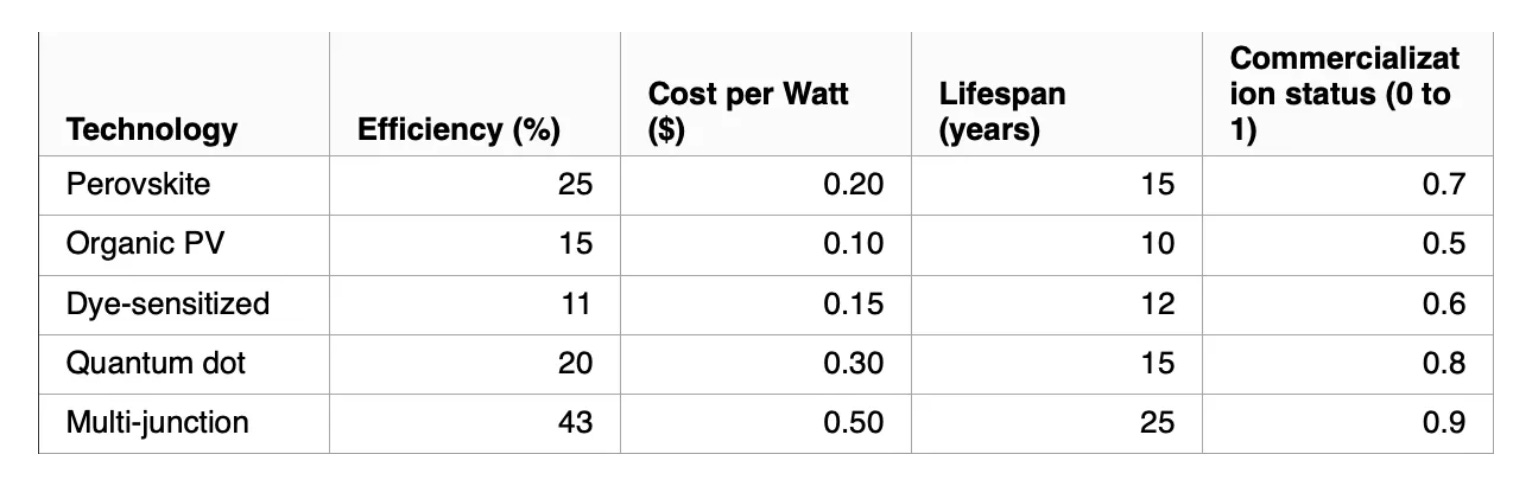
Among them, I think that I do not think that, however, that this would be an exponentially growing field with merely small efficiency gains. It didn’t stop me trying to find ways to learn more. For your entertainment, here’s me getting ghosted by a bunch of solar cell researches.
