More Thoughts on Space Solar Energy

Anticipating the cost of energy in the far future
What do we expect energy prices to be in 50 to 100 years time? Currently, electricity prices tend to be identified with natural gas prices. However, since it is likely that energy will soon come from renewable resources, I think that the prices of energy in the future will likely be more dependent on the cost of setting up and maintaining solar energy.
Previously, the problem of electricity price forecasting looked like an exercise in time-series analysis. I am not so sure that time series modelling is appropriate for a prediction problem like this one. One reason is because electricity prices are just highly correlated with natural gas prices, so I wouldn't expect any prediction of current electricity prices to carry any information about the future. Secondly, it is evident that predictions become worse the further along we forecast. I imagine that an energy price analysis for anything further than 1 year out requires a different approach. I would think that an approach from a first-principles cost analysis might be more appropriate, and this is what I'll try to write about in this post.
How much would solar satellites cost?
It would be interesting to predict some sort of cost, in today's dollars, of energy in the future. Assuming that we are in a society that is exclusively powered by solar energy, what would this be? The approach I would like to take would be to tally up the total fixed and variable costs of a functioning solar system, and then divide the total annual output of a space solar satellite by this number. This post will be a start to tallying up these costs.
So, what do I think will be the costs of a space solar energy system? Well, to me there are a few main ones. I've listed them below here.
The cost of building a solar satellite with microwave/laser transmitters.
The cost of sending something into orbit - we can figure this out through spaceX's cost of sending something into orbit. I think this is a reasonable first pass estimate since spaceX can currently deliver things into orbit cheaper than NASA can. Whilst I would like to get data on this, we can make educated estimates from news articles online. This is what I'll estimate below.
The cost of maintenance - this is probably two humans going up and fixing things every month.
For now, we'll disregard the costs associated with the antennae on Earth. However, this is still an important component of our total energy.
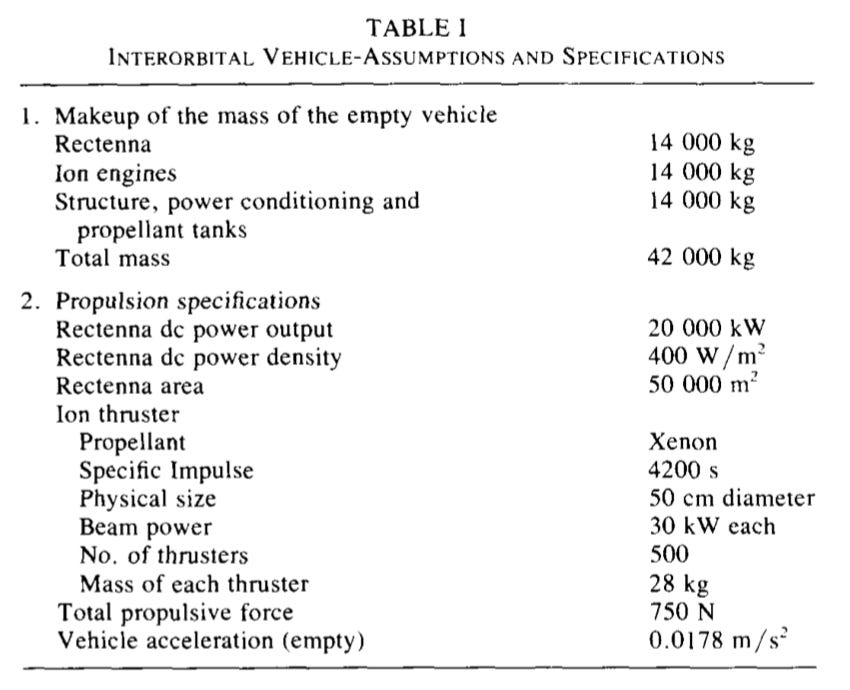
SpaceX seems to charge $2500 per kilogram of payload [2]. The first estimates from the paper [1] would place a satellite as around 14000kg for the rectenna alone, plus other components for a total of a 42, 000kg payload of a single satellite. This puts the total cost as
2500×42000=$105,000,000 per satellite
Imagine a satellite with that is around the size of a race-track. This would be a reasonable size to put in orbit, covering around 80 000m^2. Assuming that this is in helio-syncronous orbit, with a power of 1kWh every 1m^ 2this would have an energy output of the following over a year.
0.75×24×365×1kWh×80,000=525,600,000kWh
Now, assuming a launch of 1 satellite a year, this puts the cost of electricity at around 19 cents per kWh. This is already cheaper than current energy prices today.

Other notes
How likely is space solar energy in 50 years time anyway? How likely is energy storage technology?
More light hits the atmostphere but at this stage most of it is washed out by clouds. Having it in space would retain this. Apparently, only 30% of the light comes through.
The difference between laser and microwave energy lies in the wavelength that is used.
We could even put solar panels in the ocean and use wireless transmission in that context.
Could balloons be used for solar panels?
I've posted this question on lessWrong, which is a forum on rationality.
Current Progress
Caltech recently completed a proof of concept with MAPLE [3], as of June 2023, where energy was beamed to and from space with microwaves. MAPLE is one of the technologies being tested out by Space Solar Power Demonstrator (SSPD-1). The reduction in cost to launch, mainly driven by SpaceX, seems to be making these projects more and more feasible. As stated in the Caltech article, a Momentus Vigoride spacecraft launched aboard a SpaceX rocket on the Transporter-6 mission carried 50-kilogram SSPD to space.
The Current Funding Environment for Space Solar Power
Funding and research so far seems fairly concentrated. Just from first impressions, in Caltech.
Northrop Gunman - for Caltech
Donald Bren - for Caltech
In the UK, the company that is currently leading this drive is Satellite Applications catapult.
How Does it Work?
One of the components in wireless transmission consists of an RF module. An RF module, also known as a radio frequency module, is a device that enables wireless communication by utilizing radio frequency signals. It consists of several components that work together to transmit and receive data wirelessly. Here's a high-level explanation of how an RF module works. It’s
Transmitter Section:
Data Encoding: The input data, such as audio or digital signals, are encoded into a suitable format for transmission. This encoding may involve processes like modulation, which converts the baseband signals to a higher frequency range suitable for wireless transmission.
RF Oscillator: The RF module generates a carrier signal using an RF oscillator. The frequency of this carrier signal determines the RF module's operating frequency.
Modulator: The modulator combines the encoded data with the carrier signal, resulting in a modulated signal. There are different modulation techniques such as Amplitude Modulation (AM), Frequency Modulation (FM), or Phase Modulation (PM) that can be used, depending on the specific RF module design and application.
Transmitter Antenna:
Amplification: The modulated signal is then passed through a power amplifier, which boosts its power level.
Transmission: The amplified signal is fed to the transmitter antenna, which radiates the RF signals into the air.
Receiver Section:
Antenna Reception: The receiving RF module's antenna captures the transmitted RF signals from the air and converts them into electrical signals.
Low-Noise Amplifier (LNA): The received signals are weak and often accompanied by noise. The LNA amplifies the signals while minimizing the introduction of additional noise.
Demodulation: The demodulator extracts the original encoded data from the received modulated signal. It reverses the modulation process applied during transmission, recovering the baseband signals.
Data Decoding: The decoded signals are further processed to extract the original information or perform any necessary decoding operations.
Output:
The decoded data is then available at the output of the RF module for further processing or utilization, depending on the application.
In the context of wireless power transmission, an RF module operates as part of a system that wirelessly transfers electrical energy from a power source to a receiver device without the need for physical connections. Here's an overview of how an RF module can be used for wireless power transmission:
Transmitter Section:
Power Generation: The power source, such as an electrical outlet or a battery, provides electrical energy. This energy is converted into high-frequency AC (alternating current) or RF signals.
RF Amplifier: The AC or RF signals are amplified to increase their power level, ensuring efficient energy transfer.
RF Antenna: The amplified RF signals are connected to a transmitting antenna. The antenna radiates the RF signals into the surrounding space as electromagnetic waves.
Receiver Section:
Receiving Antenna: The receiving device, equipped with an RF module, has a specialized receiving antenna that captures the transmitted RF signals from the air.
RF Rectifier: The RF module contains a rectifier circuit that converts the received RF signals into DC (direct current) power.
Power Management: The DC power is further processed and managed within the RF module to ensure efficient power transfer and compatibility with the receiving device.
Power Utilization:
Energy Conversion: The RF module outputs the DC power to a load or a charging circuit within the receiving device.
Charging or Powering: The received DC power can be used to charge a battery, power electronic devices, or perform any other desired function.
Wireless power transmission using RF modules relies on the principle of resonant coupling or electromagnetic induction. The transmitting and receiving antennas are designed to resonate at the same frequency, allowing efficient energy transfer between them. This resonance helps overcome the limitations of power loss over distance.
It's important to note that wireless power transmission using RF modules is still an active area of research and development. Different techniques and technologies, such as near-field or far-field wireless power transfer, are being explored to improve efficiency, range, and safety in wireless charging applications.
References
[1] W.C Brown, Beamed Microwave Power Transmission and its Application to Space
[2] https://www.nbcnews.com/science/space/space-launch-costs-growing-business-industry-rcna23488
[3] https://www.caltech.edu/about/news/in-a-first-caltechs-space-solar-power-demonstrator-wirelessly-transmits-power-in-space
[4]