Solar Energy from the Sahara.
Tl;dr
Previously, I did have previous optimism about space-based solar energy being viable. However, my current view is that it is unlikely that we will require space-based solar energy in the medium term if governments attempt earth-based solar energy collaboratively to begin with. I would place my probability that we would resort to needing space-based solar energy by 2100 as 1%. In this post, I develop a simple upper bound for how much land we need to meet the Earth’s energy demands. This has some practical implications, such as reallocating academic research funding to other sources or investing in other, more pertinent forms of energy technology. However, I find it likely, with a 50% chance, that a toy model might be in production by 2050. I’ll expand on that in another post.
Motivations - Purely Personal Reasons
This is not that important - you can skip this, but hopefully, I can convince you that solar science is fun and worth exploring!
I find energy forecasting interesting. From just an academic point of view, I like physics, and there is a nice aesthetic to the physics of batteries and solar power in particular. I also like the economic and policy considerations involved in providing cheap and sustainable energy to all. To dig in on how solar batteries and photovoltaic cells worked, one of the subjects I had to learn was condensed matter physics, a field of physics that I find most beautiful for its utility and its aesthetic. A nice resource on energy storage that I found was R.A. Huggins, Energy Storage. For the condensed matter physics side, Ashcroft and Mermin is one of the canonical textbooks in the area. I also did math and physics at Cambridge, which helped my understanding.
In general, I think that enjoying the aesthetic of something makes you more likely to stick to it. From a utilitarian standpoint, I also think knowing where the wind is blowing regarding energy strategy is useful. For example, suppose one had a level of conviction that energy cost would tend to zero in the future - I guess this might encourage people to spend more in the present to offset future energy savings. One topic that I have debated at length with my peers is the topic of space-based solar energy. I also briefly chatted with Satellite Applications Catapult for their views.
An update on Space Solar Energy research
Last year, I wrote a post on the viability of space solar energy to power our Earth’s energy demand. Space-based solar energy refers to several proposed systems that use microwaves to transmit power from solar panels in space, down to rectennae on earth wirelessly. Currently, wireless transmission at close range is possible. It sounds like a pretty sexy idea, and the technology required is actively developing. There is also an exciting moonshot-style startup ecosystem dedicated to space-based solar energy in the UK. I also maintain that the energy output from space-based solar energy would be unfathomably large. Before writing this article, Caltech completed a nice proof of concept that beamed some microwave energy down.
An Upper Bound on Solar Energy Output from Earth
Now, even if space-based solar power is viable, does that then mean it is necessary? This is a tough question - because what does necessary even mean? I think a sensible interpretation of the word necessary would be the following -
Under what conditions would we have greater demand than the Earth’s renewable energy resources can supply?
It would be useful to answer this question by offering an upper bound on how much energy we could get from solar cells, assuming nice conditions and perfect distribution. I’ll start by outlining a toy example highlighting the relative possible solar energy output, just on Earth. After all, it is much easier to harvest solar energy from Earth than beam it down from space. As a caveat, though, even if we had perfect conditions to harvest solar energy, this discussion is limited because we still haven’t built enough capacity to store it reliably. Even after that, we would still need to find a way to get enough copper for effective distribution.
One of the merits of space solar energy is that storage wouldn’t be strictly necessary because the energy output would be continuous.
Is There Enough Land on the Sahara to Power Earth?
The Sahara desert has lots of space and sun - so let’s do a little thought experiment. Relative to the size of the Sahara desert, how many solar panels would we need to power the Earth’s energy demand? In the analysis below, I am missing out on many factors we must consider, but I thought this illustration was useful.
In 2022, world electricity demand was around 28kTWh. I took the power of a typical solar panel that you would get in the UK, along with the size it takes up in square meters. was actually pretty difficult to find, and I am unsure that these kinds of solar panels are the natural candidate you could use in the Sahara. A typical solar panel could probably produce around 8 hours of sunlight.
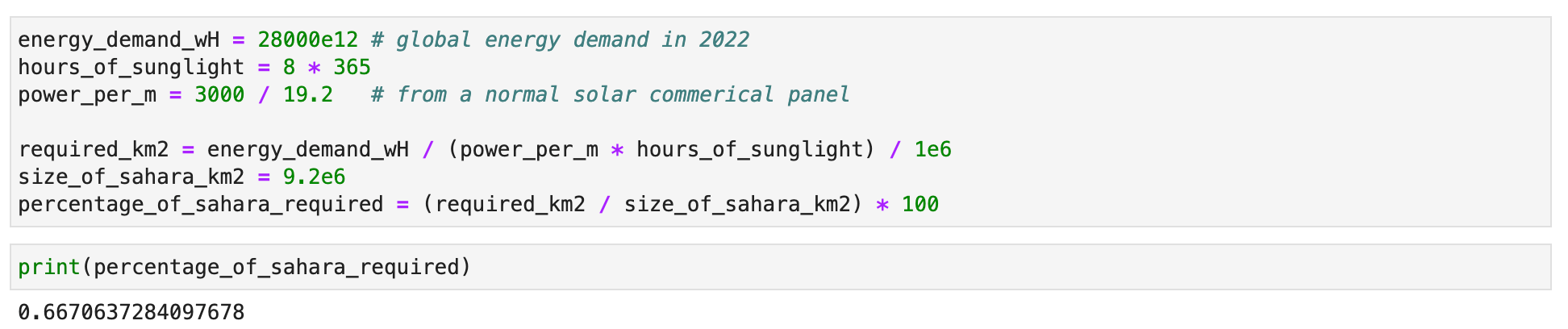
Even though these assumptions are quite generous, it’s still surprising to see how little of the Sahara one needs to take up to meet global energy demand. The requirement above is only .7% of the area of the Sahara. Given that this is such a small fraction, I think there is likely enough land on Earth, assuming perfect distribution and storage, to power the Earth’s energy demand. I feel like we should build more and more solar panels at this point and see where it takes us.
The State of Solar Tech that could help us get there
I have some cautious optimism about some of the following solar technologies below, I plan to write a review on some of the physics and data / successes behind the following approaches
Solar Flow Batteries: These are devices that integrate photovoltaic cells and flow batteries in a single unit. They convert and store solar energy in a highly efficient and flexible way. Current research is focused on improving efficiency, scalability, and lifespan, as well as developing novel redox couples and exploring new ways to integrate the photovoltaic and battery components.
Hybrid Solar Cells: Research is ongoing into hybrid solar cells that combine multiple materials (e.g., organic, inorganic, perovskite) to enhance the efficiency and stability of solar batteries. For example, perovskite/silicon tandem solar cells have recently attracted significant attention due to their potential for high efficiency.
Photoelectrochemical (PEC) Cells: PEC cells convert solar energy into chemical energy (hydrogen) via water splitting. The challenge is to develop cost-effective and efficient materials for the photoanode, photocathode, and catalysts.
Solar Thermal Storage: In this technology, solar energy is stored in the form of heat, which can be converted back into electricity when needed. Current research focuses on developing new thermal storage materials and systems with high energy density and efficiency.
Solid-State Batteries: While not exclusive to solar batteries, solid-state batteries are a significant area of research for energy storage. They promise higher energy density and safety compared to liquid-based batteries. Researchers are exploring how these can be integrated with solar cells for efficient and safe energy storage.
Emerging Photovoltaic Materials: Researchers are continually seeking new materials for photovoltaics that could offer higher efficiency or lower cost than currently dominant silicon-based cells. Examples include perovskites, quantum dots, and organic photovoltaic materials.
Artificial Photosynthesis: This involves creating devices that mimic the natural process of photosynthesis to store solar energy in chemical bonds, typically by producing hydrogen from water or converting CO2 into fuels. This is a complex challenge that involves materials science, catalysis, and engineering.
Machine Learning and AI: Machine learning and AI are increasingly being used to accelerate the discovery of new materials and configurations for solar batteries, and to optimize their performance.