The Triumph Of The Embryo
I am interested in how structure arises from disorder. This is why embryology is particularly fascinating to me, because it’s about how biological structure emerges from a fertilised egg. The Triumph of the Embryo by Lewis Wolpert [1] is a book about the developmental biology of embryos. It is written clearly for non-specialists like me, and has beautiful illustrations by Deborah Skinner.
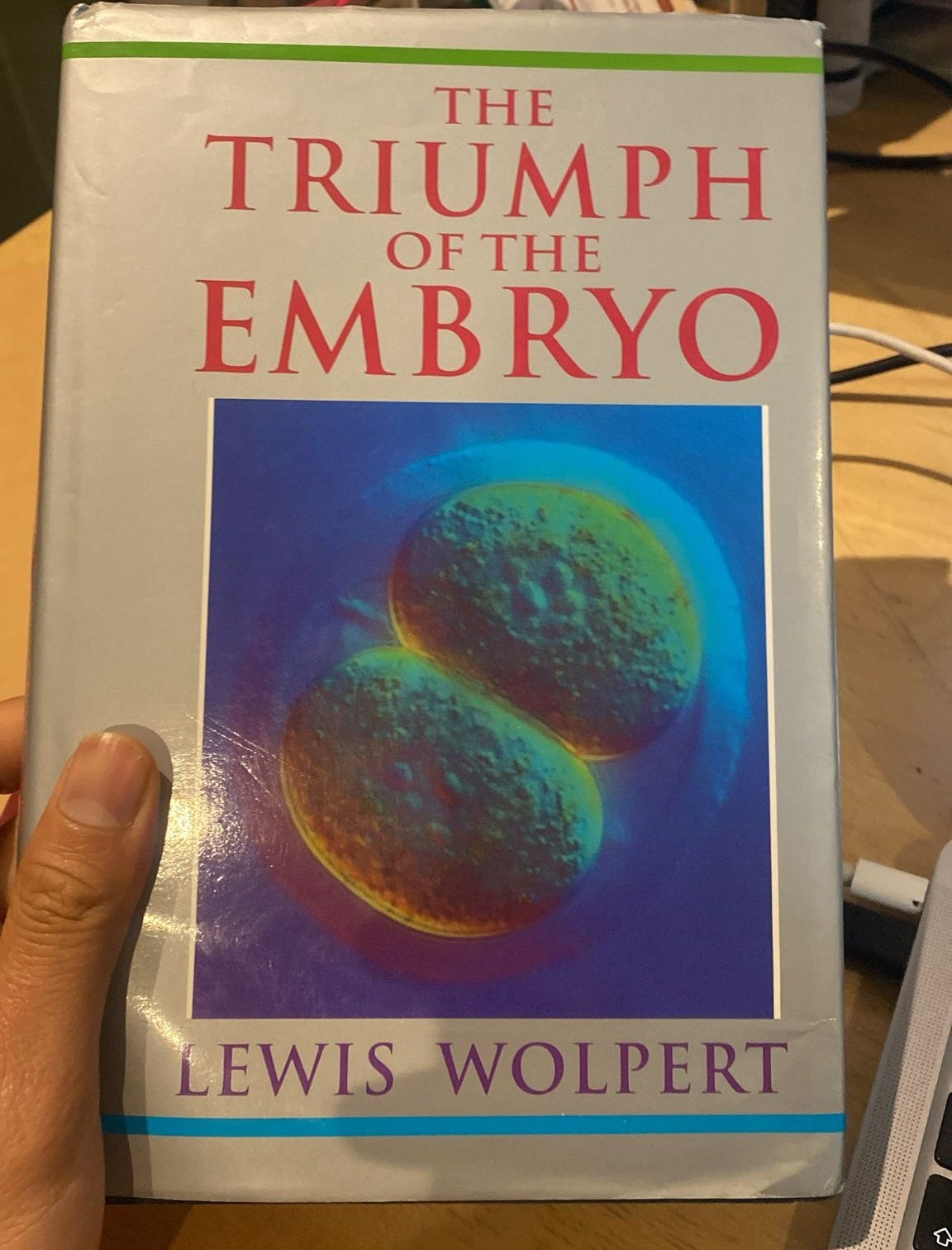
I’m not an expert on this topic, but I wanted to write some parts of the book that have stuck out. None of this is my original work of course.
I learned that the most important event for an embryo is gastrulation. Wolpert himself famously said that “it is not birth, marriage, or death, but gastrulation, which is truly the most important time in your life” [1, p. 12]. A newly fertilised egg soon becomes a blastula, which is a spherical ball of cells. Gastrulation is when this ball of cells develops a form, which begins with the formation of the gut. To do this, cells move inward and take a different type, moulding the blastula to look like this:
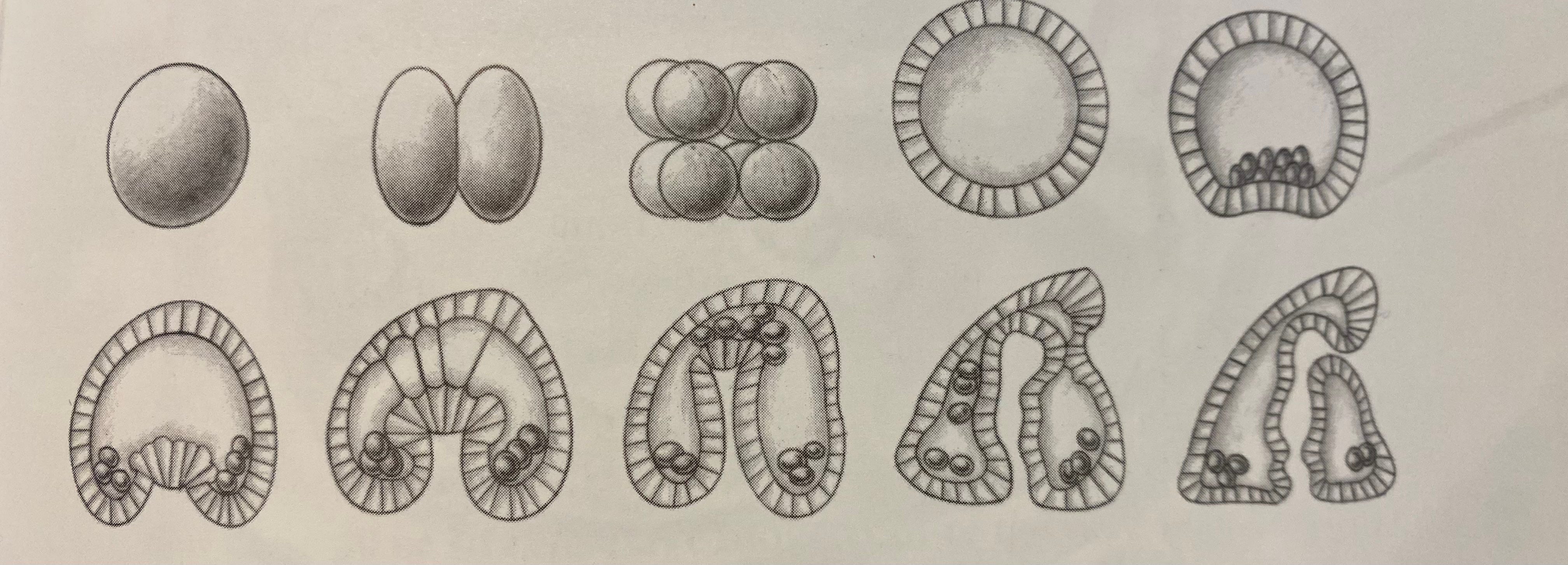
As a mathematician, this to me is a case of biological symmetry breaking. Initially the blastula has a spherical symmetry, but then this breaks and the embryo becomes cylindrically symmetric, approaching the topology of a torus. An exercise to the reader; what Hamiltonian, if any, exhibits symmetry breaking from a sphere to C2?
On the empirical side of things, I learned that the history of embryology started during the time of the Greeks. Aristotle was amongst the first to investigate the development of embryos by cracking open fertilised chicken embryos [3]. And there was a debate until the 19th century about whether embryos came pre-formed, or developed throughout time (epigenesis) [1, Ch. 1].
One useful thing I learned is about the ease of using sea urchin embryos as a model study. Wolpert says that these are popular amongst developmental biologists because they’re easily available [1, Ch. 3]. The embryos are transparent, so you can easily see the development through a microscope. I’ve been thinking a lot about how I could do this safely at home too. More on that in a future post.
References
[1] Wolpert, L. (1991). The Triumph of the Embryo. Illustrated by D. Skinner. Oxford University Press.
[2] Aristotle. Generation of Animals (De Generatione Animalium). Translated by A. L. Peck. Loeb Classical Library, Harvard University Press, 1942.