What is our natural Rate of Extinction?
Will we go extinct before we can see the current edge of our universe?
As a child, I was always curious to know how long we could expect the human race to last before the next mass extinction event. Why is this an important thing to consider? Considering that the speed of light travels only so far, an upper bound on an extinction event would give us insight into how much information we could get from the universe. The following is a crude example but illustrates what I mean. If you knew that you were going to die in the next 1 hour, and cars had a speed limit of 50 kilometres an hour, then clearly you’ll never find out what people living further than 50 kilometres from your house think of you.
The same limits apply to the speed of light. If our upper bound for surviving as the human race is X, then to the first order, we shouldn’t expect to learn anything about cosmological objects which are more than X * c away, where x is the speed of light. So, how far is this distance? The paper [1], which I will discuss below, places an upper bound on the rate of extinction rate as 1/87000 annually. We can use this as an extinction rate. We model the lifespan of the human race as an exponential distribution. We can see the probability that we live to see up to a time t in the future is given by

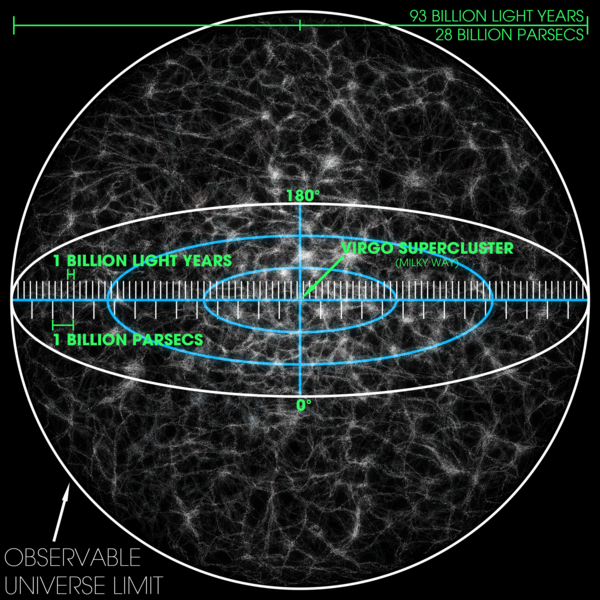
The radius of the observable universe is around 46.4 billion light-years. This distance means that it will take us approximately 46.4 billion years to see the light at the boundary of this sphere. The probability then that we successfully observe the edge of the currently observable universe is what we get when we substitute the values in.

This number is so tiny that it’s essentially zero — we have no chance of seeing what’s happening right now on the edge of the observable universe.
Estimating the Upper Bound
How would we estimate a potential upper bound for the lifetime of the human race? It is far from obvious. In my view, there are pretty much only two clear approaches. The first approach is to try and find some big aggregate of catastrophic events that might happen and estimate the total probability. However, this kind of approach is both challenging and uncertain around the probability estimates.
I was reading a paper about an upper bound using a different approach. Instead of examining all of the separate ways we could go extinct, the article “An upper bound for the background rate of human extinction” uses estimates of our current lifespan as the human race to estimate the rate itself. The paper is written by Andrew E. Snyder-Beattie, Toby Ord and Michael B. Bonsall.
One pitfall of getting an estimate using this method is called observation selection bias. Observation selection bias skews observers’ estimates about the state of the world when the observation of specific phenomena is directly incompatible with the observer’s existence. For example, consider an alien planet that has lasted for a billion years. Suppose that is now trying to estimate the probability of getting hit by a meteor shower. The fact that it is still alive necessarily means that it is part of a sample that a meteor shower has never hit, and so is likely to have a bias in estimating the actual rate based on its history alone.
The basic approach of the paper is to maximise the likelihood function of the parameter mu — which is the rate of extinction we would like to estimate. The likelihood function computes the probability that homo-sapiens have lasted this long, given a variable value of mu. The lower case t in the equation below can be substituted with your estimate of how long homo-sapiens have lasted.

With the paper’s current estimate of the length of our existence, they find that
Assuming a 200 thousand year (kyr) survival time, we can be exceptionally confident that rates do not exceed 6.9 × 10⁻⁵
In the case of human extinction, this observation bias effect comes from the fact that there might have been previous humans on this Earth before us, but those humans haven’t lived long enough yet to make observations. Hence, we need to come up with a modified likelihood function that is conditional on the human race having enough means to record their own observations. I would like to go into a bit more detail on these modifications in a later post.
References
[1] Snyder-Beattie AE, Ord T, Bonsall MB. An upper bound for the background rate of human extinction [published correction appears in Sci Rep. 2019 Dec 11;9(1):19222]. Sci Rep. 2019;9(1):11054. Published 2019 Jul 30. doi:10.1038/s41598–019–47540–7