Teaching Cambridge-Level Math At Scale (Without Charging $150k)
I've been part of a team trying to build an effective independent science community. Our goal is seeing people on our discord meaningfully contribute to open science problems in academia. There are a whole host of pressing problems that require researchers. And it would be cool if anyone in the world could turn themself into an effective scientific researcher.
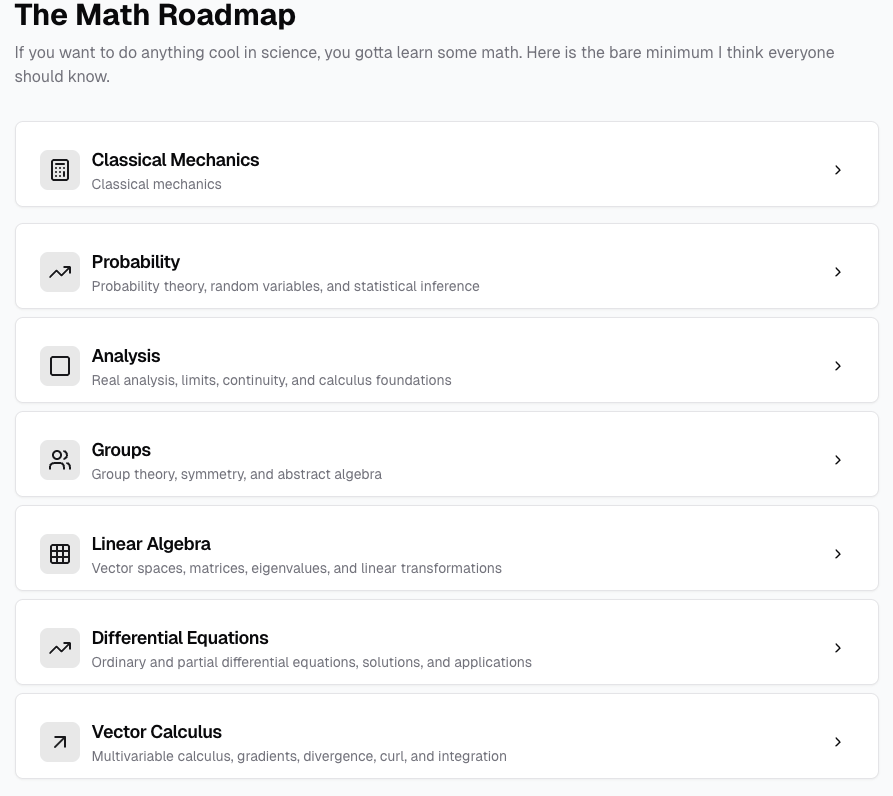
But, the main blocker is skills gaps. In the case of physical sciences, the hump most people have to get over is getting good at 1st year undergraduate math. This is absolutely essential, and a bare minimum threshold. This means that they should be able to solve problems at the introductory level in these areas.
But the problem is, learning math correctly is expensive, because university is expensive. A lot of people I spoke to in the discord don't have access to learn quality math at university (they live in developing countries), and so have to go abroad.
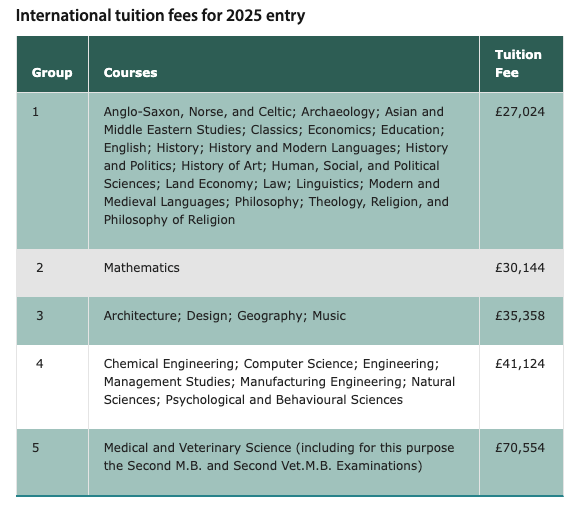
But, going abroad is expensive. Take Cambridge for example. All in all, it's about $40k for locals, but $150k for international students to do the three year Cambridge math course. Its 90k for the course alone, plus 30k for 'college fees'. Add in living expenses, and you have something that most people can't afford.
Is there a way to do it at scale? And for hella cheap?!
In math, correctness matters the most, and the whole point of this course is to build rigour so you know when to stop and ask yourself 'is this right'? So you need a way for experts to check people's work. As such, the main thing about Cambridge's teaching system is supervisions, which are one-on-ones with experts that give students personalised advice.
So, I wanted to see how I could do offer supervisions at scale, for cheaps.
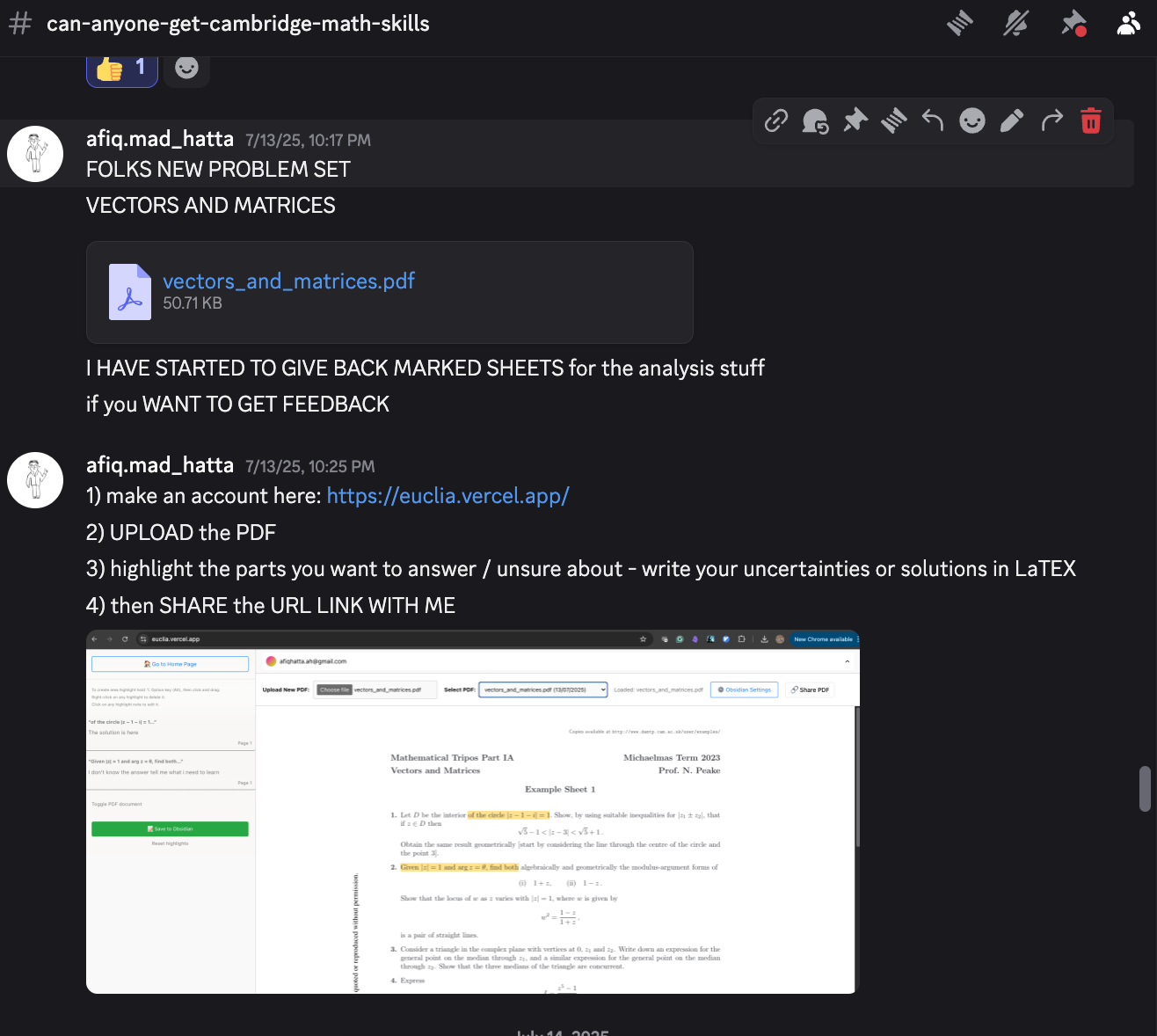
I tried setting weekly math problems on a group my discord, and tried to 'supervise' people. I learned quickly that doing this at scale, is hard. There is just too much math my brain has to do in short times to make it practical. One way I tried to make this more efficient was through a collaborative PDF tool I wrote, called Euclia, where people submitted problem sheets back and forth with annotations. I started off with Analysis, then moved into Linear Algebra and Quantum Mechanics. I've never done tutoring before, and was surprised with how much energy it takes.
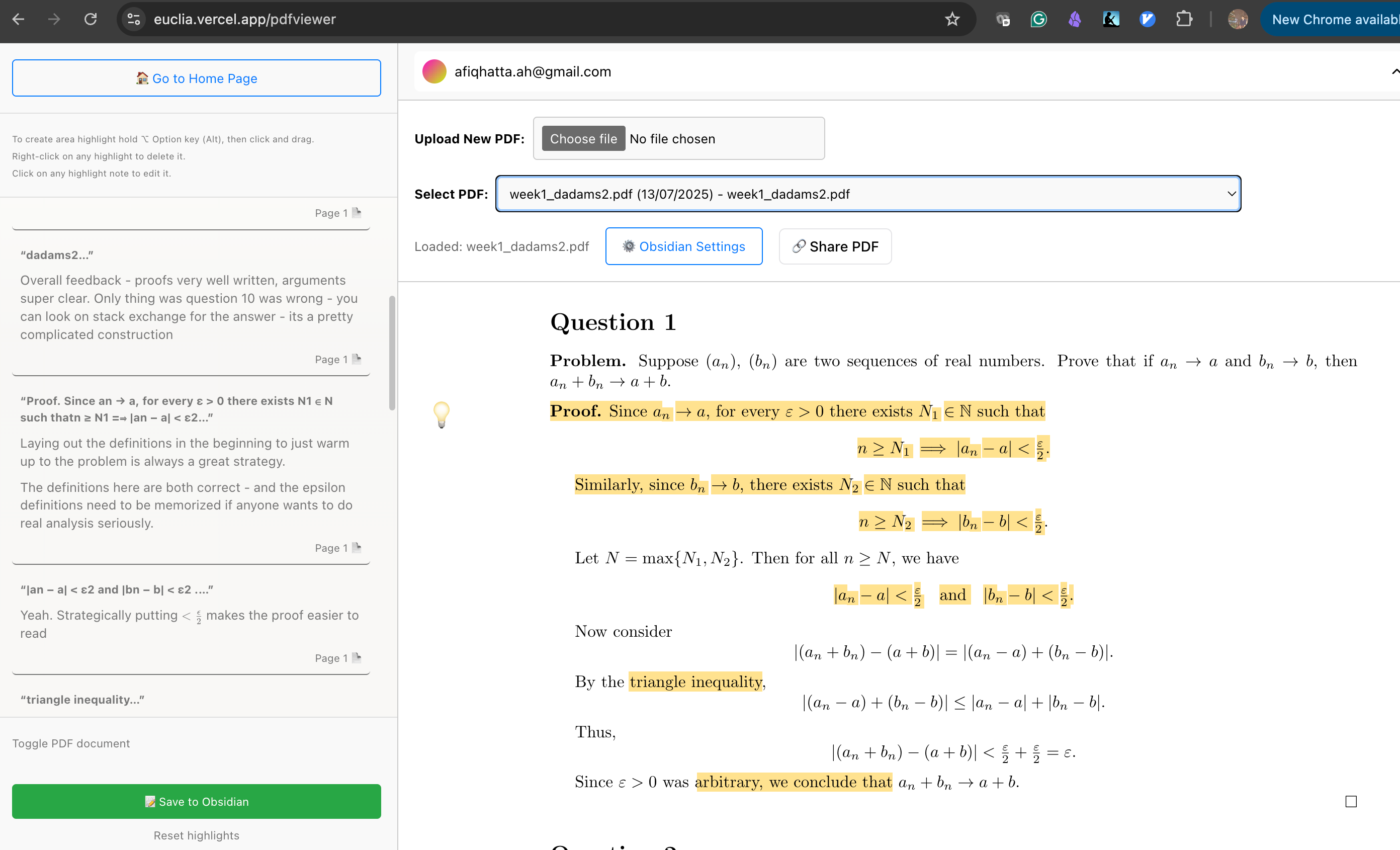
Around 20 people participated, which is great, but the hard part is that it takes a lot of energy to check people's problems. People are also shy, and have to work to your schedule.
I see no reason why we can't make technology to offer personalised, university level math supervisions at scale in the near future, especially with LLMs. Brilliant.org and Khan Academy are already trying to do this for K-12.
What would we need for tertiary level math?
A key part of this looks like using AI to help explain stuff, like ChatGPT study mode.
But since we still have the LLM hallucination problem, I'm also really excited about using proof assistants like Lean and PhysLean to verify correctness.
These languages throw errors when incorrect logical statements are written, and could be used as homework markers.
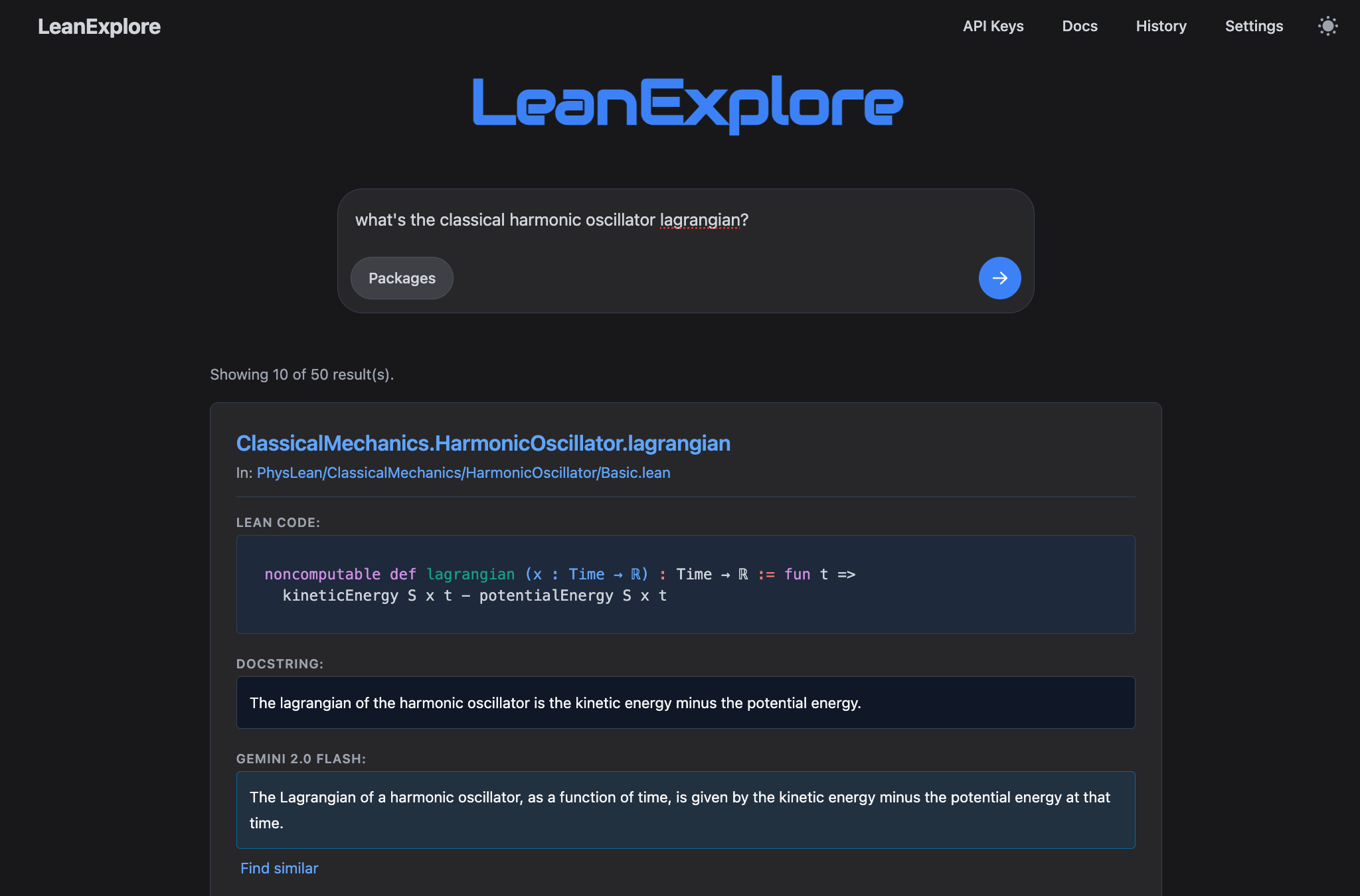
On the physics Lean side, there still is work to be done in contributing physical theorems and lemmas to the language. Lean is also pretty hard to learn, and once this gets more developed, I would be excited at the thought of making interfaces to make it easier for students to interact with it helpfully, making better interfaces like they’ve done at LeanExplore.
If you're interested in building things like these please feel free to get in touch!
Acknowledgements
Thanks to Jess Carr for the discussions on math teaching! And thanks to Joseph Tooby-Smith, the founder of PhysLean, for introducing it to me!
Disclaimer: This project is not affiliated with, endorsed by, or sponsored by the University of Cambridge. “Cambridge” is used only to describe the style and level of mathematical content, inspired by publicly available curricula.