Turning my Passion into a Job was a Bad Idea
It’s a common story - picture your average young professional, someone doing a nine-to-five job to pay the bills to fund some sort of passion on the side. It might be a consultant doing food reviews, a banker selling cupcakes, or a computer scientist developing Effective Altruism. Recently, with the wave of resignations and quiet quitting during COVID, we hear soundscapes that suggest that the image has gotten more extreme. Soon, the person manages to take their passion more seriously (opening a delivery service for their cupcakes, for example) and turns it into a job.
Now, a hobby that you like AND pays the bills? Sounds pretty ideal, right? Well, I tried, and no, it is not perfect.
From 2021 to 2023, my efforts to pursue passion projects more seriously have been a bad decision - whilst they offered small monetary gain, they have not increased my life satisfaction or enjoyment in line with the added time dedicated to them. I pursued blog writing as an income source on Medium and authoring a book. Hobbies, side interests, and exploration should stay as they are - distractions. Turning them into income sources doesn’t make them hobbies - it makes them, well, jobs. I have convinced myself that the temptation of transforming passions into more serious pursuits dampens their contribution to the ‘good life’ feeling. This is at odds with societal caricatures - I can’t count the number of times I’ve heard about someone in real life trying to pursue the caricature of a jaded banker now finding solace in quinoa farming in the countryside. But are these banker-turned-quinoa farmers happier? I am not convinced.
The explanation above seems obvious in hindsight, but I couldn’t convince myself that this was true without doing some natural experiment or analysis.
The Experience
I like physics, and not just because of the satisfaction with solving problems you’d get with any quantitative subject. For lack of better words, I like the content and the weird God-like aesthetic of learning about nature. When I graduated from school in 2021, I started to blog about physics once every two days because I worked full-time as a quantitative trader. At this point, it was just a hobby, and there wasn’t much time after work. Soon after, I felt the urge to ‘turn this into something bigger’, something monetizable. In hindsight, I couldn’t justify rigorously why I needed to do this - I felt that I needed to go all the way on my pursuits, thinking I’d get more out of it. In my brain, my mental model went something like this:
If I wasn’t excelling, making money from it, or competing at a high level → it wasn’t worth pursuing.
The problem is when I started making small amounts of money and a steady following. Here’s some data about when I started. Notice the dip after the initial spike? Yep, that’s when I started to enjoy writing less and less.
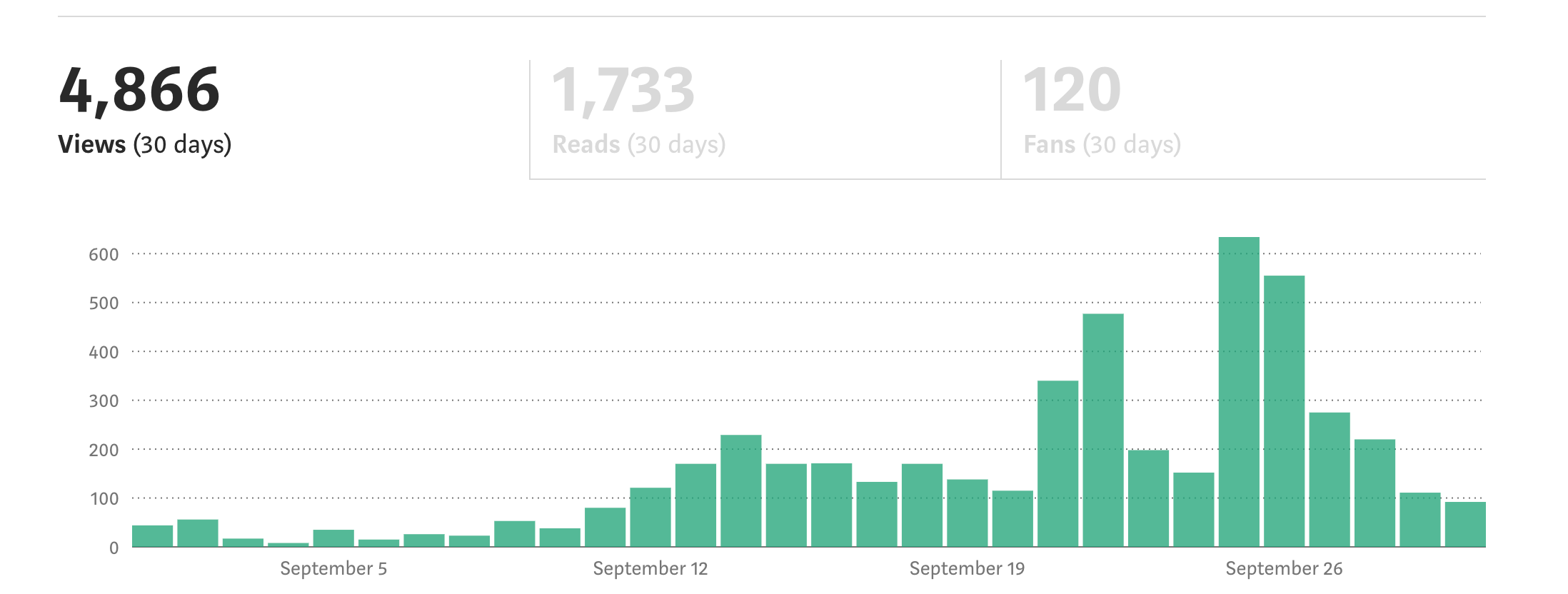
Medium’s reward system incentivises writers to produce as much as possible. What started with writing every week turned into trying to get a new article out every day. The transition got even worse when I got offered a book deal for my book, The Language of Symmetry. After the book deal, I stopped deriving joy from blogging about physics, and ultimately, I stopped writing for a long period after that - from the summer of 2022, till 2023.
Now, is this because I burned out, or because of some weird interaction effect with having set goal? More notes below.
What went wrong?
I think that happiness from a hobby stems not necessarily just from the activity itself, but the ‘directedness’ of the activity. More precisely, I think the value of leisure has a significant beta on the activity itself being ‘purposeless’. It seems to do something with the state of being engrossed in an activity for the sake of its aesthetic. The problem with pursuing a hobby or a passion as a serious thing is that it provides an end goal - but ironically, think that spoils exactly what is the source of the happiness. This idea - of ‘purposiveness without purpose’ is expanded in “How Much is Enough” [2]. Maybe this is kinda like in Kant’s aesthetics [3]. To first order, it feels like creating an external goal itself ruins the experience of leisure.
Let’s take a look at some data. The leisure time study by Wang and Wong [1] looks at the relationship of general life satisfaction as a function of leisure time and the type of leisure undertaken. The paper references previous studies that “People feel happy when they have excellent health, have high family income, are married (living with a spouse), and have children in the household.” and that there is a beta to leisure time as well! This seems obvious. But crucially, I think that the claim below, from the paper
“In terms of the meaning of leisure, individuals who often use their leisure time to develop important skills or establish useful contacts tend to report a higher level of happiness”
is false. My basic model is that life satisfaction derived from leisure is a function of another crucial factor - how purposeless it is. Crucially, this leisure term can be negative if purposeless is now.
General life satisfaction = Regular Factors + f( time in leisure, “Purposive Purposelessness” of activity ).
Now, the problem, with this claim is that it feels impossible to prove. This might be true for me, but is it true in general? That’s the question! To verify this claim, we’d have to look at the happiness of the population who took a passion and turned it into something more, and check whether they were happier. But I do think there are reasonable proxies embedded in the data.
[1] asserts that satisfaction from leisure does not depend significantly on the amount time spent doing the leisure activity. This is consistent with the claims I made above - people who spend more time are more likely to have some embedded goal, the pursuit of which offsets the extra utility that they get from the extra time they spend on it. When time in leisure is large, goal pursuit is also likely to be large, and so satisfaction is likely to be low. In the below, I would expect that goal pursuit and time are both related to each other, and indeed are functions of one another, so estimating the parameters is likely to be difficult.

More thoughts to follow.
Mitigating factors
Was I unhappy because of the act of monetisation - or because my endeavour to monetise was not successful?
Succeeding in competition does bring me happiness.
This is quite a personal experience, and the problem is that its hard to find a framework to test this in general.
Dataset
The dataset is here from the ISSP 2007 - "Leisure Time & Sports" survey:
Reference
[1] Happiness from Leisure time is not a function of time of Leisure spent, but rather the type of leisure.
Wang, Miao and Wong, M. C. Sunny, "Leisure and Happiness in the U.S.: Evidence from Survey Data" (2011). Economics Faculty Research and Publications. 202. https://epublications.marquette.edu/econ_fac/202
[2] Skidelsky, Edward, and Skidelsky, Robert. How Much is Enough?: Money and the Good Life. Illustrated, reprint edition. Penguin UK, 2012. ISBN 0141969008, 9780141969008. 272 pages.