A TL-DR for Basic Group Theory
What I wished I knew as a Math Undergrad (with no talent for math)
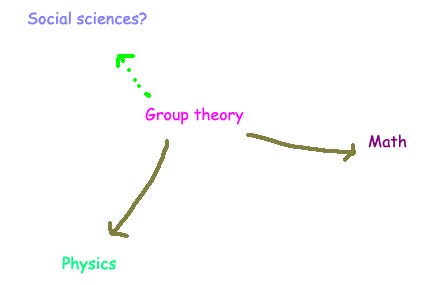
My previous essays have described the role of symmetry and order in physics. Whilst the lines between mathematics and physics are now incredibly blurred, the science of classifying symmetries into rigorous and well-defined objects was primarily the domain of mathematicians. This study is known as group theory, or abstract algebra. It is now a wide reaching field of rich research with applications in anything from physics, computer science, geometry, number theory and topology. I wonder if there will be any strong links with the social sciences in the future.
Prioritisation is a skill I definitely lacked when I was younger, and I wanted to write some posts about what I wish I prioritised in my undergraduate years learning math. I wanted to start with group theory. In my opinion, a person wanting to learn basic group theory should learn a few key theorems and then build their understanding of groups around that. This I think is sensible for two reasons. Firstly, it frees up space in our memory for more important things. Secondly, it forces our brains to find the pieces of information that are the most reusable, and hence the most important.