Geometry as the Theatre of Physics
What is a manifold, and how do physicists use it?
In my modern physics classes, I learned the importance of understanding shapes. Shapes are essential because they set the stage where interesting physics can play out — they dictate the symmetry and dynamics of any physical system. A shape is any geometrical object, and luckily in physics, they tend to be smooth.

This article is going to be about manifolds. Manifolds are a type of shape that are used repeatedly in physics for their friendly properties. Namely, they allow us to paste on a set of coordinates in any place. Moreover, a manifold can encode helpful information on their surfaces. This information is crucial to understanding why objects move the way they do.
The use of manifolds is ubiquitous across pretty much every field of modern physics. Of course, I studied it most rigorously in geometrically intense subjects like general relativity, but it also pops up frequently in particle physics all the time.
But firstly, however, we're going to talk about the most straightforward shape of all — open space.
The physics we learnt in high school probably involved the most basic shape there is — open space. When we say open space, we tend to mean either a two or three-dimensional space extending to infinity. In three dimensional cases, this is like being an astronaut in space with nothing around you. This kind of open space is called 'Euclidean space'. More specifically, mathematicians call two-dimensional open space R² and three-dimensional open space R³. The R stands for the 'real numbers', and the 2 or 3 represents the copies you need to specify a location in the space.
This space is called Euclidean space because we can easily measure the distance between any given two points with what is called the Euclidean metric. For example, if the distance between points A and B were x in the x-axis, y in the y-axis, and z in the z-axis, then the total distance between those points would simply be x² + y² + z².
Most importantly, the notion of Euclidean space is of critical importance for us because it is easy for mathematicians to construct a set of coordinates that can uniquely define our position at any point in space. You did this all the time in high school. If I gave you a blank piece of paper, and we both decided on a common origin, I could point you to a specific place by giving you two sets of coordinates. For example, I could say 'show me where (1, 3) is', and you would know where to find it.
It is of utmost importance that one can construct coordinates on a space — it allows us to talk about where things are! This is not something we should take for granted. For example, take a circle. Is it so obvious that I can give you coordinates to properly locate something on a circle? Maybe, maybe not. It's also not obvious if I can do the same thing on a sphere or a doughnut.
What is a manifold?
The problems above bring us to the topic of manifolds. A manifold is a geometrical shape where locally, it looks like 'open space' in either one, two, three, or any number of dimensions. The word locally translates to, 'in the approximate area around any given point'. The word locally is used in contrast to globally, which means 'viewed as a whole'. This distinction between local and global is essential, and I will give an example in the following paragraph.
The example of a standing human on the surface of a sphere is the easiest one. We know that the sphere as a whole doesn't look like an open space — so globally, it doesn't look like R² or R³. However, does this conclusion remain true when we look at a specific point? The story changes! Standing right now — the space around me seems pretty darn flat to me. If I look around, it looks like I'm standing on a flat two-dimensional surface, which is why it is easy initially to believe that the world is flat. So, we have that locally, in an area around any point of a sphere, it looks like R². So, in three dimensions, a manifold M is a shape that looks like a' flat plane' from the perspective of a creature standing on its surface.
At every 'neighbourhood' on this manifold, some mapping takes the area around a point and makes it look like an open space. If the open space is of dimension n, an object is called an n-dimensional manifold. For example, whilst a sphere is a three-dimensional object, the flat area at any point on its surface locally only looks like a flat plane of two dimensions. So, we say that the sphere is a two-dimensional manifold. Similarly, a circle looks like a one dimensional manifold since any slice of the circle looks like a line.
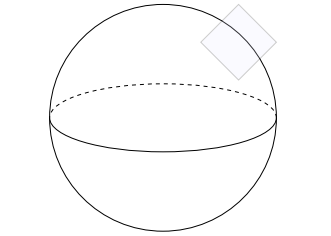
If you've managed to read the last three paragraphs and are feeling a little stressed about why I'm going on about this, you are not alone. Now, why go through the effort in defining an object like this? Being able to map local areas to open space allows us to stick on a set of coordinates to orient ourselves. For example, I can look around me — I am sitting at my desk in London. If I want to travel to Hyde Park, I can pull out a map, and that map has a coordinate system that I can use to get there. This ability to place coordinates locally at any point on Earth is what makes a sphere a manifold.
There are plenty of examples that are not manifolds. For example, take a cube. Whilst the faces on the cube are locally like R², there is a problem at the cube's corners. At the corners of the cube, there is no smooth way to assign a coordinate system that makes the shape look like a flat space if you happen to be standing at the corners.
In mathematics, there is a significant amount of study on determining when an object is a manifold. Again, this is important because we often need to understand when it is possible to place a set of coordinates in physics. For example, there is a slew of proofs and embedding theorems in math that decide when a curve in space is a legitimate manifold or not. These are the kinds of problems that inspired theorems like that of Nash's embedding theorem.
What can we do with manifolds? Lie Groups and Tangent Vectors
What was the point in being able to define coordinates at different points? Well, there are some things in math and physics that you just cannot do unless you have a well defined coordinate system at a point. This is why manifolds are so important to us.
Now that we have a smooth coordinate system on this manifold at any given point, we can define objects like curves and functions. For example, a function on a manifold is like a' heatmap' — at any point on the manifold, I can give you a number. Now, because there is a coordinate system attached at any point, there are several fundamental mathematical concepts that have now become well defined. For example:
We can determine if functions on a manifold are smooth by checking if the function is what we call differentiable.
We can also define 'tangent spaces'. For example, in the diagram of the sphere in the previous section, a tangent space is the rectangle attached on the side of the surface. It represents the space that of what an ant on the surface would experience. Tangent spaces are essential building blocks used in general relativity and modern presentations of classical mechanics to understand how objects naturally flow from one point in the manifold to another point.
In addition, there are symmetry structures in physics that are also manifolds themselves. These are called Lie groups. The concept behind a Lie group is actually reasonably simple. Lie groups are mathematical objects that describe smooth transformations. For example, the symmetry group of rotations of an object are a Lie group because rotation is a 'smooth' transformation. By smooth, it means that I can rotate an object just a tiny bit. On the other hand, transformations like reflections don't have this smoothness property associated with them. So you can't reflect something 'just a tiny bit'.
Now, the reason why Lie groups are manifolds is a little more subtle. Think about rotating an object. The instructions I can give you when you turn it is just the degrees you need to rotate it by. The number of degrees is between 0 and 360. The number of degrees is also the exact amount of information I need to point you to a specific place on a circle. But wait, a circle is also a manifold in itself!
This identification of the symmetry group with a particular shape is what makes Lie groups unique. Hence, they are of utmost importance in looking at symmetry structures in particle physics. A specific type of Lie group, called semi-simple Lie groups, have been classified into several distinct families. It turns out we can organise all finite semi-simple Lie algebras over into four infinite families denoted An, Bn, Cn, Dn, where n ∈ N with five exceptional cases: Lie algebras denoted E6, E7, E8, G2 and G4. This system is called the Cartan classification for Lie algebras.
So, a Lie group is a group of continuous transformations, which depends smoothly on n given parameters, say. Since it takes n parameters to define a transformation in this group, we could also interpret this as an n-dimensional manifold.
Classifying manifolds
Mathematicians like to organise and classify different mathematical objects. Classification is helpful because it helps us identify which shapes or manifolds are genuinely distinct. We can classify manifolds by some of their topological properties. A topological property is a type of property that is just 'inherent' to a given shape. In the following few points, I'll We'll outline them here.
Connectedness is the property in which we can construct a smooth path from anywhere in the manifold to any other point. Thus, for example, a sphere is connected, but a manifold whose set of points is two spheres is not.
Simply connectedness is subtly different from connectedness. It comes from the concept of a homotopy group. A space is 'simply connected' if any loop on the surface can be continuously deformed to a point. Something that's not simply connected is a solid torus; since we can' tie a string' around the centre doughnut.
Compactness is when we can cover a space with a finite amount of subsets. In layman terms, this means that the object is not 'infinite', like plain open space. A sphere, for example, is compact. On the other hand, an infinite line, which itself is a manifold, is not compact. This condition is equivalent to saying that if we're embedding the space in R³, the subset is closed and bounded. So, for example, a quadratic curve on R is not a compact manifold since it's not bounded.
Wrap up
I hope this article was a nice introduction to what a manifold is and how it can be used in modern physics! Stay tuned for more. I host a physics blog here if you're interested to learn more!
References
[1] Introduction to Smooth Manifolds, John Lee, 2012 DOI: 10.1007/978–1–4419–9982–5