Let's Not Rawdog the Next Plague
In line with my previous post on a two-tiered career model, I am trying to find tractable areas where my contribution might have high upside.
Something that is high-risk / high impact that I am now exploring is existential threats from pandemics. So far, I think I might be a good fit to explore policy around physics based approaches to pandemic prevention, like antimicrobial surfaces.
This is currently the best book I’ve read on the topic, which I will reference throughout this piece.
Deadliest Enemy: Our War Against Killer Germs by Michael Osterholm and Mark Olshaker
An Internal Outline of Strategies in Biosecurity Space.
There is ambiguity and redundancy in the definitions below, but here are some strategies that come to mind. Each point has a summary take on what I think so far. And each point is subject to change, since I’m new to the area.
Natural Pandemic prevention.
Natural pandemics are unlikely to be existential, but still well worth investigating. It seems to be true that this is still a neglected area compared to climate change.
The bulk of worrying diseases, with tractable solutions, are in emerging markets. Things that come to mind are TB, Chikungunya (which I’ve had), dengue and malaria.
Engineered Pandemic prevention
Could be at an existential risk to us, and more dangerous than natural pandemics. See dual use research of concern (DURC)
There is reason to believe that LLMs are making it easier to engineer dangerous pathogens. So one line of attack is to prevent it from making it too easy for malicious actors to engineer catastrophic viruses.
Preventing a ‘post antibiotics’ world
A world in which bacteria become resistant to antibiotics is scary. I am trying to learn about this more.
We use a lot of antibiotics in farming, which has been less well flagged compared to antibiotic use in humans.
Emerging markets have more relaxed laws around doctors prescribing antibiotics. All of the usual plays like sanitation and hygiene feed into cutting unnecessary antibiotics prescriptions.
There seem to be wins that are not based on scientific innovation here, like posters of commitment to not prescribe in clinics’ walls.
Research on first principles mutation mechanics - like why E. coli increases its mutation rate in times of stress. Quantum physics based explanations to
Physics based approaches. I might have some edge here since physics is my background, and I find this stuff really interesting
Antimicrobial surfaces are a double edged sword because we rely on good bacteria to stay healthy as well
Far UV sterilisation - I’ve contacted some researchers on this but they seem to have given up
Preventing the proliferation of bioweapons
So far there are reasons to believe that major governments are already working on this
Meta
Funding estimation
Cause prioritisation
Genetic engineering
Genetically engineering ourselves to be more resistant to disease
Bringing back extinct species like the Dodo and build another jurassic park to stimulate the economy!
Funding Estimates of Biosecurity and the Life Sciences
From a philanthropy standpoint, trying to understand where neglected areas are in the life sciences seems hard. It also seems hard to figure out how much, within that spend includes biosecurity. Also biosecurity isn’t necessarily just a ‘life science’, since economic and sanitation policy is involved as well. So finding a total cost number is hard.
Some life science philanthropy estimates
Research funding in life sciences is already huge. Life science funding doesn’t necessarily mean ‘biosecurity’, but there are bound to be overlaps. Funding in the life sciences is never a bad thing, except when it comes to DURC.
The private side of life science research is hard to estimate. I guess that’s why they call it private. But on the other hand, we can get an order of magnitude estimate on life science philanthropy. From what I understand, the big players in philanthropic life sciences funding are :
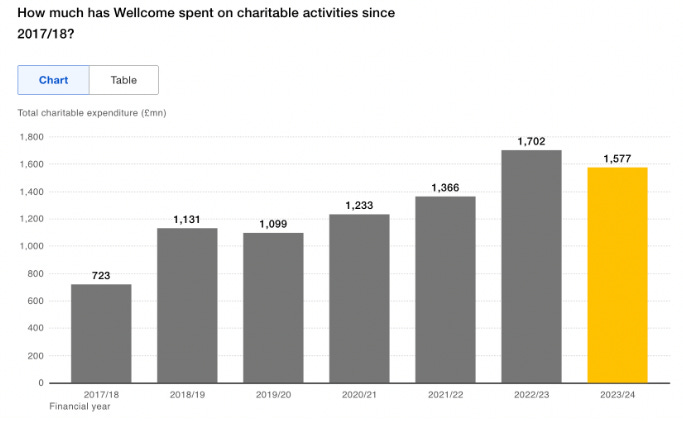
Wellcome Trust - 1.5bn annually
Howard Hughes Medical Institute - probably around the same annually
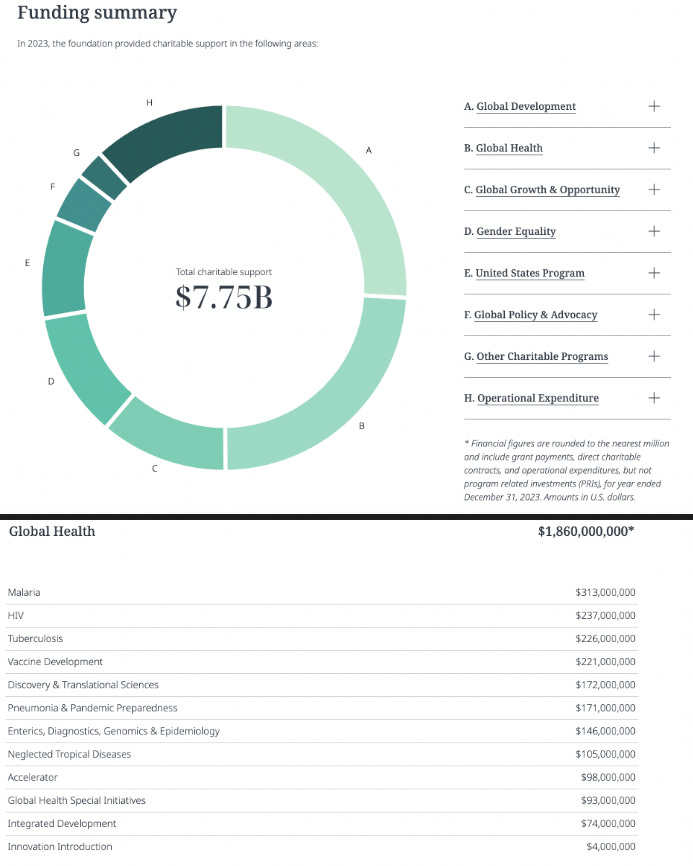
Bill and Melinda Gates Foundation - 1.6bn annually
American Cancer Society - ?
Cancer Research UK - ?
It’s important to note, from an outsider at least, that these efforts have actually worked. Here’s an update for this year from the Wellcome trust.
We celebrated the approval of the first new pharmacological approach for treating schizophrenia in 50 years and the world’s first vaccine for chikungunya. These were realised through strategic partnerships and long-term investments in research.
Here are some graphics to show research distribution
Wellcome Trust
Bill and Melinda Gates Foundation
In terms of biosecurity work, one report that I’ve started looking at is by C.K’s report on the EA forum.
How Well-Funded is Biosecurity Philanthropy?
I like this report because of its ambition and the fact that I think its an important question. Although, for now, I am skeptical of the quality of the estimates (which the original writer has already made strong disclaimers on).
And one main takeaway for me is the possibility of underfunding in PPE and other materials science based approaches. I think I might be a good fit for exploring these appraoches.
C.K claims that the order of magnitude of biosecurity funding is around 130bn a year, which actually seems a little high to me, but its highly uncertain.
1. *Given this definition, biosecurity roughly represents **1.3% of the global spend on public health** or about **$130bn** of **$10tn a year**.*
2. *Of this **$130bn**, governments likely make up to **$100bn (80%)** as an upper bound, and the actual figure could be much lower. The US government is likely the biggest government spender, spending $24.3bn in 2023. **Private philanthropy is likely about $1bn (1%).** The rest comes from private spending, private philanthropy, and public-private partnerships that aren't independent foundations (e.g., universities).*
The essay also gives a nice reference list of areas of interest
Technologies of Interest
Next-Gen PPE
Far-UVC
Rapid Vaccines
Metagenomic Sequencing
AI-Bio
Key Areas
Global Catastrophic Biological Risks (GCBRs)
Bioweapons
Bioterrorism
Dual-Use Research of Concern
Lab Leaks
Novel Pathogens
Pathogenesis Research
Biosecurity Policy
Gain of Function Research
Indoor Air Quality
Lab Biosafety
In terms of approaches to bioterrorism, I like this quote from Bill Gates, taken from The Deadliest Enemy
Bill Gates realizes the enormity of the challenge, even with his resources. “If you can tell me how to write checks and stop bioterrorism, then sure,” he said to us. “I’m a risk-adjusted kind of guy; I’ll write checks. But who are you writing the check to? What is it you’re doing?” When we’re talking about this kind of event, he rightly concludes, “This is governmental stuff.”
There is a point estimate from ‘The Deadliest Enemy’ which references a 2016 Lancet paper on antimicrobial funding requirements:
In an article in the January 12, 2016, issue of the Lancet Infectious Diseases, twenty-four distinguished scientists, led by Dr. Lloyd Czaplewski, pointed out that CERN’s Large Hadron Collider project cost about $9 billion and the International Space Station cost about $144 billion, then concluded, “Antimicrobial research and development to address the problem of antibiotic resistance probably needs an investment that is somewhere between the two.”
What actors are dangerous to us?
One thing that could potentially be high impact is to have some sort of monitor on the number of people in the world who potentially might have the expertise to construct a catastrophic virus. I found a podcast on 80000 hours with Kevin Esvelt that has some sort of an estimation - around 30000 people globally, which feels like a lot.
Maybe this is a sorta low hanging fruit to work on - live estimates of labs with catastrophic virus making capability. Or working to design policy to regulate such labs.
Find the podcast here. Here’s the excerpt that I am referencing
Kevin Esvelt: *And we’re setting aside students, and master’s degree folks, and even talented undergraduates, and technicians who have been working for a long time. Let’s just focus on PhDs: 1,500 people a year get PhDs in virology or one of these other disciplines worldwide. And you can do that because you get to basically 125 in virology. Another three times that many gives you 500 a year in the US. The US is about a third of the global total. So you’re at 1,500 a year. Assume a 20-year career in which you’re reasonably active, and you’re at 30,000 people with PhDs.*
***Luisa Rodriguez:** Wow.*
***Kevin Esvelt:** Now, that’s influenza. With coronaviruses, you’re probably down to the single-digit thousands. And [paramyxoviruses](https://en.wikipedia.org/wiki/Paramyxoviridae) and so forth.*
What kind of profile would be most effective?
Here’s a quote from The Deadliest Enemy
But the fundamental tool of epidemiology has always been, since long before we had a scientific method for identifying microbes or a germ theory of disease—and, I expect, will always be—observation.
Well, to have an outsized impact, one of the things I am trying to think about is whether my current background is suited to this kind of work. Ideally, I want my skills to be in some meaningful, non-crowded set complement of the current existing skillset. By outsized impact, I mean an impact that puts me in the potential top 5% of contributors.
So for me, and outsider who has is highly uncertain about what is actually needed to be successful, this is basically reframed to the question:
Is it possible to contribute meaningfully for someone who didn't study medicine, biochemistry or epidemiology?
Studying any of the three above is a lot of work. It would be super-costly for me to do any of those as a full time degree, and its probably not an option. I actually did end up looking at trying to do the LSHTM’s course on public health. But first, I wanted to investigate if it was worth the time-cost to spend time studying those areas, versus trying to contribute with the skills I already have:
my background is in mathematics and physics
most of my career has been in data-engineering, software-engineering, and risk decision making
So is there a route to an outsized contribution?
Well maybe. Something that I think could be true is that the biosecurity field doesn't necessarily need *technical* advances to be effective - a lot of problems can be solved with good policy.
Nor does it need someone extremely technical. Here are some examples of people with impact without technical backgrounds but had edge else where
Holden Karnofsky - Open Philanthropy
Bill Gates
Ron Klein - White House Ebola Response Coordinator in 2014-2015, and then COVID coordinator
Lord Jim O’Neill
Similarly, it is not necessary that diseases have to be fully understood before effective measures can be placed against them. Which means more reasons to
Examples are malaria nets, lockdowns, patient histories, investigative epidimiology is a lot more than just understanding the disease.
We can always choose conservative policy options if they are not harmful. For example, more testing (provided that it’s cheap) is almost never harmful.
This is why I'm leaning towards pandemic preparedness, in a route that focuses less on the science side (academia and pharma incentives), and more on neglected strategy.
Indeed, trying to figure out where to allocate research funding in the basic life science is hard, and seems to be crowded.
From Open Philanthropy, here are some notes on difficulties they had trying to get into the field
*One is the sheer level of expertise required. As we’ve written [previously](), we often don’t feel positioned even to understand the meaning – much less the plausibility – of many key claims. We’ve sought generalist scientific advisors to help us with this issue. My early intuition is that even with strong scientific advisors, it would take far more time to do a [**shallow investigation**]for a cause in this space than for a cause in another space, which may mean we have to take more shortcuts in order to arrive at priorities.*
But even if technical expertise is required, I can also just try and learn the content. Even though I don't have a biology / public health / medical degree - i am now trying to change that by doing chemistry and biophysics research. I'm starting off by trying to predict protein spectra.
This is part of a strategy of 'immersion', like what Holden Karnofsky did when he tried to understand the life science space better at Open Philanthropy. Here are some things that I am doing as part of this immersion
Initially I started to attack this problem by getting into biology from a physics standpoint
reading 'Life on The Edge' by Jim-Al-Khalili - about physics in biology
getting into physical chemistry, with the hope that I can transition from
I am also reading undergraduate level biochemistry from Lehninger's textbook
Reaching out to potential project supervisors on biology textbooks
Physics based approaches that I like
Anti-microbial surfaces
Anti-microbial surfaces work either by killing microbes on the surface, or making it harder for them to stick onto.
I am now thinking that, given my experience in physics and materials, that I could be well placed to look into policy on regulation and funding allocation of anti-microbial surfaces. I read this interesting paper on the need for stewardship in the area. From first glance, it also seems relatively neglected.
The paper above also has a handy diagram to show the mechanics of an antimicrobial surface.
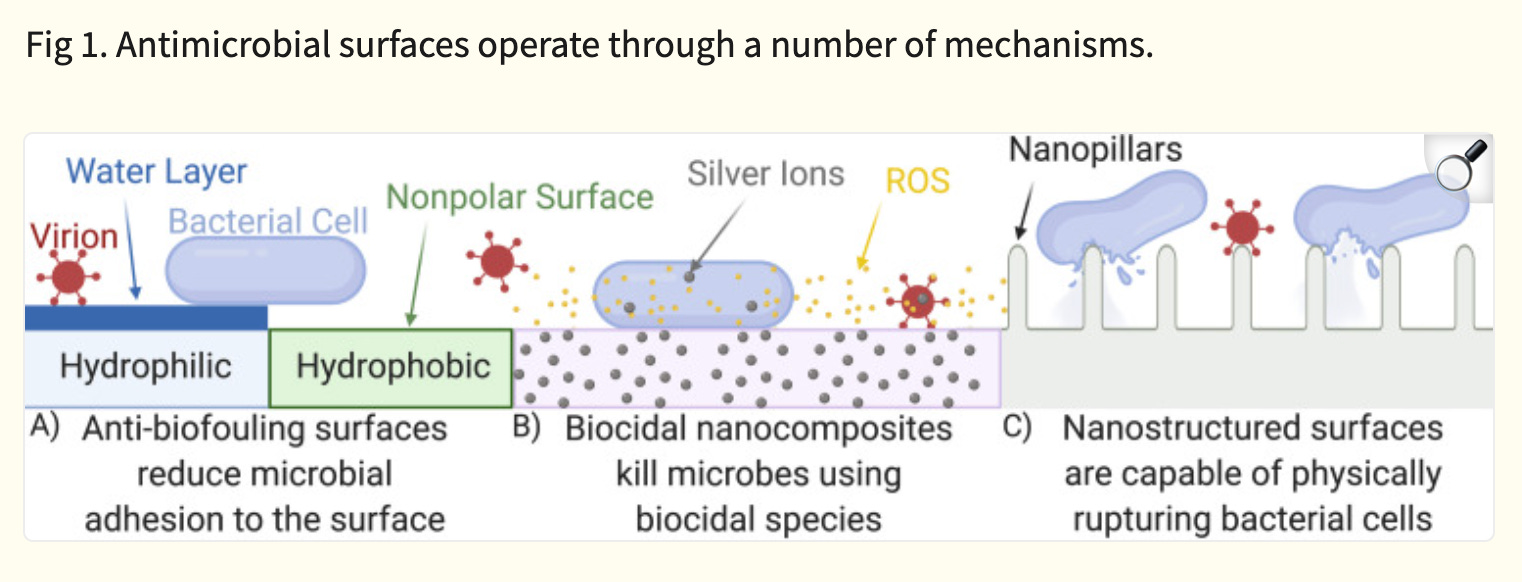
I also have a lot of sympathy with what they are calling for - we should use anti microbial surfaces with caution, especially given risks of adaptation and harm to our current microbiome.
*In conclusion, the authors call upon industry, national and international policy makers, healthcare professionals, and healthcare agencies (including those responsible for commissioning services and estates management) to recognise that (1) early phase research must address the potential impact of antimicrobial surfaces on AMR before they are widely employed; (2) there is a need for stewardship of antimicrobial surfaces intended for the healthcare setting; and (3) the broader exploitation of antimicrobial surfaces in domestic, industrial, commercial, and transport settings must not be undertaken lightly and requires oversight. With strict regulation and sensible governance, antimicrobial surfaces should become an important and long-lasting addition to the public health armamentarium currently available to control the transmission of infection.*
Here is an interesting paper on Far UVC sterilisation.
Sterlizing the air - Nature 610, S46-S47 (2022)
doi: https://doi.org/10.1038/d41586-022-03360-
Disinfecting the air with far-ultraviolet light
*Many infectious diseases, including COVID-19, are transmitted by airborne pathogens. There is a need for effective environmental control measures which, ideally, are not reliant on human behaviour. One potential solution is Krypton Chloride (KrCl) excimer lamps (often referred to as Far-UVC), which can efficiently inactivate pathogens, such as coronaviruses and influenza, in air. Research demonstrates that when KrCl lamps are filtered to remove longer-wavelength ultraviolet emissions they do not induce acute reactions in the skin or eyes, nor delayed effects such as skin cancer. While there is laboratory evidence for Far-UVC efficacy, there is limited evidence in full-sized rooms. For the first time, we show that Far-UVC deployed in a room-sized chamber effectively inactivates aerosolised Staphylococcus aureus. At a room ventilation rate of 3 air-changes-per-hour (ACH), with 5 filtered-sources the steady-state pathogen load was reduced by 98.4% providing an additional 184 equivalent air changes (eACH). This reduction was achieved using Far-UVC irradiances consistent with current American Conference of Governmental Industrial Hygienists threshold limit values for skin for a continuous 8-h exposure. Our data indicate that Far-UVC is likely to be more effective against common airborne viruses, including SARS-CoV-2, than bacteria and should thus be an effective and “hands-off” technology to reduce airborne disease transmission. The findings provide room-scale data to support the design and development of effective Far-UVC systems.*
Outside of the US
Even more so unclear is the commitment from East Asia and South East Asia on biosecurity funding and research. Spending seems fairly opaque as well. On my end this probably comes from language barriers, and the fact that I’m just not in the scene.
Here is a paper on biosecurity by researchers in China Challenges and recent progress in the governance of biosecurity risks in the era of synthetic biology.
Biodefence spending in the US
The US is probably the leader in biosecurity investment right now, and so it probably pays to look at what they are doing.
Actual Department of Defence Slides go into excrutiating detail on each of the biosecurity project proposals the department wants to fund.
You can find the slides here.
'The FY 2025 budget request of $1,656.7M enables the CBDP to translate strategic guidance into concrete capabilities tailored to the future threat. This budget request continues the ENBD efforts to modernize the Department’s biodefense capabilities to stay ahead of the threat.'
Heres some of the focus in that document:
Accelerated Antibodies
Vaccine Acceleration by Modular Progression
Countering Emerging Threats Rapid Acquisition and Investigation of Drugs for Repurposing,
Discovery of MCMs Against Novel Entities, and
Generative Unconstrained Intelligent Drug Engineering.
Here are some interesting project themes along the lines of material physics for biosecurity
Innovative materials focuses on understanding the physics, physical properties, fabrication pathways, and characterization methods related to material classes that would enable novel, advanced capabilities for decontamination, protection and detection of chemical and biological (CB) threats.
Novel sensing research to improve the understanding of elementary physics or fundamental materials properties to construct novel platforms and approaches for detection, diagnostics, hazard mitigation and protection.
Modeling sciences research to explore the potential of Artificial Intelligence/Machine Learning (AI/ML) computational approaches for hazard mitigation, stand-off physio-monitoring, rational and rapid design of medical countermeasures, and novel materials with enhanced efficacy*
Other Notes, Papers and Literature
Here are some less polished thoughts that I want to work on a bit more.
The paper below looks at dangers of synthetic biology. It was written in 2009.
Mukunda G, Oye KA, Mohr SC. What rough beast? Synthetic biology, uncertainty, and the future of biosecurity. Politics and the Life Sciences. 2009;28(2):2-26. doi:10.2990/28_2_2
Focuses on the marginal impact of DNA synthesis and synthetic biology
Its currently hard to actually get biological agents, but we might be able to get them with synthesis techbology
Viruses easier to synthesise than bacteria
Natural agents could be turned into bioweapons
Dangerous but non contangious could be modified into contagious
Arguing that dangers come mostly from the long term
Talks about dual use research funding - when research goes bad
The link below talks about UK biological security strategy.