A Thermodynamics For Biology
Thermodynamics relates variables that are observable on a large scale (macro), to variables of objects that are very small (micro).
The most celebrated result is the Maxwell-Boltzmann distribution. Given the temperature of an ideal gas, this result gives the probability distribution of the speeds of the particles in the gas. It’s not obvious to link these two together. The temperature is the macro variable, and the speeds of the particles are near impossible to observe in isolation.
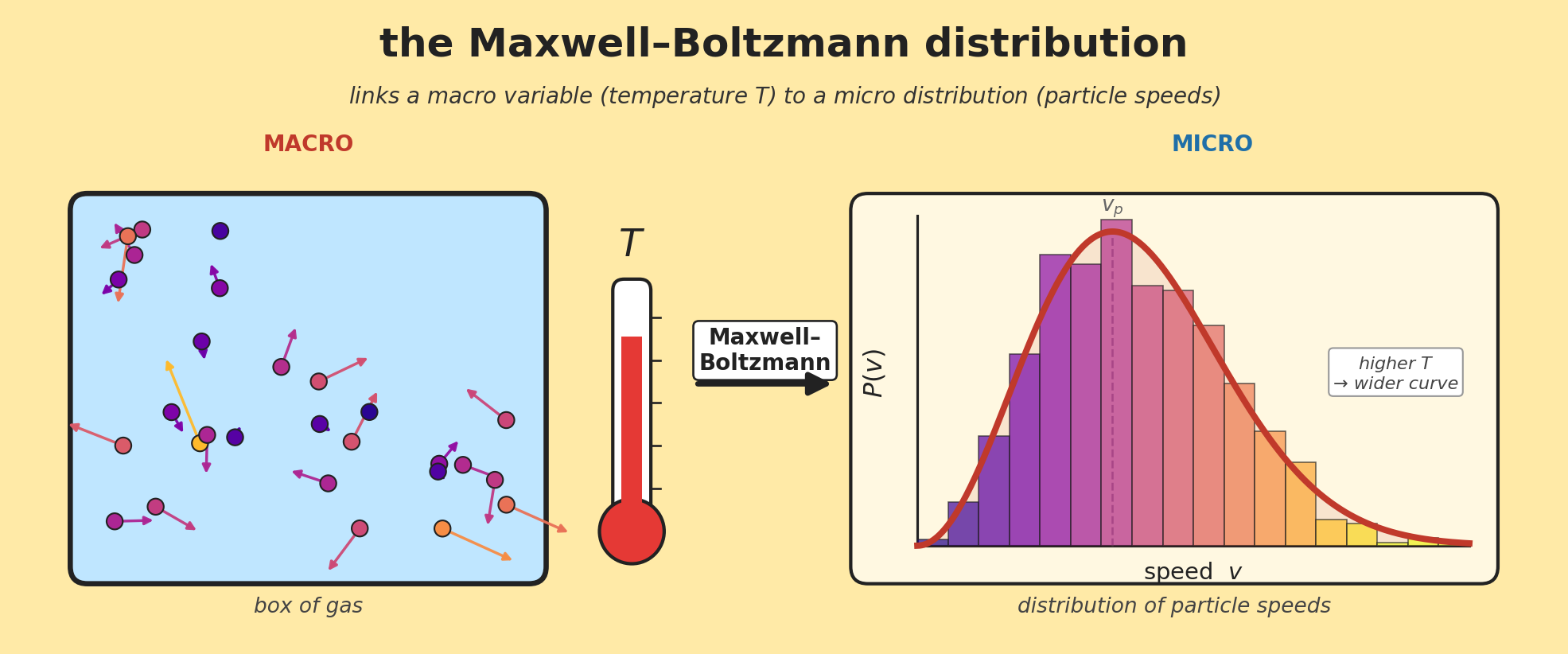
Explicitly, the probability density for a particle of mass m to have speed v at temperature T is
$$ P(v) \;=\; 4\pi \left(\frac{m}{2\pi k_B T}\right)^{3/2} v^{2}\, \exp\!\left(-\frac{m v^{2}}{2\, k_B T}\right) $$
where k_B is Boltzmann’s constant. The whole curve is set by the single macro number T — increasing T shifts the peak to higher speeds and broadens the tail.
Why is this important? Well, it’s not easy to observe the speeds of particles in isolation. But having a model for the speed distribution of particles then gives us the ability to compute other interesting things, like heat capacity, diffusion constants, and more. And these are observable.
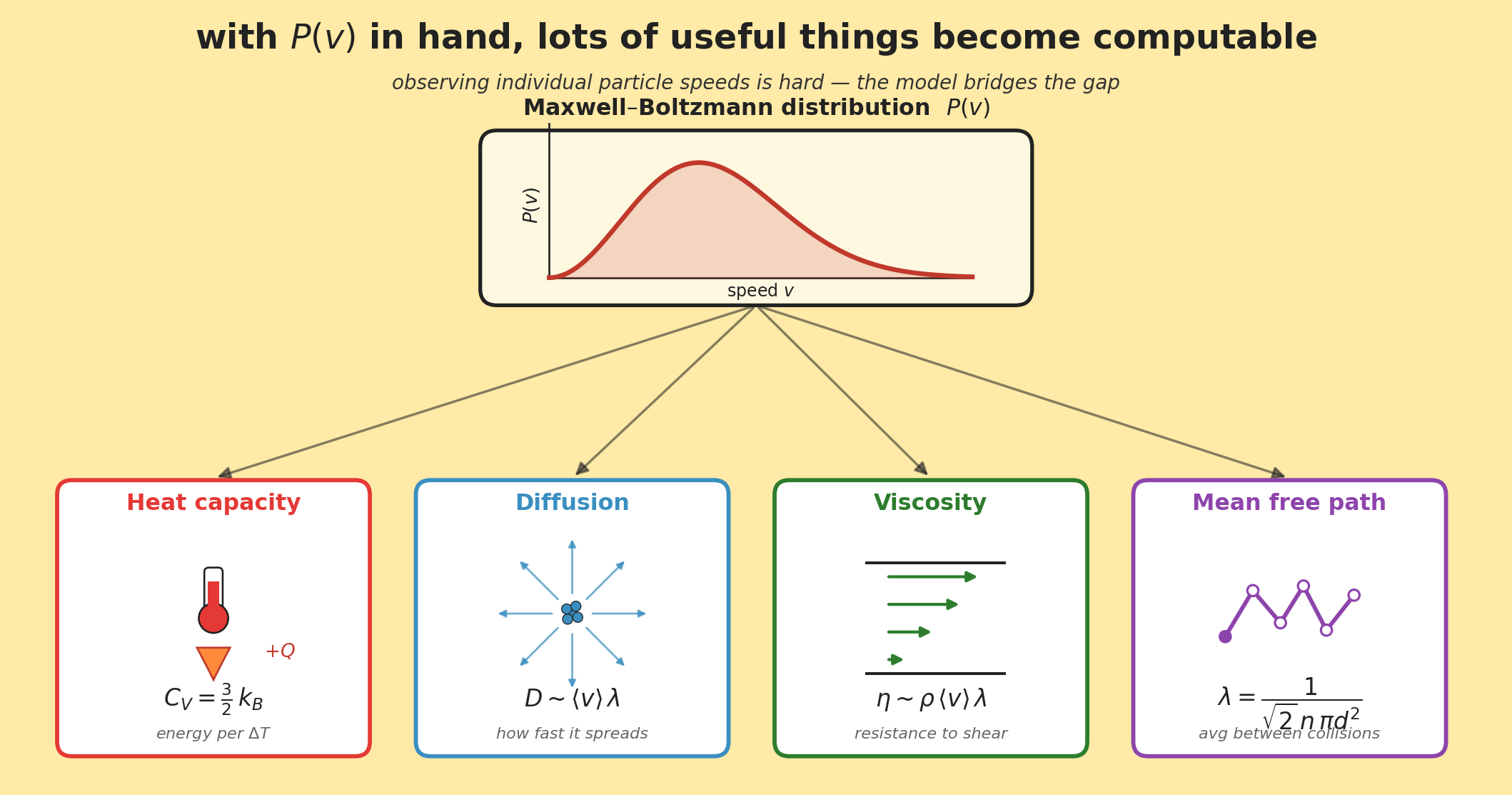
There is one legendary result that uses the distribution to relate the viscosity, heat conductivity, and heat capacity all in one!
Elementary kinetic theory gives two macroscopic variables, viscosity and heat conductivity, in terms of microscopic quantities — the number density n, the mean speed ⟨v⟩, and the mean free path λ:
$$ \eta \;\approx\; \tfrac{1}{3}\, n\, m\, \langle v \rangle\, \lambda \qquad\qquad \kappa \;\approx\; \tfrac{1}{3}\, n\, c_v\, \langle v \rangle\, \lambda $$
where η is the viscosity, κ is the heat conductivity, m is the mass per particle, and c_v is the heat capacity per particle. When you take the ratio — all the messy microscopic quantities (n, ⟨v⟩, λ) drop out and you are left with
$$ \boxed{\;\kappa \;=\; \eta\, \frac{c_v}{m} \;=\; \eta\, c_V\;} $$
where c_V = c_v / m is the specific heat capacity per unit mass. So if you measure any two of {η, κ, c_V}, the third is determined — a non-trivial macroscopic prediction that falls out of the micro-level distribution.
What would an analogous result in biology be?
Last time I used David Jordan’s bioreactor to observe the state variables of algae. The macro variables here are temperature, CO2 concentration, O2 concentration, and so on. It would be cool to link these variables to genetics, which are the micro variables of biology.
In other words, what information does a macro state variable give us about the probability distribution of genetic states in the algae?
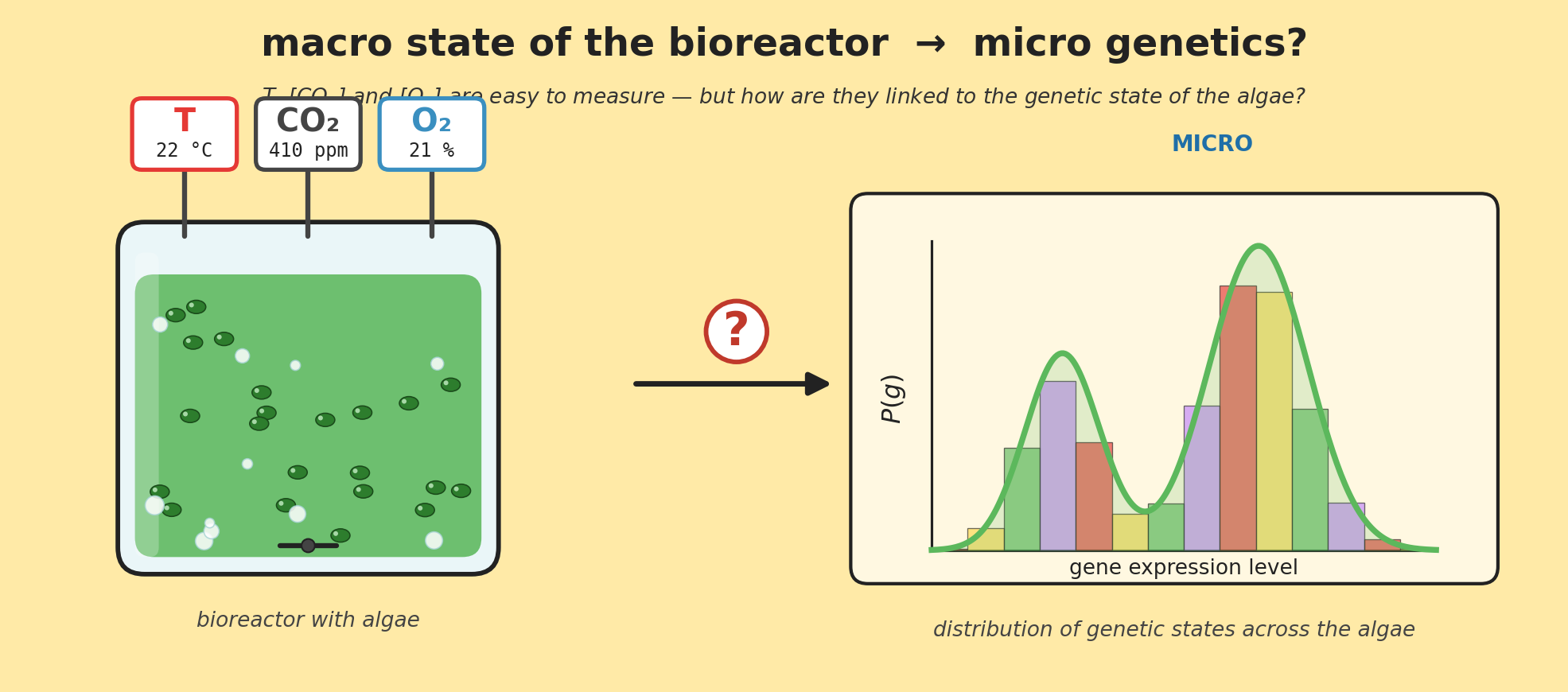
And if we know that distribution, can we relate it to any other macro variables that we can observe, like behaviour?
Thanks to David Jordan for extensive discussions.
References
Roberto Livi and Paolo Politi, Nonequilibrium Statistical Physics: A Modern Perspective (Cambridge University Press, 2017), Chapter 1. DOI: 10.1017/9781107278974. Chapter 1 gives a clean derivation of the kinetic-theory transport coefficients above.